When It’s Time for Someone to Go
Scripts and strategies for the hardest conversations
Long story short? If you know it's time for someone to go, it's not working for anyone — not you, not them, not the team. Check out the “Honest Transitions Toolkit” for a guide to making the tough conversation less painful, communications templates for sharing the news with the rest of the team, and guidance on severance.
One of the BEST and hardest things I’ve ever learned in my career is that employee transitions (that is, whether an employee stays or goes) are normal, healthy, and often the best thing for everyone involved. The key isn't whether or not to make a transition — it's HOW to approach it.
My learning around this began the hard way at Revolution Foods, where we restructured and did layoffs almost every calendar year. This was really hard, especially in years when I felt I had done exceptional work: 90+ customer retention, hitting sales goals, retaining our teams in a competitive environment. Even though I had done everything I could to improve the bottom line, changes were often made without even asking me!
But you know what? It also taught me something crucial: the importance of a business being able to do what was needed to keep going. Having the flexibility to change based on what we were learning and who was on the team was SO important to being able to continue carrying out our mission. It taught me that our work was why we were there, not to employ people. Grounding employee transition decisions in our work and our mission made it possible to move the organization forward.
At other times in my career, when it came to making individual decisions about whether it was time for someone to transition from our team, I used to get stuck on how I — or the organization as a whole — was failing. I refused to give up. I felt a sense of possibility that we could salvage things if we just tried a different way. Inevitably, we ended up spending wild amounts of time focusing on specific employees. I was scared of making the tough call. This only prolonged the inevitable while creating unnecessary stress for everyone involved. And it pulled my focus away from carrying out the work our team set out to do.
My gut feeling — that the employee in question wasn’t working out — was right and deserved to be trusted. AND, the impacts of me ruminating or trying to fix what couldn't be fixed rippled across the entire team:
The person in the wrong role wasn’t thriving, which feels terrible.
Their manager was spending a disproportionate amount of time trying to make things work OR avoiding the problem.
The team felt the friction of misalignment. Each person involved — all of us — felt frustration, uncertainty, angst, and perhaps blame, insecurity, or resentment.
Eventually I stumbled across Netflix's original culture deck, which offered me a template for a less painful way to handle employee transitions. (I know Netflix isn’t a perfect organization, AND the overall philosophy and approach in that original deck was powerful and really helped me see a new way!) They made decisions about employee fit that were rooted in business needs, but they did it swiftly and with refreshing candor and generous severance. That combination of things felt closer to something that worked well for all parties involved and that I wanted to replicate.
The idea of bringing folks in, having honest conversations, and treating people like I want to be treated just kept evolving. One key evolution was realizing that there are times you need to make the decision for the person on the other side of the desk, and there are times when you can leave the transition decision up to them. I started calling this the “Opt-in Conversation” and it has absolutely transformed employee transition conversations for me.
The reality is: employee transitions are normal, healthy, and often the best thing for everyone involved. Our work isn't to employ people — it's to do great work. AND how we navigate those employee transitions matters enormously.
The Key Takeaway
Here's what I've learned after years of having these conversations and helping other leaders have them: the status quo isn't working for anyone. Not for you, not for your team, and not for the person in the wrong role.
When you do what's right for the organization and the work, it almost always ends up being what's right for every human involved — including the person leaving. An Opt-in Conversation — where you're honest about what's not working and give someone a real choice in whether or not to stay or go — is simpler than you think. AND it's the kindest thing you can do for everyone.
The Opt-In Conversation
If you're a "just give me the template, I'm ready to get started" kind of person (aka Helia's COO Libby), the Opt-In Conversation Guide in our Honest Transitions Toolkit walks you through:
Before the conversation — get clear on your own head, prep the logistics
Two example scripts — so you can see what the conversation actually sounds like
The four steps — set the tone, name what's not working, present the choice together, close with care
Common reactions — what to say when they need time, get emotional, want to negotiate, or push back
After the conversation — next steps whether they stay or go
If you're a "tell me why this works" kind of person (aka our Founder Jess), read on for the good stuff!
Ground decisions in your mission
When you find yourself facing an employee transition, the first and most important thing for any organization is getting clear on its purpose. Are you trying to maximize profit? Be in the most places and help the most people? Change how a system operates? Employ the most humans or the same folks for a long time?
Once you're clear on the purpose you're trying to fulfill with your company, this becomes a grounding force for how you think about employee transitions.
I've never worked somewhere where building up a workforce of long-term employees was the primary goal. My work has always focused on driving impact, changing systems, achieving profitability(!), and expanding reach. Within that context, I spent too many days — sometimes even years! — knowing someone wasn't a fit but being too nervous to do anything about it. Getting clear on your mission helps cut through that paralysis.
Trust your gut — and keep it simple
When you have that gnawing feeling that someone on your team isn't working out, start by asking yourself:
Have I been clear about the organization’s expectations?
Have I asked this person what they need and want?
Am I meeting these needs and wants? Why or why not?
Sometimes addressing these questions solves the problem. I've seen seemingly insurmountable issues resolved through better communication and support. We once had a director who seemed to be struggling with every deadline. Instead of jumping straight to transitioning them out, we discovered through these questions that they needed more regular check-ins and clearer priorities. After making those changes, they became one of our strongest leaders.
But when it's not enough, you need to get honest about what the organization needs.
We recently worked with an organization transitioning to become their own fiscal sponsor. They'd been nervous to let anyone go for years — and they knew, in their gut, that certain people weren't the right fit. But instead of having honest conversations, they kept creating workarounds. Temporary staffing structures. Consultants hired to cover gaps. Very complicated processes built around people rather than addressing the core issue.
The workarounds weren't protecting anyone. They were delaying the inevitable while draining energy, budget, and focus from the actual work. What they actually needed was to trust themselves: identify what skills were needed given the organization's current reality and who on the team has those skills.
And the others on the team? Have honest conversations about what's needed — whether giving them a chance to get there in a reasonable amount of time, offering them the choice to leave with support, or just making the call and saying goodbye.
When we spend countless days, weeks and months trying to make it work with certain folks, the only thing that's always true is that frustration grows all around. Once you know, you know. Delaying isn't fair to anyone — not the person in the wrong role, not their teammates, and not the mission we're all there to serve.
Here's the other thing I've learned: the more you script these conversations, the worse they go. When you over-prepare the words, you end up reading lines instead of being present with the person in front of you. The best opt-in conversations I've had — and the best ones I've helped others have — were direct, warm, and simple. You know what needs to be said. Trust that.

These decisions, these convos — they're hard. Make sure to take time to breathe and ground yourself, both before and after.
The Opt-In Conversation
Instead of making decisions FOR people, I give them the opportunity to opt into or out of the role.
This might sound unrealistic — who can just give up their salary and benefits? — but how you approach it is what matters. The goal is to create real choice while maintaining dignity and relationships. This isn't about being cold or transactional. It's about treating people like the humans they are while still doing what's needed for your organization.
First, you're crystal clear that things aren't working as they are. Then you have an honest conversation — not about delivering a verdict, but about figuring out together what makes sense. If they want to stay, there need to be specific, immediate changes with very little wiggle room. If this isn't the right fit anymore, you offer direct support to get to their next step, including a generous severance package.
I think of opt-in conversations in two flavors:
"Pretty sure they're leaving" — You know in your gut this isn't working. The opt-in is genuine (they really can choose to stay), but you're being honest with yourself that it's unlikely. This conversation is about giving them dignity and agency in the transition.
"Genuinely open to either outcome" — Something's not working, but you honestly believe this person could turn it around. The opt-in is a real crossroads. This conversation is about co-designing what comes next.
Naming which flavor you're in — even just to yourself — changes how you show up. It keeps you honest.
Why this approach works:
Prioritizes agency — people get to make real choices about their future instead of having decisions made for them
Maintains relationships — you can often stay connected when transitions happen with care
Creates clear paths forward — both staying and leaving are dignified options
Allows for genuine choice — severance makes it a real decision, not just financial pressure
Builds trust across the team — when people see that transitions are handled with care, they trust you more
The Shape of the Conversation
The conversation itself might only take 5-10 minutes. But the preparation is where you do the real work — gathering specific examples, defining clear requirements if they stay, preparing severance details if they leave. (I recommend scheduling at least 60 minutes uninterrupted, not because the conversation takes that long, but because you need space to breathe before transitioning back to business.)
Here's the basic shape:
Set the tone. Don't ease in with small talk — that just builds anxiety. Be warm AND direct.
Name what's not working. Be specific about patterns, not a laundry list. Acknowledge what IS working too.
Present the choice — together. You're not delivering a verdict. You're inviting them into a decision. What staying requires (specific, immediate changes). What leaving includes (severance, how it's framed, timeline). The key framing shift that's made the biggest difference for me: instead of "You have a choice to make," try "I want to figure out together what makes sense."
Close with care. They should leave knowing exactly what happens next — when you'll reconnect, what happens in the meantime, that nothing changes until they've had time to think.
→ Not sure you're ready to have this conversation on your own? Nina Jacinto from the Helia Collective helps leaders think through the approach before they walk in the room. She's a wonderful thought partner for both the individual conversation AND the bigger picture. → Email Nina at ninarjacinto@gmail.com with "Helia Connection" in the subject line.
REAL LIFE STORY: An Opt-In Conversation in Practice
One organization we worked with was navigating a long-time, challenging employee situation. There had been repeated performance issues — mistakes, missed deadlines, client complaints. They'd already tried refocusing the role and taking the person off certain projects. There was also consistent feedback about attitude: resistance to changes, complaining, refusal to adopt new technology the team had implemented.
The Opt-in Conversation they had:
"I want to have an honest and transparent conversation with you about your role and your performance. I recognize that you've done some great things here, but I also want to address concerns that have come up... I want to figure out together what makes sense going forward. You can choose to stay and be part of the team where we are now, and where we're headed — but this will require an immediate shift in your performance, attitude, and willingness to adopt new practices. Or, if you feel this is no longer the right fit, we can support a transition — two to three months of severance, and we'll frame this publicly as your decision to move on."
What made this work: They were clear and specific. They'd documented the issues. They had a real severance offer ready. And they framed it as figuring this out together — not delivering a verdict.
The Business Case for Generous Severance
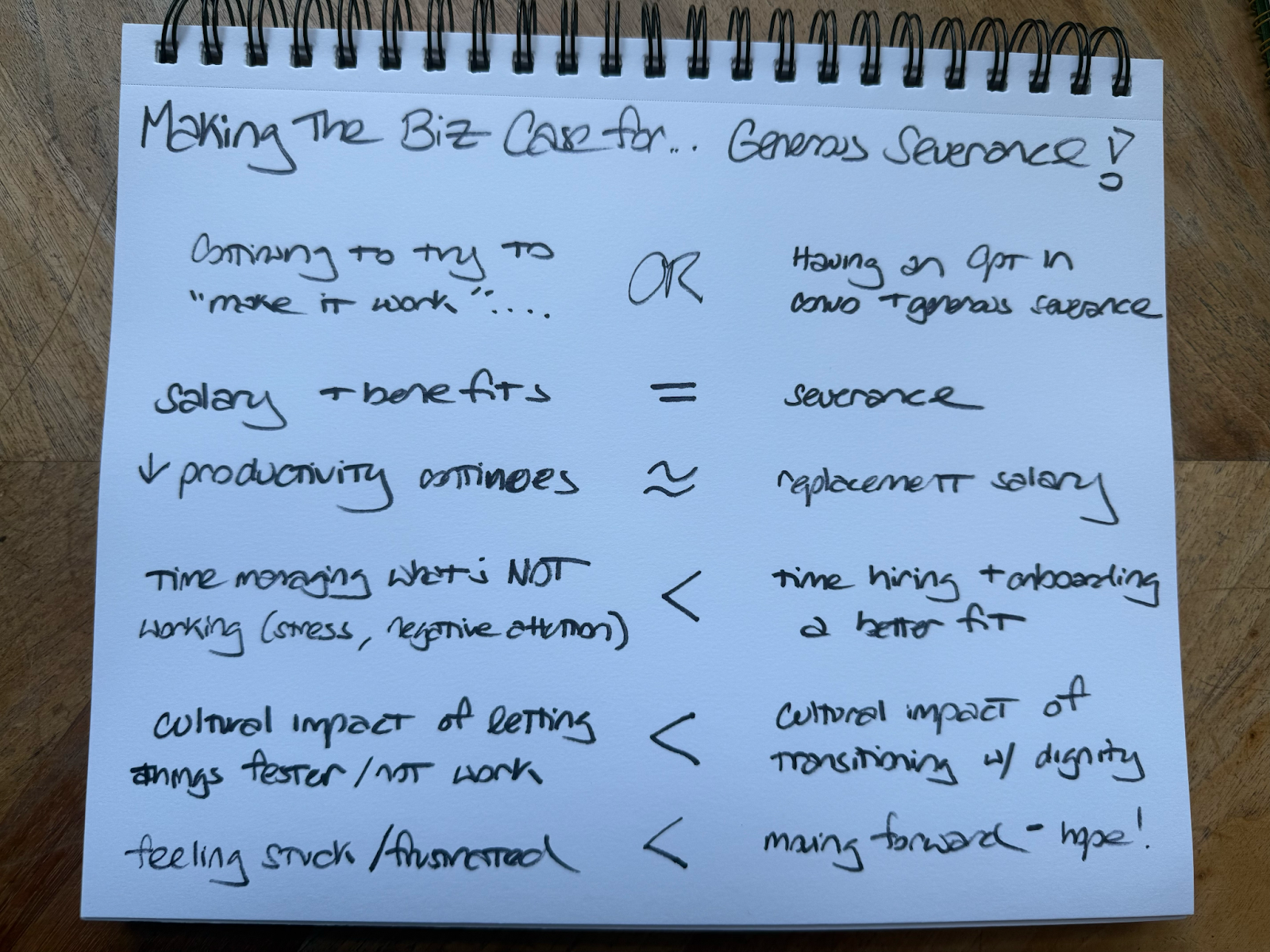
Let's be honest — we're all living and working in a capitalist society where our lives often rely on us being employed. I'm a BIG believer in generous severance, especially as part of an Opt-In Conversation.
Why it works: It gives people runway so they can make an honest choice (not a panicked one). Without a generous package, "choice" is just a nice word for getting fired. Severance communicates respect. It honors their contributions and acknowledges that everyone was part of things not working. And it builds trust across the team — when people see that transitions are handled with care, they trust you more.
Yes, this is an investment. But keeping someone in the wrong role costs more — in team morale, lost productivity, missed opportunities, and the energy you're spending trying to make it work.
What we generally do is drag our feet — throwing money and time at trying to make it work for months before having an Opt-In Conversation. How much more beautiful and straightforward to have the conversation earlier and then focus on the work!
Helia's Take: Why This Approach Creates Trust
I've done this many times now. And here's what I've learned: the opt-in approach creates a kind of trust and agency that "You're being terminated effective immediately" never could.
When you offer someone a real choice — with real information about what staying requires and real support if they leave — something shifts. They're not a victim having something done TO them. They're an adult making a decision about their own career.
Most of the time, in my experience, folks choose to move on. They leave with their head held high, with support for their next step, and often with the relationship intact. I've stayed connected with people I've had these conversations with. Some have become references for each other. That doesn't happen when transitions feel like ambushes.
And those who choose to stay? They're truly committed. They know exactly what's expected. They've looked at the reality and said "Yes, I want this." That's a different kind of engagement than someone who's just... still there because no one's told them to leave.
Both are successful outcomes!
One More Thing Before You Put This Off
Right now, if you have a nagging feeling that it’s time for someone to go, it’s important to know that everyone is already in pain. The person in the wrong role isn't thriving. You're spending disproportionate energy trying to make it work — or avoiding the problem entirely. Your team feels the friction.
That's months of low-grade misery for everyone.
The conversation itself? That's 36 hours of discomfort for you. It's hard — AND it's the fastest way through to the other side. (Thanks to Traction author Gino Wickman for this framing!)

My grandmother was the most beautiful truth teller, bringing heart and honesty to each and every conversation. She inspires me to bring that same spirit to every relationship I get to have, at work and beyond.
When They React
People respond to these conversations in different ways. Some need time to think (give it to them — usually 24-48 hours). Some get emotional (allow space for that, but stay focused on the two clear options). Some want to negotiate (be clear about what's flexible and what isn't — requirements to stay need to remain firm). Some deny the issues entirely (don't debate the past, focus on the path forward).
After the Conversation
If they choose to leave, work with HR to finalize documentation (severance agreement, transition timeline, how it's communicated). Plan the knowledge transfer thoughtfully. And communicate to your team and any external partners — they should hear it from you first, framed warmly and professionally.
If they choose to stay, document the expectations in writing, create a clear review timeline, and schedule regular check-ins. Don't disappear and hope it works out. Actually invest in their success — if you offered the choice, mean it.
When to Do This Yourself vs. Bring Someone In
Everything I've shared here? You can do it. The Opt-In Conversation Guide gives you scripts and the framework is straightforward once you commit to it.
You might want outside help if:
You're navigating a particularly sensitive situation — long tenure, complicated relationships, potential legal concerns
You need someone outside the politics to help you see the situation clearly
You're restructuring multiple roles and want to design the approach thoughtfully
You've never done this before and want someone to think through the conversation with you
If You Want Help
Nina Jacinto from the Helia Collective is beautifully experienced in org restructures, layoffs, and thinking about all the ways you're making decisions for both the human and the organization. She's a wonderful thought partner for individual moments AND the bigger picture.
She's a good fit if:
You're facing a restructure and want to do it well — with both business sense and humanity
You need help seeing the pattern in repeated "people problems"
You want someone to gut-check your approach before you have the conversation
You're navigating the politics of a transition that implicates someone senior or long-tenured
Ready to talk? → Email ninarjacinto@gmail.com with "Helia Connection" in the subject line
Not sure Nina's the right fit? Book 30 minutes with Helia and we'll help you figure out who in our Collective might be.
Try It Yourself
Toolkit — Honest Transitions, containing:
Opt-In Conversation Guide — Two example scripts, four steps, prep checklists, and language for common reactions
The Case for Generous Severance — A thinking tool for getting clear on your severance philosophy and making the case to your board or leadership team
Transition Communications Templates — Copy/paste language for telling your team, your clients, and the departing team member
Recommended reading:
Netflix Culture Deck — Some of my foundational thinking on performance and transitions. Has shaped how I approach almost all things people for decades now!
Radical Candor by Kim Scott — Excellent resource on having difficult conversations with care. Kim Scott's TED Talk is one of my favorite introductions.
Traction by Gino Wickman — Where I first encountered the "36 hours of pain" framing that changed how I think about avoiding hard conversations
Questions to sit with
Am I spending disproportionate time trying to make one person work instead of focusing on the broader team and our mission?
If I'm being honest — am I avoiding this conversation to protect them, or to protect myself?
Have I been crystal clear about expectations and the support I'm offering?
What would treating this person like I'd want to be treated actually look like?
Which flavor of opt-in am I in — pretty sure they're leaving, or genuinely open to either outcome?
If I'm being honest, do I already know what needs to happen?
About Jess

Jess Skylar is the founder of The Helia Collective. She's spent twenty years scaling mission-driven organizations — and this article comes from years of getting this wrong and slowly getting it right. After having MANY opt-in conversations along the way, nearly all ended with folks choosing to leave — with agency and support (and so much less stress!). Exactly two where folks chose to stay and they both thrived. Both feel like wins.
Here's what I've seen over and over again: when you do what's right for the organization and the work, it almost always ends up being what's right for every human involved — including the person leaving. That doesn't make it easy. But the alternative — months of everyone stuck in something that isn't working — isn't kindness. It's avoidance. The hardest part is the conversation. And it's also the shortest part.
More where this came from
Right Role, Right Level — Before you have an opt-in conversation, make sure it's actually a people problem and not a role design problem
Different Cultures Need Different Humans — Get honest about your culture before you make any people decisions
Hiring with Heart and Strategy — What to look for when you're ready to hire the right fit
Remember: Always get appropriate legal and HR review before having these conversations. This approach has worked for me, but every situation and organization is different.
As always, take what's helpful, leave what's not, and make it your own.
Article & Resource Tags