
Long Story Short
No matter how skilled a candidate is, they won’t thrive if they’re not the right human for your culture. Get honest with yourself AND them—and you’ll find the people who actually belong. Don’t have time to read the whole thing? We made you a Finding Your People Worksheet in our Right Hire Toolkit.
Jump to How!
Picture this: Your delivery truck’s top gets ripped off by a low tree, blocking the only route to five schools waiting for lunch. You’re 15,000 apples short for tomorrow’s lunch delivery. And you have a huge sales pitch in three hours for the largest school district you’ve ever had the chance to be in front of. What do you do?
This actually happened to me at Revolution Foods. We made it through—one team bought out Little Caesar’s entire lunch supply and another took a giant truck on a fruit run to Restaurant Depot so that I could lock in for my sales pitch.
I turned this experience into my favorite interview question. Was this scenario a candidate’s idea of a nightmare? Or were they the kind of person who saw it as a fun puzzle?
There’s no right answer. At that moment, “thrives in chaos” was the honest description of who we needed on our team. Some candidates couldn’t get out of the room fast enough. Others leaned forward and said, “Tell me more…” The latter were our people.
There’s no right answer. At that moment, “thrives in chaos” was the honest description of who we needed on our team. Some candidates couldn’t get out of the room fast enough. Others leaned forward and said, “Tell me more…” The latter were our people.
Someone who needed predictability would have lasted about a day at Revolution Foods—even if they were brilliant. We were tackling a mission where every day brought new fires, and we needed people who saw chaos as an opportunity to get creative.
Being honest with ourselves AND our candidates about our real culture was what helped us find the dispatch managers and account leads and customer service reps who actually thrived.
And here’s the thing — even within one culture, different roles need different humans. At Rev Foods, I was hiring general managers who needed to love chaos and problem-solving. But we also had a nutrition and compliance team — pages and pages of spreadsheets, the most minute detail about every meal, extensive packets submitted monthly for state audits. We needed people who LOVED that structure and detail AND who didn’t mind the shifts happening around them. When we couldn’t get the apples and needed to replace them with oranges that day, we needed someone who said “okay, got it, let’s figure out how to do that” — not “but wait, apples were in the plan, what’s happening here?” Same culture. Very different humans within it. So don’t be too rigid about this — your culture is rarely all one thing.
The Key Takeaway
Before you write a job description or schedule a single interview, get honest about your culture—not the one in your values statement, your actual culture.
Most of us hire for the organization we wish we had. We write job descriptions full of aspirational language about collaboration and innovation, then wonder why new hires seem surprised by reality.
The organizations that consistently find the right people do something different: they get brutally honest about who they actually are, then look for humans who genuinely want that.
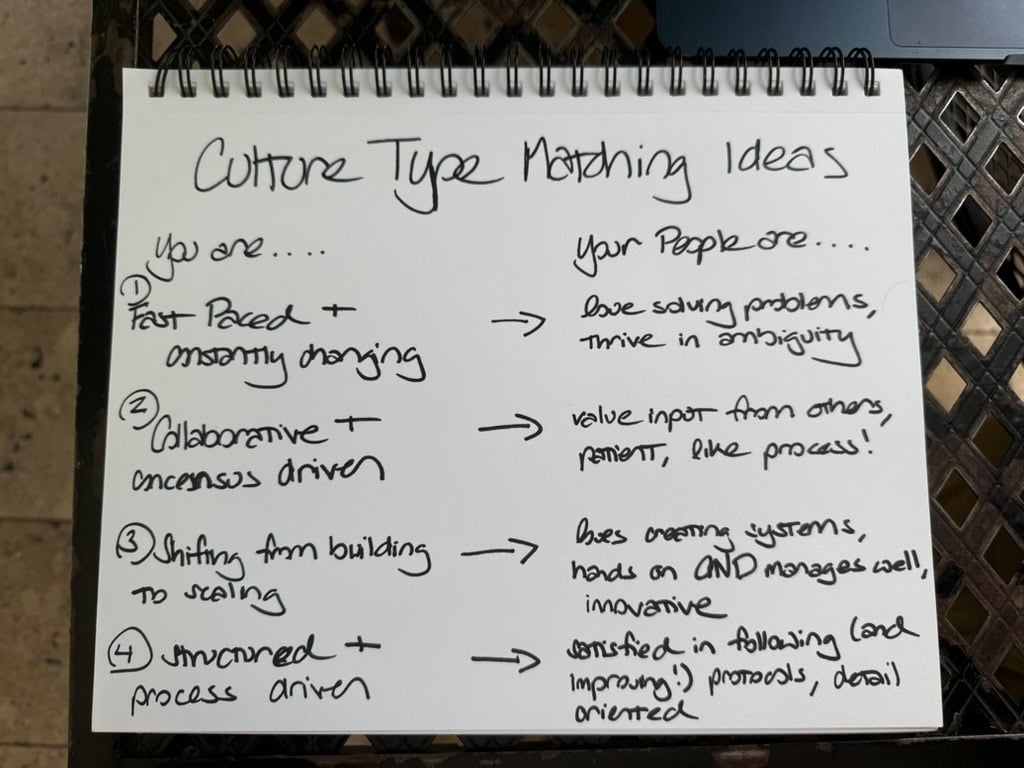
This isn’t about good cultures versus bad cultures. It’s about fit. A startup in rapid growth mode needs different humans than an established organization focused on stability. Neither is better—but hiring a stability-seeker into chaos (or vice versa) sets everyone up to fail.
The Finding Your People Process
If you’re a “I want to see the template, I’m ready to get started” kind of person (aka Helia’s COO Libby), check out the Finding Your People Worksheet in our Right Hire Toolkit — it walks you through the whole approach step by step.
If you’re a “tell me why this works” kind of person (aka our Founder Jess), read on. Here’s what we’re going to cover:
- Part 1: Getting honest about your culture
- Part 2: Naming your patterns
- Part 3: Putting it all together into language you can actually use.
How the Finding Your People Process Works
Part 1: Get Honest About Your Culture
Not the culture you wish you had or the one written in your values statement—the actual, day-to-day experience of your team.
Start with three big questions:
What makes folks successful here? What causes them to struggle?
Think about your current team.
- Who’s thriving and why?
- Who’s having a harder time and what’s getting in their way?
Consider things like: their need for structure, how they like to work (collaboratively or independently), preferences for decision-making (hierarchical or consensus), how they like their days to feel (predictable or always shifting), communication styles, pace preferences.
What do we celebrate? What creates friction?
- What gets highlighted in team meetings?
- What creates tension or misalignment?
Think about approaches to work, how people handle challenges, attitudes toward change.
How do decisions really get made here? I’m not talking your official process—how do things actually happen?
- Through data and intuition?
- Input from many but ownership by one?
- Spirited debate?
- CEO makes final calls?
- Consensus-building?
Think of Us built language around this that I love: “We are a Why and How culture.” That shorthand immediately signals something real: If you’re someone who just wants to execute a clear plan, you’re going to struggle here. If you light up when someone says, “Figure out the best approach and tell us why,” you might be the right human for their culture.
That kind of honest language doesn’t happen by accident. It comes from sitting with these questions and being willing to name what’s actually true.
One thing to watch for here: there’s a difference between a culture that genuinely asks “why” to go deeper and one that uses “why” as a side door for “no.” You know the version — “why would we do that?” said in a way that’s really just a passive-aggressive way of shutting something down. I love when people are honest about where they’re coming from — something like, “I’m inclined to say no to that. Can you tell me more why so I can be open?” That’s real. That’s a culture of inquiry. The other thing is just a culture of resistance wearing a “why” costume. Know which one you are. And if you’re interviewing, listen for which one your candidates are describing when they talk about places they’ve worked before.
That kind of honest language doesn’t happen by accident. It comes from sitting with these questions and being willing to name what’s actually true.
Part 2: Name Your Patterns
Now let’s look at the humans who’ve worked well here versus those who haven’t.
Who tends to stay and thrive? What do they have in common?
Look for the through-lines. Maybe it’s people who are comfortable with ambiguity. Maybe it’s people who love process and structure. Maybe it’s people who push back in meetings rather than agreeing and complaining later.
Who’s left quickly? What patterns do you notice?
This one can be uncomfortable, but it’s gold. When someone leaves within the first year (or you part ways), what’s the pattern? Were they surprised by the pace? Frustrated by the lack of structure? Expecting more autonomy than the role allowed?
What stories do you tell new hires about “how we do things here”?
These stories reveal your actual culture more than any values statement. At Rev Foods, we told the delivery truck story. At a more structured organization, you might tell stories about careful planning that paid off or processes that prevented disasters.
Think about your best hire. The one who became an amazing fit. What made the interview conversation feel different? What did they want to know more about? How did they react to hearing about challenges or the realistic aspects of the role? What gave you confidence they’d thrive?
At Rev Foods, our best hires were the ones who heard the chaos stories and got excited. They asked follow-up questions about how we solved problems. They weren’t fazed by uncertainty—they saw it as part of the adventure.

My kiddos Rev Foods’ing – hairnets and delivery trucks and lift games and apples and, well, all the things!!!!
Part 3: Put It Together
Now synthesize everything into language you can actually use.
Complete these sentences:
People who thrive here tend to…
- Get energized by…
- Feel comfortable with…
- Have experience with or want to learn…
- Value…
- Work best when…
People who struggle here tend to…
- Need…
- Prefer…
- Get frustrated by…
Here’s what this might look like in practice:
“People who thrive here tend to get energized by solving problems on the fly, feel comfortable with ambiguity and changing priorities, and work best when they have autonomy to figure things out. People who struggle here tend to need a lot of structure and clear direction, prefer predictable workdays, and get frustrated by frequent pivots.”
That’s not a judgment. It’s an honest description that helps you AND candidates figure out if there’s a real fit—before anyone’s first day.
Note – it’s important you’re not only honest about where you are but also, where you are going! II was working with one org recently who was really trying to streamline and solidify their operations. They’d been in place for a while and were like, we have to move out of the reactivity space. But they hired a COO whose favorite description of themselves was “Scrappy.” This person absolutely LOVED where the org was, but they were not the person to bring order to the chaos and guide you through a transition. They hired for who they were, not who they were becoming. The fit wasn’t wrong — the timing was.
USING THIS IN INTERVIEWS
Once you’ve done this work, you can use it directly in interviews.
Share a real scenario from your organization—like my delivery truck story—and watch how candidates respond. Do they lean in or pull back? Are they asking clarifying questions about process, or questions about how they’d have freedom to solve it?
The goal isn’t to test candidates. It’s to give them real information so they can self-select. The best hires are the ones who hear your honest culture and think, “Yes, that’s exactly what I want.”

Two brilliant folks who helped scale Think of Us in VERY different ways – Pauline who loved to turning chaos into detailed (and human-centered!) processes, and Whitney, who helped turn an idea into a living/breathing/beautiful program.
When to do this Yourself vs Bring Someone in
Do this yourself when: You’re hiring for a role you deeply understand. Your leadership team is aligned on culture (or you want to surface where you’re not). You have 20-45 minutes to be honest with yourself.
Consider bringing someone in when:
- You’ve done the worksheet and you’re still not sure what’s actually true (or what you want to be true!) about your culture.
- Or you and your are all filling it out separately and getting very different answers.
- Or you keep hiring people who look great on paper and interview well — and then something’s off by month three.
- Sometimes you’re just too close to see the patterns, and you need someone outside to reflect back what they’re seeing.
If you Want Help
Nina Jacinto helps leaders do exactly this kind of diagnostic work — holding up a mirror to your organization so you can see the patterns you might be too close to notice. She’s spent years helping startups and nonprofits figure out what’s actually true about their culture, what kind of humans will thrive there, and how to structure roles that set people up to succeed. If you’re stuck in a cycle of mis-hires and can’t see why, or if your leadership team keeps describing your culture in completely different ways, she can help you get aligned before you write another job description.
She’s a good fit if:
- You keep losing people in the first year and can’t figure out the pattern
- Your leadership team has different ideas about “who we are” and it’s showing up in hiring
- You want an outside perspective on your actual culture before you start your next search
- You need help translating culture insights into role design and team structure
Connect with Nina!
Try it Yourself
- Right Role, Right Level Template: A step-by-step template for matching level to decision-making authority, and reality-checking whether you can actually support the hire you’re considering.
- Finding Your People Worksheet: A structured reflection to help you hire for your real culture—not the one in your values statement.
- Common Roles Reference Guide: A reference table breaking down common roles across five functions (ops, development, sales, program, product) — with quick descriptions, sample responsibilities, what each level won’t do, and salary ranges.
- The Why Interview: A guided conversation framework for uncovering whether a candidate actually wants to do the specific job you’re hiring for — not just any job with that title.
Questions to Sit With
- What’s the gap between how we describe our culture and how people actually experience it?
- When someone leaves quickly, what pattern are we missing?
- Are we hiring for who we are, or who we wish we were?
Not sure Nina‘s the right fit? Talk to Helia directly!
This article comes from years of lessons learned and hard-won wisdom by Jess Skylar. These articles form the heart of the Helia Library — because we’ve learned the most from doing and from talking with other doers willing to share their wisdom. We don’t need to start from blank pages or do everything alone.

About Jess
Jess Skylar is the founder of The Helia Collective. She’s spent twenty years scaling mission-driven organizations — growing Revolution Foods from $14M to $170M and co-building Think of Us into a national leader. Along the way, she’s hired hundreds of folks. Some became her favorite humans to work with. Others taught her what not to do next time.
Work with Jess