Fundraising that Runs Itself (Almost)
Why treating fundraising like accounting changes everything
Long Story Short:Fundraising CAN be predictable — not frantic, not anxious, not scramble-in-Q4-and-hope-for-the-best. You just need to treat it like you would any other part of your business: with clear goals, consistent tracking, and regular reviews. If you want fundraising that feels like a well-oiled machine, Andrea Chen’s Fundraising Toolkit has a Pipeline Tracking Spreadsheet and a Weekly Development Meeting agenda to get you going in the right direction.

Beach day with my daughter in Half Moon Bay
Libby Here!
Want to know one of the differences between me and Helia’s co-founder, Jess? I HATE sales and fundraising. (Also, Jess doesn’t like pepperoni. Weird.)
Back to sales and fundraising. Hate. Fear. Dread. Any of these words work to describe how I felt about doing sales when I was CEO of my startup, Whetstone. This was unfortunate as I was the first salesperson at Whetstone. I came in with exactly ZERO sales experience (besides giving the sales pitch of my life when I convinced the founders to hire me) and every lesson I learned on my way to selling Whetstone’s first $2MM in revenue was basically learned against my will. When it comes to fundraising, I proudly say we accomplished everything we did at Whetstone bootstrapped (meaning, we did it without taking money from outside sources) but, if I’m being completely honest, we were bootstrapped because I was afraid to try fundraising growth capital from investors.
Sales always felt like an unknowable black box to me. Maybe we would hit our number. Maybe we wouldn’t. The lack of surety kept me up most nights. The only time of the year I was relaxed about sales was the two-week period at the end of the year when we knew exactly how much revenue we’d brought in. Then the nerves would start back up.
I kept thinking: There has to be a better way than crossing my fingers and hoping.
Good news: There is!
The person who showed me that fundraising (and sales!) can be predictable
I’ve known Andrea Chen since 2014 when Whetstone rented its first office at Propeller, the co-working space and social impact accelerator she founded in New Orleans.
Andrea’s impact numbers speak for themselves ($100M+ raised and 100+ nonprofits and social entrepreneurs supported!). And, as someone who shared a paper thin wall with her for years, I can tell you from first hand experience that she didn’t hit those numbers with flash and bang magic — she did it by building systems and running them diligently.
Andrea will be the first to tell you that fundraising is not easy. It’s not guaranteed. But it can be predictable — in the same way that closing your books every month is predictable. When you know what you have, you know what's coming, and you know what's at risk, you're never surprised.
"I never want development to feel frantic, to feel anxious, for EDs to be up at night worrying about their money. Development should almost feel like accounting." Not in a soul-crushing way. In a "I know exactly where I am and what's next" kind of way.
Most fundraising feels like the opposite of that. It feels like scrambling, hoping, waiting to see what comes through.
Andrea's approach is different: clear annual goals using a specific formula, a giving pyramid that tells you where the dollars need to come from, a weighted pipeline so you know what you actually have (not what you're hoping for), and weekly meetings that keep everything moving.
The result? A well-oiled machine and a good night’s sleep.

Stumbling upon a rainbow on a misty day
The Key Takeaway
Andrea's whole philosophy is that fundraising CAN be predictable. She gets there by creating a fundraising system: a formula for realistic goals that give you buffer, conservative pipeline weighting for accurate forecasts, and weekly meetings that keep everything moving forward.
If your fundraising feels frantic, it's not because fundraising is inherently chaotic. It's because something in your system is missing.
Andrea’s Fundraising System
Andrea's system takes fundraising from "constant scramble" to "well-oiled machine." It's not magic — it's treating revenue like you'd treat any other part of your business: with clear goals, consistent tracking, and regular reviews.
If you're a "just give me the template, I'm ready to get started" kind of person (aka Helia's COO Libby), check out Helia’s Pipeline Tracking Template in our Fundraising Toolkit — it walks you through the whole approach step by step.
If you're a "tell me why this works" kind of person (aka our Founder, Jess), read on. Here's what we're going to cover:
Step 1: Set your annual goal using the 50-80% formula
Step 2: Build a “giving pyramid” to understand where the dollars need to come from
Step 3: Build your pipeline with weighted values so you actually know if you're on track
Step 4: Run weekly meetings with a consistent agenda that keeps everything moving
Step 5: Review your dashboard monthly to catch problems before they become crises
How Andrea’s Fundraising System Works
Step 1: Start with Images
Most orgs set fundraising goals that are either wildly optimistic or, essentially, "whatever we raised last year plus a little more." Andrea's formula is more intentional.
The formula: "I always want to raise more than we're budgeting for the current year — somewhere between 50% and 80% of next fiscal year's budget, depending on my risk tolerance. If I know we’re in a tough economy with high uncertainty in government or philanthropy, I might set our team’s goal to raise 80% of next fiscal year’s budget by the end of this fiscal year (12.31), so we build ourselves a big buffer to allow for what could be a chaotic fundraising environment. If everything is humming along with lots of great prospects, maybe setting a goal of raising 50% of next year’s budget by the end of this year is just fine. But I never want to be starting a new year with 2-3 months of runway and worried about making payroll. This makes things way too stressful for me, and it makes planning almost impossible for the programmatic team."
Why this matters: If your budget is $2M and you only raise $2M by the end of that fiscal year, you're starting next year at zero. You're always behind. But if your budget is $2M and you raise $2.8M–$3.6M (that's $2M plus 50-80% of next year's $2M), you're starting with runway. That's what makes fundraising feel less frantic. And if you hit a down year, you know you can weather any storm or unexpected hiccups.
And if you're NOT on track to hit that number? "That's when you need to start figuring out a different budget. Maybe your budget needs to be $750K instead of $1M in order for you to get there."
The other piece most orgs miss: restricted revenue vs. unrestricted.
"You should have a clear sense of how much of your total revenue you can spend on anything you need to make the organization function (“unrestricted”) and how much of your revenue you’re required to spend on items stipulated by the funders (“restricted”).”
You need to be able to tell your team, ‘Here's how much we already have covered for Program A — we're actually over-covered. But Program B, we're only 25% funded.’ If your development team doesn't know that, they might spend months chasing grants for fully-funded programs. Or, if your team hits its overall financial target but they do so by bringing in mostly restricted revenue, you could be in a situation where you don’t have enough unrestricted revenue to cover overhead and admin costs like rent and salaries for non-programmatic teams.
Andrea has seen organizations end the year with positive overall net assets and negative unrestricted net assets, which means you've essentially borrowed from restricted money to pay unrestricted expenses.
“That's a big red flag for donors." You will typically get questions from institutional donors if this shows up on your audit, and I’ve seen donors pause future funding until an organization can right the ship with their negative restricted net assets.

Thousands of plums growing in my backyard
Step 2: Build your “Giving Pyramid”
For the uninitiated, a giving pyramid (or “donor pyramid”) is a triangular-shaped visual that organizes the individuals in your current donor base by their donation amount and frequency. There are generally a few individuals who give large gifts at the top and a large number of individuals who give smaller gifts at the base.
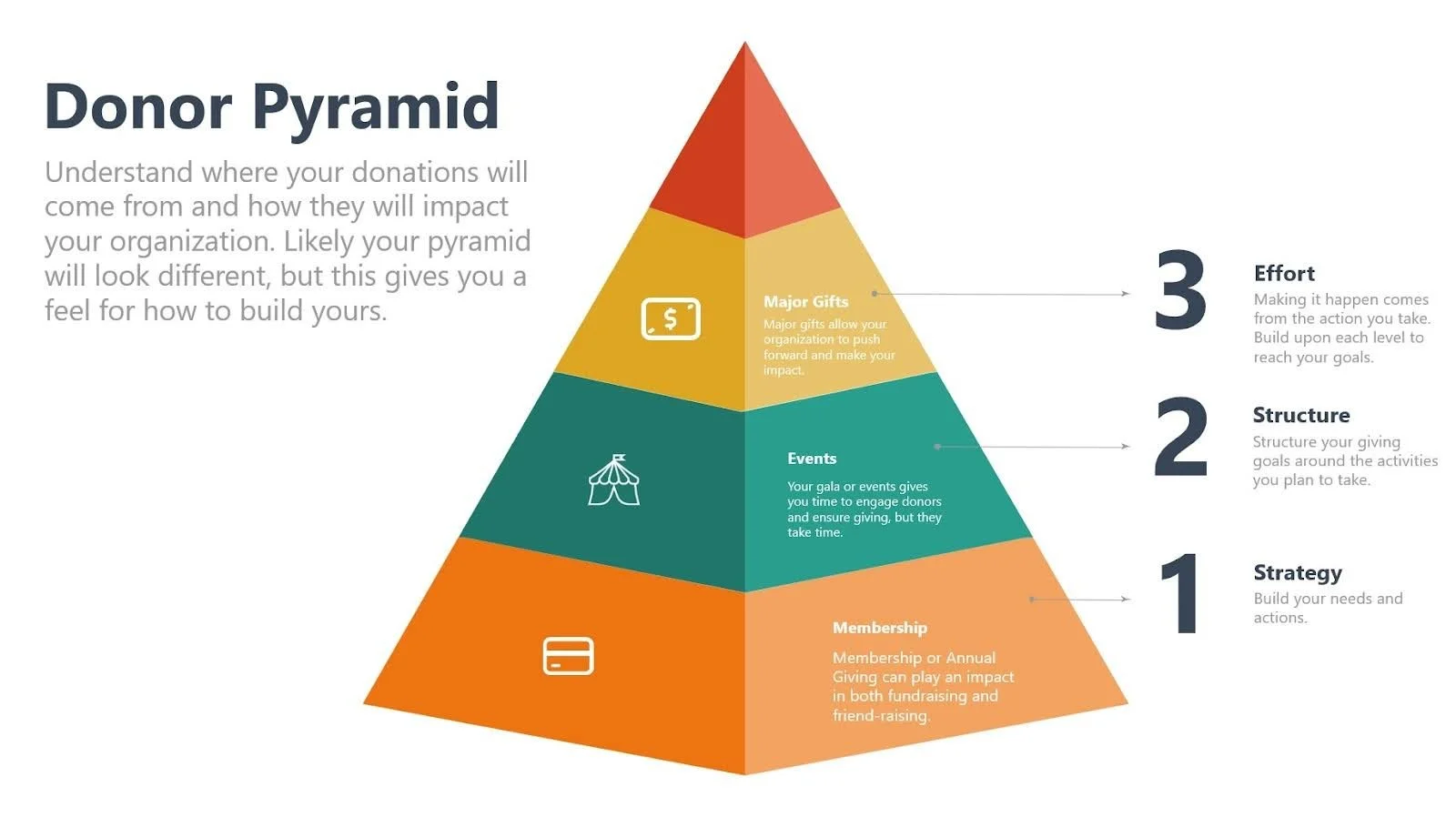
The giving pyramid isn't new, but Andrea uses it differently than most. It's not just a visual — it's a planning tool.
"You need to know: ‘How many $100K+ gifts do I need? How many $50K? How many $10K?’ And then you work backwards from there. If you need four donors at $100K and you only have two prospects at that level, you have a problem — and you need to know that in January, not November."
The pyramid tells you where the dollars need to come from. The pipeline tells you if you're actually going to get there.
One note on strategy: "It's often more efficient to raise from large donors than smaller donors. If you can access a couple donors at a million dollars, you'll get to your goal faster than approaching a hundred thousand donors for $100 each. Often, it takes about the same amount of time to go after a big gift as a smaller gift — so if you need a lot of smaller gifts, you'll need more staff."
There are good reasons to pursue smaller donors — accountability to community, power-building, relationships. But be honest about the capacity it requires.
Step 3: Build your pipeline with weighted values
This is where Andrea's "accounting brain" really shows up. Many development teams track prospects, but they don't weight their probability — which means a $500K "maybe" looks the same as a $500K "verbal yes."
Andrea wants to know: “What's the weighted value of your pipeline? If you have $3M in your pipeline but it's all 20% likelihood, you actually have $600K. That's very different information."
Andrea’s pipeline stage/weighting system:
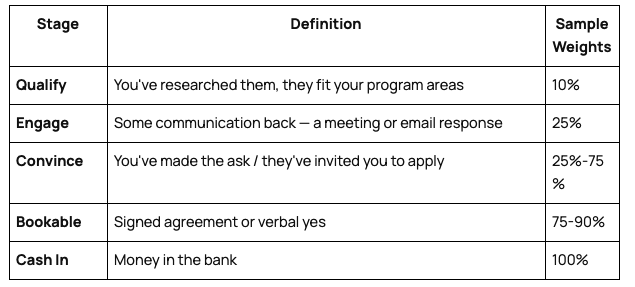
As you start talking to donors, you’ll have a better sense of likelihood percentages, and a lot of this is by feel. When you multiply each prospect's potential gift by their stage percentage, you get a real number. And that number should be trending toward your goal throughout the year. You can also set quarterly goals for each prospect stage, so your development team knows where to focus for each quarter.
"If you need four donors at $100K, you need at least 40 prospects at “Qualify”. Then you work it down: 30 of those 40 need to get to “Engage”, 15 of those need to get to “Convince” stage, and then 5 to “Bookable” — and hopefully all five convert to “Cash In”."
One caveat Andrea added: "We are in very uncertain economic times. In my 20 years of fundraising, I've only had one or two donors in “Bookable” that did not convert to “Cash in”. However, last year, so many reimbursable government contracts were cancelled mid-contract. So maybe you discount bookable to 75% instead of 90%. These are rules based on experience — you can change them when there's higher volatility."
Step 4: Run weekly meetings that keep everything moving
Having a pyramid and pipeline is one thing. Actually using them is another. Andrea runs a weekly development meeting with a consistent agenda — and this is where the "well-oiled machine" really happens.
"The meeting is an hour long, and it happens every week. That's what keeps things from slipping. We always catch things when we review our pipeline on a weekly basis."
Andrea's Weekly Development Meeting Agenda (in our toolkit!):
Gap to Goal - what’s our current gap to goal? [To figure this out in advance of the meeting, we review our monthly close and net asset roll forward and include any committed but unrecognized multi-year funding.]
Pipeline Review — [In advance of the meeting and during the meeting, we scan to make sure there is a follow-up action item (i.e. email to set up meeting, email a connector for an introduction, research, etc.) and date assigned to every prospect in our pipeline, and we haven’t missed any due dates.] What moved this week? What's stuck? Who do we need to talk about to figure out next steps? at's the current weighted value vs. goal?
Specific Funder Strategy — Who did we just meet with? How should we craft the proposal or follow-up? Do we need to set up a proposal development meeting with the programs team and determine feasible metrics?
Proposal Review — Are we on track with current proposals? Where are we getting stuck? Do we need to shift timeline? Who needs to weigh in? (Our project management system already includes timelines, draft dates, review dates, submission dates, and person responsible, so it’s just checking in to make sure we’re on track.)
Report Review — Are we on track with our upcoming reports? Is the person responsible able to get all the information they need? Do they need help tracking things down or framing a response?
Flags & Asks — What does the team need from leadership? Any blockers?
The consistency is the point. You're not having a big strategy session once a quarter and then scrambling in between. You're checking the pulse weekly, making small adjustments, and catching problems before they become crises.
"Everyone says they're going to do it, and then it becomes monthly, and then it becomes 'when we have time.' But the meeting IS the system. Without it, everything else falls apart."

The spiders were busy this morning
Step 5: Review your Dashboard Monthly
Weekly meetings keep things moving. Monthly dashboard reviews help you zoom out.
Every month, Andrea wants to see:
Where are we against our annual goal of raising this year + 50% of next year’s budget?
What is our projected cash for the year based on only committed and recurring dollars?
What's our weighted pipeline value?
Are there any major gifts we're counting on that haven't moved in 60 days?
This isn't complicated — but it forces everyone to look at the same numbers and have the same conversation about whether you're on track, both in finance and in development. Sometimes, the result of these conversations might include going back to a donor and asking for a different disbursement timeline (if cash is tight). It might mean having to rein in spending in a certain category to ensure you can meet your 50% goal. It might mean focusing on timely invoicing for your reimbursement grants.
"A lot of people will be like, 'Oh, we're doing great' — but maybe they're looking at the total pipeline, not the weighted pipeline. Or they're looking at dollars raised but haven’t compared that to actual expenses. I’ve seen situations where the development team was on track to meeting the goal they had at the beginning of the year, but finance and dev weren’t talking, programmatic expenses ballooned mid-year, the org ended up being short, and the dev team had a mad scramble to try to make up the difference in the last quarter. The dashboard keeps everyone honest and helps keep strong coordination between finance, development, and programs."
Andrea also recommends monthly report-outs to the full staff: "Everyone knows where we are in our fundraising progress. This is our gap to goal, this is our cash position if we raise $0 for the rest of the year, we're at $5M in Engage, this many in Convince, here are the asks we've made, here are the recent wins and for which programs. Transparency helps."
When to Do This Yourself vs. Bring Someone In
The pipeline template? That's a you thing. Download it, start weighting your prospects, see what you actually have.
Running a weekly meeting? Also you. Put it on the calendar and protect it.
Consider bringing someone in if:
You're not sure your goal is the right number — and you need help with the finance piece
You thought you raised a lot of money, but you’re wondering why cash always feels tight
Your restricted vs. unrestricted situation is messy and you're not sure how to untangle it
You want to build a full development strategy, not just track what you're already doing
You need thought partnership on how to build your pyramid when your donor base is shifting
You want someone to help facilitate the weekly meeting until it becomes habit
If You Want Help
Andrea Chen works with organizations through The Helia Collective to build development systems that feel less like a scramble and more like a well-oiled machine.
She's a good fit if:
Your fundraising feels frantic and you want it to feel predictable
You're not sure if your goal is the right number — or how to break out restricted vs. unrestricted
You have a pipeline but you're not weighting it (so you don't actually know what you have)
You want help building the weekly meeting rhythm that keeps everything moving
You're growing and need systems that scale with you
You need to expand your networks and relationships to reach your target donors
You’re spending a lot of time sending in blind proposals and receiving rejections
What working with her can look like:
Fundraising strategy and goal-setting
Pipeline buildout and tracking systems
Weekly meeting setup and facilitation
Board development support
Donor and relationship building strategy
Ready to talk? → Email Andrea with “Helia Help” in the subject line.

Morning commute
Not sure Andrea's the right fit? Book 30 minutes with Helia and we'll help you figure out who in our Collective might be.
Try it Yourself
Helia’s Pipeline Tracking Template — Build your pipeline with weighted values so you always know where you actually stand
Andrea's Weekly Meeting Agenda Template — The actual agenda she uses, including the questions to ask at each stage
Related Helia reads:
Net Asset Roll Forward — Andrea's other piece on the financial tracking tool that changed how she runs organizations
Questions to sit with
What is your current fundraising goal? What is your gap to goal?
Are you building next year's runway, or just trying to make this year's budget?
If you didn’t bring in any more money starting today, how long will it be before you run out of cash?
Do you know your weighted pipeline value right now — not your total pipeline, your weighted pipeline?
When's the last time you ran a consistent weekly development meeting — and actually kept it on the calendar?
Do you know how much of your budget is covered for each program — or are you chasing grants without knowing what's already funded?
Do you have a follow-up action item for each donor prospect, and are you consistently implementing all of your follow-ups?
About Andrea

Paddleboarding on Smith Lake in Alabama
Andrea Chen built Propeller from $30K in the bank to a multi-million dollar organization in New Orleans — and along the way, figured out how to make fundraising feel less like a constant crisis and more like a well-oiled machine. She started with a federal grant so complicated she spent her Sundays reconciling receipts down to the penny ("If anyone knows anything about CDBG grants, they are terrible if you don’t have a finance/accounting team"), and eventually developed systems that let her see exactly where revenue stood at any moment. Propeller has survived multiple economic cycles, multiple hurricanes, COVID, and months without a full roof — without ever having to do forced layoffs. She still gets excited about seeing positive unrestricted net assets on a balance sheet.
This article comes from a coffee chat with Andrea in late 2025. These conversations form the heart of the Helia Library — because we've learned the most from doing and from talking with other doers willing to share their wisdom. We don't need to start from blank pages or do everything alone.
As always, take what's helpful, leave what's not, and make it your own.
Article & Resource Tags