Net Asset Roll Forward: The Financial Tool Every Org with Restricted Revenue Needs
Summary
Your P&L and balance sheet aren't enough when you're managing restricted revenue from multiple sources with different timelines and categories. Andrea's net asset roll forward system transforms the nightmare of compliance into a strategic management tool that actually helps you run your organization — and gives you the real-time pulse you need to make smart decisions.
What’s in it for you:
You're drowning in restricted revenue from multiple sources and can't tell if you're actually in compliance
You want timely financial info that helps you make real decisions about staffing, funding, and strategy
You need to catch accounting mistakes before they become major problems
You're managing restricted funds from grants, contracts, and donors with different timelines and requirements
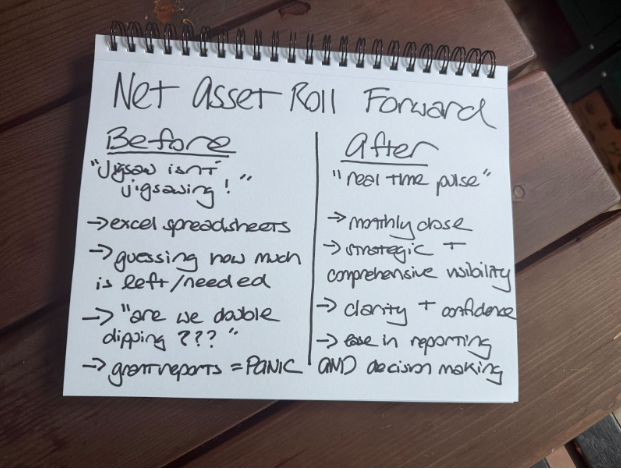
A Net Asset Roll Forward is a tracking system that shows how your organization's restricted and unrestricted funds move from one period to the next. Think of it as a master spreadsheet where every grant gets its own row, showing:
What you started with
What came in
What went out
What's left—organized by the restrictions attached to each dollar
Unlike your P&L (which only shows revenue you can recognize NOW) or your balance sheet (which shows total assets but not restrictions), this reveals:
How much money you ACTUALLY have
What you're allowed to spend it on
When those restrictions expire
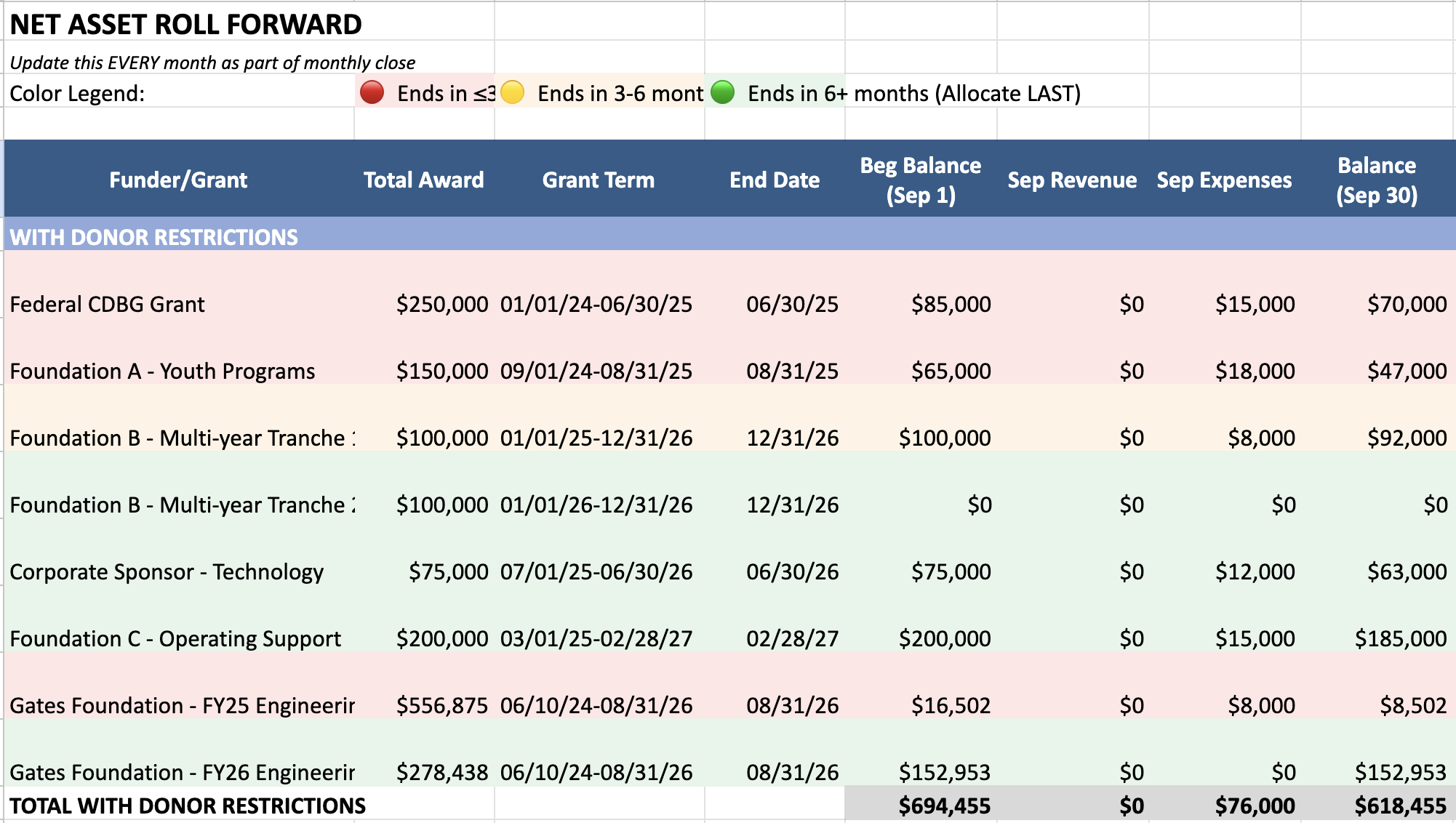
Sample Net Asset Roll Forward spreadsheet
Helia’s Perspective
I've known about Andrea (through the grapevine!) for a long time — she helped bring Revolution Foods to New Orleans (no small feat!) and has helped HUNDREDS of businesses build through Propeller, the social sector incubator she founded. She's done the work herself, evolved her role multiple times over (for which I have deep respect), and is now helping others by sharing some of her greatest resources and learnings, including NET ASSET ACCOUNTING TOOLS!
So many of us are drowning in restricted revenue — grants with different timelines, different categories, different rules. Your P&L doesn't show the full picture. Your balance sheet doesn't show what you can actually spend. This tool does. And it gives you what you actually need to manage your organization strategically.

Andrea hiking with her daughter.
The Story
Andrea started Propeller with $30,000 in the bank and "a federal grant — specifically a disaster community development block grant. The reporting was incredibly intense. "I remember Sundays were my accounting days and I would have to justify every single expense and had to have all the receipts to back it up, but it took a very long time to make sure and I would get it wrong. I would send it to them, they'd be like 'this is off by two cents' and then I’d have to redo it."
She had "a very patient program officer at the state who was okay with me redoing it three or four times before getting reimbursed." But as Propeller grew — doubling in size for five to eight years — the financial complexity became overwhelming.
"We started getting foundation grants, and those came with restricted line item budgets. I was trying to match up the expenses with different Excel spreadsheets. I did not have a background in accounting. When new grants would come in, I'd scramble to get it organized based on my budget, but then we get a huge grant three months later and it's like, 'Oh wait, then I have to reshift all those categories again.' I just couldn't wrap my mind around it."
The breaking point? "In the beginning if you have four or five grants you can kind of do it yourself, but once you get past 20, you can't. You're getting it wrong and then you have the grant report coming up and you're guessing what you spent money on. Are you double dipping? I don't know. Probably. Who knows? Can't tell."
It took her a couple of years to find an accountant who'd been a nonprofit CFO at several organizations, who set up a Net Asset Roll Forward for Propeller and taught Andrea how to use it. That's when everything changed.
What this looks like in practice
Andrea's system transforms the chaos of multiple restricted revenue sources into a manageable monthly process that actually gives you the information you need to run your organization.
-
"You set up a spreadsheet with your accountant and fill it in every month as part of your monthly close process." This isn't something you wing on your own.
From the QuickBooks side: "Get it set up right so that you can class everything. Have your accountant or bookkeeper do this. The best setup is if you can give your accountant a cheat sheet ahead of time of like, 'This new grant, these kinds of expenses, this is what you should be allocating to.'"
But here's the critical part Andrea learned the hard way: "A lot of people don't do a monthly close process. That's not okay, especially when money is tight. If you're struggling financially, it is really important to have timely financials and to know which grants are getting drawn down, which ones are not." If you don't have a monthly close process, work with your bookkeeper to establish that as soon as your accounting system is set up.
-
🔴 HARDEST FIRST → 🟡 MOST STRINGENT → 🟢 EASIEST LAST
Allocate grants ending soonest first, then tight restrictions, save flexible for last.
Why? If you use flexible money first, you won't have it to fill gaps when stringent grants run out. "Essentially you have a spreadsheet where every single grant is listed and you have your previous fiscal year net asset roll forward and monthly close with allocations." Andrea's allocation strategy:
Hardest first: "The ones that end first, you allocate those first"
Most stringent next: Add in the funding sources with the tightest restrictions next
Easiest last: "The ones that are generally like, 'Maybe there's a time restriction but it's all programmatic,' — those you do at the end"
Why this matters: With multiple funding streams, it's easy to end up in a situation like this — "This program is overfunded by $200,000, but this one's underfunded by $200,000. You're like, 'Oh, I have $400,000, I'm in good shape. I have enough money.' No, you don't. Those funds are restricted and you can only use them for what they're allotted for. If you can negotiate with your donors, this is the time to negotiate — 'Instead of funding me for program A, I actually need money for program B.'"
-
This is where Andrea gets really excited — and where the true power of this system shows up. "This tool enables you to think strategically. People are always like, 'What do your financials look like?' As the CEO, you need the financial information necessary to make decisions."
What kind of decisions? "Decisions about staffing. Do you have enough budget to hire another person for the next 10 years? Do you need to let people go? What kind of funders do you need? Do you need to really expand your unrestricted revenue?"
But here's the game-changer: "A lot of people will be like 'Oh my P&L looks really good, my balance sheet looks good,' but it's actually the net asset roll forward that I look at — that's my go-to. It's not the P&L."
Why? "As a nonprofit, so much of your revenue is not recognized in the moment. If you are doing your job right, you are getting lots of multi-year commitments, and none of your multi-year grants are reflected on your P&L because you cannot recognize future revenue this year."
The result? "You might raise $3 million in multi-year grants — none of that's going to show up on your P&L. So it might look like you're not doing well on your P&L, but you actually have $2 million coming in 2026, 2027, 2028. That's really good information to know because you could actually be in a very healthy position but it might not look like that on your P&L."
Andrea created a dashboard showing "committed grants by year" so they could see years out what they'd raised. "Cash is so different from your P&L, so different from your net asset roll forward. They talk to each other, but they are not the same thing. The net asset roll forward became the primary document."
The strategic power: "This gives me a real-time pulse on what's actually happening. I can see patterns and make decisions before something becomes a crisis."
Secret Sauce & Takeaways
If there's one thing you should do, it's: Institute a monthly close process immediately and make the net asset roll forward your primary management document. "You as the ED need to be signing off on this every single month and showing that you've reviewed it." This becomes your strategic dashboard — not just compliance, but the tool that tells you what's really happening in your organization.
Understand the compliance rules upfront: "A lot of foundations have internal rules and guidelines around how much you can go over/under and they won't tell you upfront and it won't be in your grant agreement." Ask every funder about their percentages for shifting between categories. "From a compliance perspective, you need to get sign-off from the donor that they're okay with you moving categories, but usually people are very okay with it — they just need that email."
Common pitfalls to avoid: Don't try to manage this with Excel spreadsheets and hope. "People just kind of fudge it as they go along — then when you have to submit reports, you just say that it matches and make the QuickBooks report match it, but if you look at it in totality, the jigsaw is not jigsawing." Also: relying only on your P&L to make decisions when you have significant restricted revenue.
Common Scenarios Where This Saves You:
"This program is overfunded by $200k but this one's underfunded by $200k" → You think you're fine but you're not. Time to negotiate with funders about shifting between programs.
Grant gets double-booked → You think you have $200k more than you do. The net asset roll forward catches this before crisis.
Multi-year grant looks like nothing on P&L → You raised $3M but it won't show until 2026-2028. Net asset roll forward shows you're actually healthy.
What makes this work well: The net asset roll forward transforms how you run your organization. "There will be mistakes made no matter how good your accounting team is, and your job as the CEO or ED is to catch them early. This tool helps you do that." More importantly: "The net asset roll forward became the primary document" because it shows you the full picture of your financial health and gives you the information you need to make real strategic decisions about staffing, fundraising, and growth.
If you’re starting from scratch
If you don't have a monthly close process: Work with your bookkeeper to establish one immediately using our Monthly Close Checklist. This is especially critical when money is tight.
If you're starting from scratch: Use the Bookkeeper Cheat Sheet to tell your accountant exactly how to set up QuickBooks and which expenses go to which grants.
If you catch a big discrepancy: This is your job as ED — don't expect your finance team to catch everything. Dig in immediately.
Questions to ask yourself
Do you have a monthly close process — and are you actually reviewing the results each month?
What strategic decisions are you avoiding because your financial picture feels unclear?
If you had real-time visibility into your restricted revenue, what would you do differently?
How much time do you spend scrambling to prepare reports versus using financial data to plan ahead?
Want to Try This?
Templates & Guides:
Helia’s Net Asset Roll Forward Template including:
📖 START HERE guide with Andrea's advice built in
📊 Dashboard showing committed grants by year
📋 Bookkeeper Cheat Sheet (give this to your accountant!)
Full Net Asset Roll Forward with realistic examples
Sample Monthly Close Checklist - What to review every single month
Recommended Reads
Prepare, protect & propel your work with responsible financial management practices from Raj Thakkar’s* book fiscally seCURE - written for charter schools specifically and full of learnings for all!
Connections
Nonprofit accountants who understand restricted revenue: HeliaRecommends x Accountants
*Helia Collective Member
About the Contributor
Andrea Chen spent her Sundays for years justifying every expense down to the penny with receipts spread across her kitchen table, trying to make sense of federal grant reporting. She turned that painful experience into a system that helped her grow Propeller from $30K to a multi-million dollar organization — and now helps other social sector leaders avoid the financial chaos she lived through. She still gets excited about a well-organized monthly close process.
This article comes from a conversation with Andrea in September 2025. We've learned the most from doing and from talking with other doers willing to share their wisdom. We share these stories in the Helia Library because we don't need to start from blank pages or do it all alone.
As always, take what's helpful, leave what's not, and make it your own.
Article & Resource Tags