Build Something Worth Belonging To
A Helia Member Story on what happens when you lead with people and place — and let them lead right back
Long Story Short:The organizations people fight to keep alive are the ones that make people feel like the organization is theirs, too. Check out Timothy's five moves for building that kind of belonging into whatever you're already doing.
Why We’re Sharing This Story
Jess here!
I've been thinking a lot lately about what it means to be held.
Not just personally — though that's been its own journey — but organizationally. Whether the things we're building actually hold people. Whether the spaces and programs and services we're creating feel like somewhere people genuinely belong.
I used to think being held meant having all the right things in place. The right staff, the right funding, the right programming. Get the infrastructure right and people will show up and feel cared for.
And then I kept encountering these moments — in my own life and in the organizations I work with — where all the right things were in place and something was still missing.
Or, the opposite: bare-bones operations where people were inexplicably loyal, fiercely devoted, showing up like the place was theirs. Because to them, it was.
What makes the difference? I've been sitting with that question for a while.
And then I met Timothy.
He's a startup founder, musician, and community builder — someone who will tell you plainly that the business world has sometimes felt to him like cosplay. Sometimes he feels out of place — "I’m the guy who shows up to a pickup basketball game in hockey skates" — because what he's really geared for is people. The micro-level moments where you can see the impact of what you're building on a single human being. And then watching those moments multiply.
What Timothy built with the Oakland Ballers — an independent minor league baseball team in West Oakland — is one of the most genuinely community-rooted organizations I've heard about in a long time. And it was a for-profit startup.
"It was capitalistic in that it generated a return," he told me. "But it felt like just being friends with people."
That's the thing so many of us are trying to build and can't quite name. Timothy's story got me thinking about what it actually means to build something people would be shattered to lose — and what gets unlocked when you lead with belonging before asking for anything in return.
He has some thoughts on how.
Timothy’s Story
As told by Timothy Koide
I'll be honest with you — the business world has never felt entirely natural to me. My mom was a cellist and my dad was a professor. We didn't say "dad went to work," we said "dad went to school."
I grew up playing in bands. I did a Capitol Hill fellowship and worked in think tanks. My first real job was for a Japanese-American civil rights organization working on community programming. I was earnest. I wanted to make money some day, but, quite honestly, didn’t know how.
And then I ended up in Silicon Valley, drinking from the fire hose of venture-backed innovation, believing — like a lot of people did at the time — that startups were going to solve big problems and change the world. I learned pretty quickly that the zero-to-one monopolistic scale mentality attracts a lot of personas that don't quite embody that idealism. Ideas are perishable and fragile in that world. I found that out fast.
After years of playing in the venture sandbox, I found Paul Freedman. He was starting the Oakland Ballers minor league baseball team in response to the Oakland A's leaving — the last major sports franchise to abandon Oakland. I have over a hundred years of East Bay family history. I didn't have to think very hard to see how this idea could impact the community in a really positive way. I jumped on after about ten minutes of conversation.
The Cheers Effect
The Ballers, to me, was the closest I've ever come to a true manifestation of how a for-profit endeavor could make money AND have a non-extractive relationship with the community it was growing in.
Here's what I mean by that.
When I was working with the accounting platform Gusto on a partnership, they asked me how I'd define a small business. My best answer was: a small business is one where the proprietors know all their customers' names. Literally or metaphorically — meaning you really know your customers. They're not an abstraction. They're not on a dashboard somewhere. They're real people.
The Oakland Ballers was that. By the end of the first season, we were talking to people by name as they came through the gates. “Hey John, hey Susan.” A few thousand people at each game and it still felt intimate and like a family gathering.
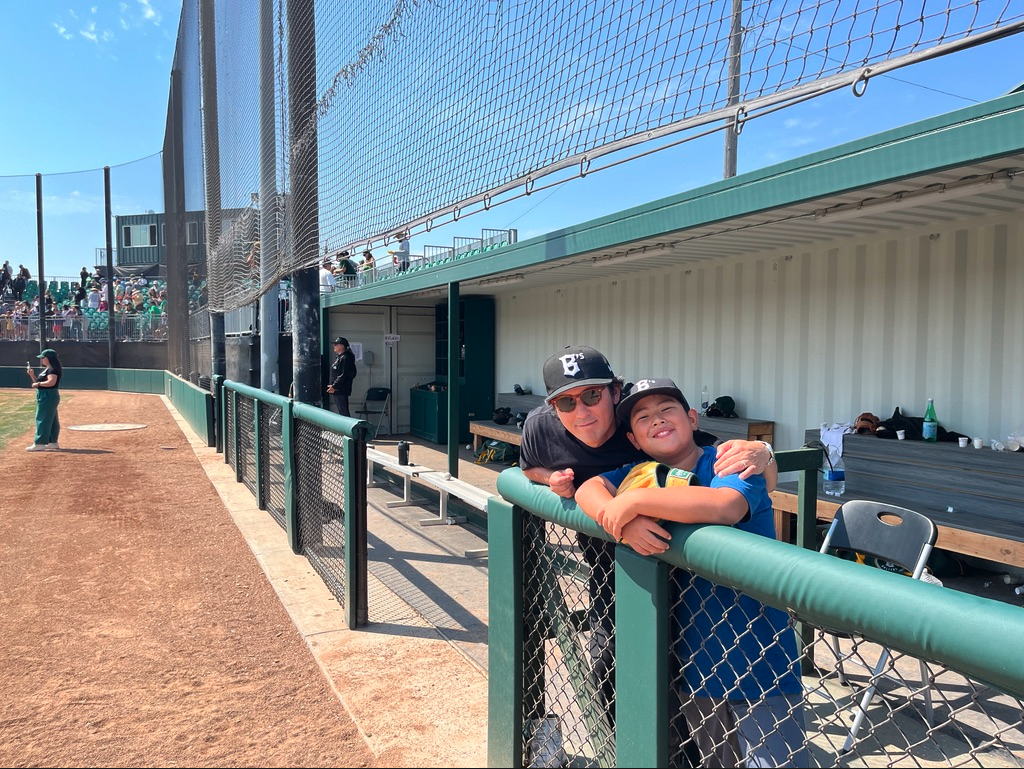
With my son Kanoa at an Oakland Ballers game
That doesn't happen by accident. It happens because you decide — before anything else — that this place belongs to the community. Not in a marketing-speak way. In a real way.
Oakland is a port town, historically diverse, more blue-collar than the rest of the Bay Area, with more nonprofit organizations per capita than any other city in the country. It has a long legacy of activism — a lot of the brands of American activism that became well-known in the post-war era were born in Berkeley and Oakland. That's not just history. That's DNA. That's how the city functions.
We understood that, from a brand-building perspective, a sports team needs the backing of its community. So, we led with that. Every game, we highlighted a community partner — the Oakland Zoo, the Oakland Museum, Bandaloop, Black Panther Party Alumni Network, Oakland Unified School District. Booths at the games, content marketing done in partnership with those organizations.
We ran a crowdfunding campaign and broke a record — so the Ballers are fan-owned, too. That community identity, that sense of shared ownership among community members, was really important to us.
There's a symbiosis there — when you engender those community relationships, those people in the community come support you at the games.
Rising Tides and Real Partnerships
We built the ballpark in an existing city park — Raimondi Park in West Oakland, which has been there for over a hundred years. Frank Robinson, Dave Stewart, Rickey Henderson all played prep baseball there. We built a stadium around the existing field, in a neighborhood called the Prescott — which used to be known as Harlem West. Writers, Black cultural and literary legends, musicians, activists all rolled through the Prescott. That historical and cultural element was critical to us. We brought in local performers — for an independent minor league team, the level of entertainment and patronage was pretty phenomenal. Too Short, Lyrics Born, Hieroglyphics, Billy Joe Armstrong.

One of my favorite views from the Oakland Temple
Across the street, there is a food hall — honestly the best food hall in the Bay Area — run by close friends, Joe Ernst, and Harv Singh. On Thursday nights during the warm months they run a night market — food trucks, entertainment, hundreds of people in the neighborhood. We'd have games on Thursdays, too, so there was this natural flow: people would pregame at the night market, fill up on food, then come to the game. The market was already going to happen. The game was already going to happen. So, we just asked, how do we amplify each other?
There was this really natural symbiosis and alignment with them that felt so reassuring and safe that made partnership feel, well, easy. The night market got screen time on the jumbotron at the ballpark. The Ballers had a booth at the night market selling merch and tickets. And, our mascot, Scrappy the Rally Possum, would be at the night market too. (Scrappy’s backstory: A family of possums lived in the old Oakland Coliseum and Scrappy escaped from East Oakland to West Oakland.) Intuitive and organic earned media opportunities came with minimal discussion or negotiation. It was as easy as calling up your buddy, seeing what they were up to, and seeing if they wanted to hang out.
With community partners like the zoo or the Oakland Museum, they got free booth time at games. They provided free value-adds — like family passes to the zoo as in-game prizes. A single family ticket was valued at over a hundred dollars, but cost the zoo very little to provide to our fans and in turn develop grateful devotees of the zoo. The zoo also became a formal sponsor with an outfield sign, a jumbotron feature, and a sponsored game where fans dressed in animal costumes and raced around the warning track. The Oakland Symphony brought an ensemble to play the national anthem, and had a booth at the games.
It’s all pretty lightweight stuff, honestly. But it's the power of bringing people together around a shared vision of promoting the community you live in.
When You Show Up, People Show Up
One of the great things about the Ballers being planted in that part of town: the impact on the community had very little to do with baseball.
Public transit ridership went up. Crime went down. Property values are going up. The city quietly started paving sidewalks and redoing streets. Car break-ins — which had been astronomically high in that area — dropped drastically (during our first season we only had one car break-in, across 48 night games).
If you foster the right kind of energy, people respect it. There's an intangible power in happiness and positive energy that has a tailwind effect — as long as that energy is respected.
And yes, the Ballers was a startup. When I left, I was more burnt out than I'd ever been in my life. Still a startup, still incredibly stressful. But part of that burnout was probably a function of the fact that I felt comfortable enough to put everything I had into it. There's something to that.
What Any Organization Can Steal from This
If you're building something that relies on a physical space — a drop-in center, a community clinic, a farmers market, a social enterprise — you have a tremendous opportunity to create a localized and inviting experience for everyone. Not just the customers. The employees too.
A few things I keep coming back to:
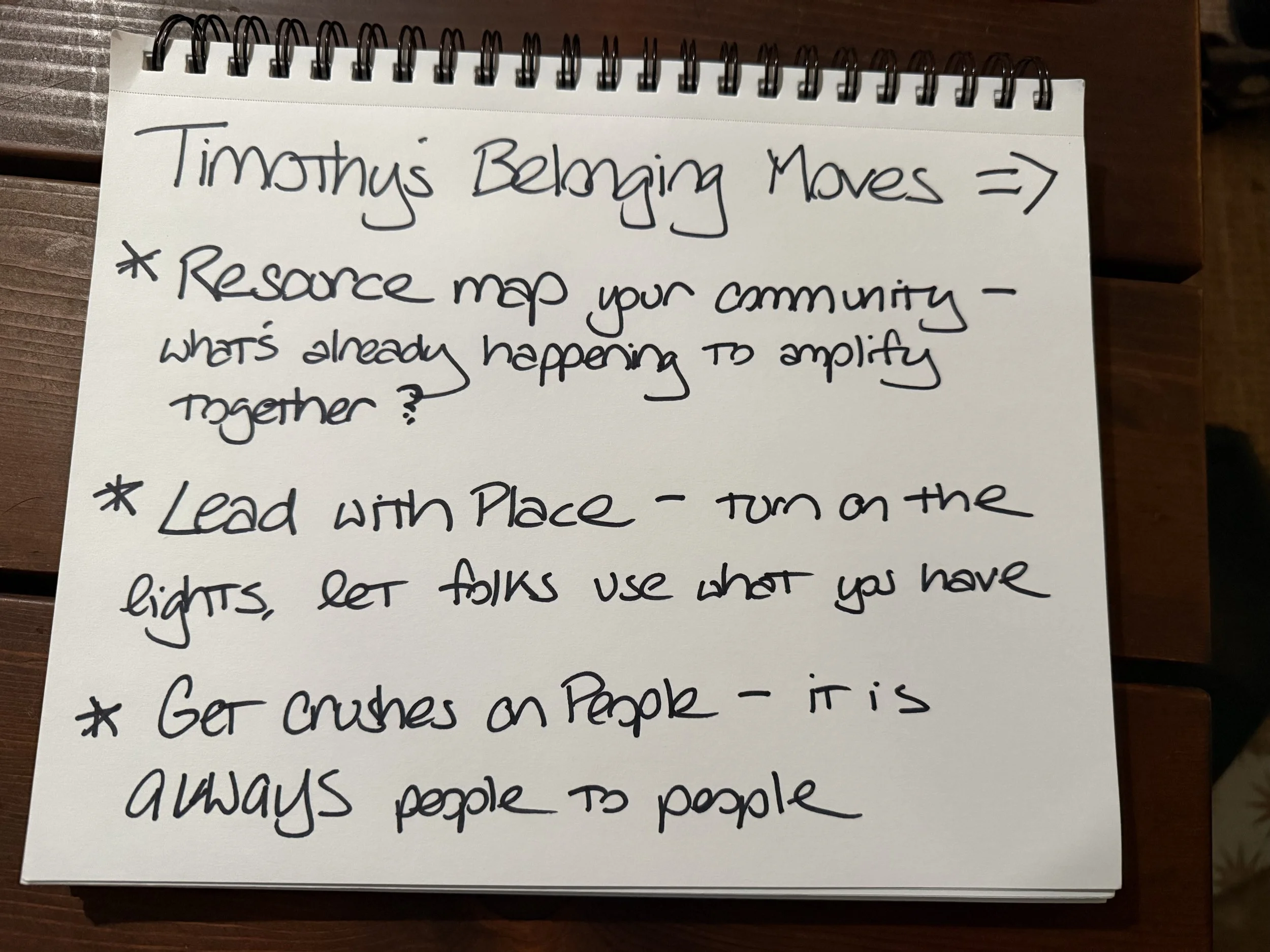
Resource map your community. What's already happening around you? What's the night market equivalent in your world — something that's already going to happen that you could amplify together, to your mutual benefit? The key to good partnerships is finding the asymmetries: low-cost or free resources that add real value to whoever you're working with.
Lead with place. Everybody is from somewhere. Organizations serving unhoused populations, farmers markets, mental health clinics — your clients, your community members, your employees all share cultural touchstones whether you acknowledge them or not. Dodgers fans. Local music. Neighborhood history. There are diagrams of cultural expression that intersect with whatever you're doing, and expressing those things with community partners builds something real.
Become the church. In a lot of communities, churches used to host Boy Scout troops, Girl Scout troops, toy drives, bake sales. They were the connective tissue of neighborhood life. If your organization has underutilized space or time, you have the opportunity to become that. Let the youth organization do their car wash in your parking lot. Host the writing class. Turn the lights on and let people use what you have.
Earn media like it's your marketing budget. Timothy told me after our conversation: "Tell your story such that members of your community would be shattered if you were to go away." A ribbon cutting for a community garden. A mural on the building with local artists. Get the council member there. Get the press. Not to be a cynical marketer — but to bring attention and incentivize people to show up. Because once they show up, they meet each other. And that's when things get going.
Get crushes on people. Every time we interact with people, we have opportunities to get interested in each other — to find ourselves thinking, "what could I do with this person?" What gets things going is always people-to-people relationships. Not organizations deciding to partner with each other in the abstract. Paul has a great vision and a great track record — that's what motivated Timothy to help him build the Oakland Ballers. It was Paul. It's always the people.

A watercolor done by my great-grandmother in the Topaz Internment Camp during WWII
If You Want Help
Timothy Koide thinks deeply about how community-driven organizations build belonging, tell their story, and create genuine partnerships with the places they're rooted in. He's not a traditional consultant — he's the person you want to think alongside when you're trying to figure out what you're building and who it's really for.
He's a good fit if:
You have a physical space or community presence and a nagging feeling you're not making the most of what's around you
You're trying to build real community ownership into your organization — not just in theory, but in practice
You want to tell your story in a way that would make people shattered if you went away, but you're not sure where to start
You're a founder, operator, or leader who wants a thought partner with startup chops and deep community instincts — not a deck, but a real conversation
Ready to connect? → Reach out to Timothy at timothykoide@gmail.com with "Helia Connect" in the subject line.
Not sure Timothy’s the right fit? Book 30 minutes with Helia and we'll help you figure out who in our Collective might be.
Try it Yourself
Reads and inspiration
Beloved Economies — If this article got you thinking, their work on businesses doing things differently is worth your time. Their recent Dispatches series on pro-democracy businesses is especially worth reading.
The Power of Unreasonable People by John Elkington & Pamela Hartigan — on social entrepreneurs who lead with community and purpose
Your local paper — seriously. Resource mapping starts with knowing what's happening around you.
Questions to sit with
Here are some questions to sit with after reading this story…
What does it mean for your organization to genuinely be of your community — not just serving it?
If your organization closed tomorrow, who would be shattered — and do they feel that sense of ownership today?
Where are you leading with the organization — and where could you lead with place and people instead?
When did you last have the chance to get a "crush" on someone doing interesting work near you — and what did you do with it?
About Timothy
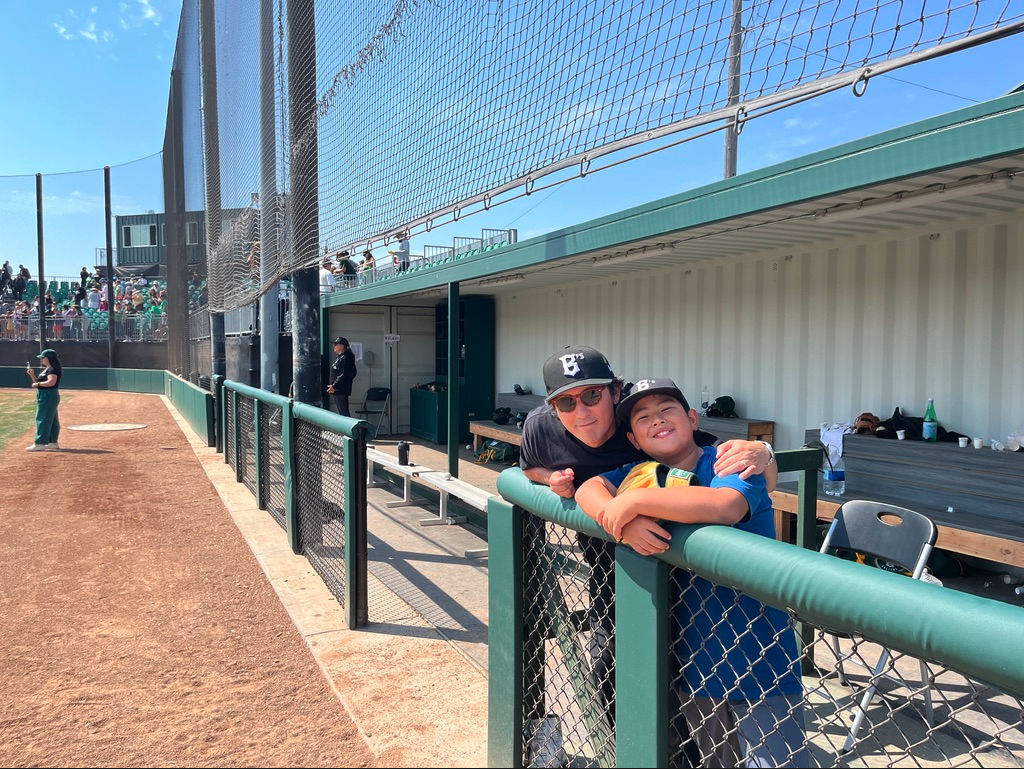
With my son Kanoa at an Oakland Ballers Game
Timothy Koide has a hundred-year family history in the East Bay, started playing music at a very early age, did a Capitol Hill fellowship, worked in civil rights, drank the startup Kool-Aid, and then found something that finally felt like what he'd been geared for all along: building something genuinely worth belonging to. He co-built the Oakland Ballers from the ground up, broke crowdfunding records, and helped create an organization whose impact on West Oakland had almost nothing to do with baseball. He's a startup founder, operator, musician, and a firm believer in the magic of just getting people together. He's also the guy who shows up to the pickup basketball game in hockey skates — and makes it work anyway.
This article comes from a coffee chat with Timothy in February 2026. These conversations form the heart of the Helia Library — because we've learned the most from doing and from talking with other doers willing to share their wisdom. We don't need to start from blank pages or do everything alone.
As always, take what's helpful, leave what's not, and make it your own.
Article & Resource Tags