Long Story Short
Most recruiting starts narrow — the same job description, the same rolodex, the same profile of candidate everybody already knows. Caroline Fitz-Roy runs searches that start wide, map possibilities you hadn’t considered, and evolve as she learns. It’s how you end up with people you’d never have imagined — and unicorn-level matches that go way beyond the job description. Don’t have time to read the whole article? Check out Caroline’s Custom Search Toolkit for the actual tools she uses.
When I was running a big round of hiring at Think of Us, I was genuinely doubting myself. We were building an organization doing systems change in foster care — growing fast, entrepreneurial, mission-forward, and working at intersections most orgs didn’t sit at. Our roles were weird. We were hiring a COO who’d need to hold operations AND strategy AND culture in a scaling nonprofit. We were hiring a Head of People who’d need to build out the team AND hold equity work AND navigate a system that was changing under our feet. And those were just the first two.
It felt like the recruiting world worked a certain way and I just… didn’t get it. So I made a decision: I’d hire a couple of different firms and run them side by side. One firm on one role, another firm on the other. See who we wanted to work with longer-term. Figure out what I was missing.
One was a really traditional recruiting firm. They had a slick onboarding process, clear decks, polished weekly check-ins. It felt comfortable. It felt safe. “These are the candidates. Here’s the profile. Here’s where we are.”
And for about two conversations, it was great. And then it wasn’t. Every week we’d meet and I’d try to give ideas about different places, different angles, different kinds of people we might look for. The recruiter couldn’t seem to get responses anywhere new. We hit a wall. We kept hitting the same wall. And I found myself clinging to the one half-decent candidate they’d surfaced — asking, “Can you find someone like them again?” — because I didn’t know what else to ask for.
The other firm was Caroline’s. Caroline Fitz-Roy and I had worked together before (full transparency!), which was part of why I was willing to test. Her approach was less formal. Honestly? At first it felt a little bit all over the place. We’d talk about some ideas, she’d come back with some profiles, some were good, some of them were off — AND every conversation kept building. There was always a pipeline. Always a new angle. Always a “what if we tried this?” or “what about this group of people who sit at this intersection?” It felt fun. It felt possible.
And one day, one of the candidates I was talking to (who happened to be in the HR world themselves) explained something to me that I’d never understood before. The difference between a recruiting firm and a search firm.
A recruiting firm is great when the role is known — traditional, defined, has a clear candidate pool. They’ve got a rolodex, they’ve got expertise in placing those folks, and they can move fast.
A search firm is what you want when you’re doing something new. When the role is cross-functional. When you’re not sure exactly who you’re looking for yet. When you need a partner to help you figure out who you’re looking for and then build the process to find them.
That distinction cracked something open for me. Because I thought back to every hire I’d ever tried to make by working my rolodex, pitching a fixed JD, and matching a checklist, and realized how narrow I’d been. How many times I’d started with “who do I already know who does this?” and gotten a perfectly fine hire who didn’t move the work forward. How many times the best hires had come from me throwing the list out, getting curious, and ending up somewhere I never could have drafted my way into.
A rolodex is not the way I want to enter hiring. I want to think expansively about who’s going to be the best match for our team, have all the conversations, learn from each one, and use the process to map what we actually need — not just the outcome I drafted in my head ahead of time.
The person who made me understand the difference
I’ve known Caroline for about 15 years. We met at Revolution Foods, where I was Chief of Staff and she was doing outreach calls to schools. The way we actually closed deals was to show up with hot lunch, feed the kids and the school food director, and win them over in person. So Caroline would book the tasting, then I’d drive four hours with hot food, leaving at 3:30 in the morning, schlepping of all schleppings and try to close the deal.
I’d walk in. Their faces would light up.
“Caroline?!”
“Oh — no, I’m Jess. I work with Caroline.”
And their face would fall. Completely. Every single time.
My colleague in Denver and I had a whole joke about it. Fifteen minutes with Caroline built more connection than four hours of us literally feeding people.
That’s Caroline. She can make someone feel so seen, so understood, so curious about what’s possible together — in such a short amount of time — that they want more of her. That’s also, it turns out, exactly what makes her great at running a search. Candidates who’ve only had one conversation with her call me up wanting to know more. Organizations who do one intake call with her come back ready to rethink the whole role.
Caroline founded Fitz-Roy and Associates after a storied career that started by cold-calling every recruiting firm in the San Francisco Yellow Pages to get her first job, then onto corporate recruiting at Gap and Schwab, and eventually following her passion for food access to Revolution Foods as employee number four. Today she specializes in searches for purpose-driven organizations — nonprofits, social ventures, healthcare orgs doing new things.
What makes her different isn’t one signature move — it’s that she’s looking at four things at once, on every search, with real curiosity:
- The role — not the one on paper, the one the org actually needs filled right now
- The org — what’s the reality at this moment, with this team, in this culture
- The candidate — not just skills and resume, but what they actually want and need from a job
- The market — what’s shifting right now, what people are (and aren’t) saying yes to, what’s actually out there
Most recruiters simply check the candidate against the job description. Caroline evaluates all four categories at once AND lets what she learns in any one of them reshape how she’s thinking about the others. That’s the whole thing. That’s why every conversation feels like it’s building and growing toward something — because it is.
The Key Takeaway
Most recruiting starts narrow. You sit down with the same team, draft the same job description, and look at the same candidates you could have named before you started.
Searching starts wide, especially the way Caroline does it. She maps possibilities you hadn’t considered, listens to what the org needs AND what the market’s actually offering, and brings real curiosity to every conversation on every side.
What you get back isn’t just a hire. It’s a search that stretches your thinking about what’s possible — and candidates in the room you’d never have known to look for.
Caroline’s Custom Search Approach
If you’re a “just give me the tools, I’m ready to get started” kind of person (aka Helia’s COO, Libby), Caroline’s Custom Search Toolkit walks you through the real tools she uses to find unexpected candidates. If you’re a “tell me the thinking behind each piece so I actually use it” kind of person (a Jess), read on for the good stuff! Here’s what we’re covering:
- Step 1: Start with a map of the market, not a rolodex
- Step 2: Treat every conversation as learning, not pitching
- Step 3: Adjust as you learn (without losing the thread)
How the Custom Search Works
Step 1: Start with a fresh map, not a rolodex
The default move is to activate a network. Who do you know? Who have you placed before? What rolodex can you work?
Caroline starts with the market, not the rolodex.
For every search, she builds a fresh map of where the right person might actually be — and that map almost never looks like “find me someone who’s done this exact job at a similar org.” It looks like five or six different categories of places where someone with the right combination of skills, instincts, and motivation might be hiding. Different sectors. Different stages. Adjacent work you hadn’t thought to consider.
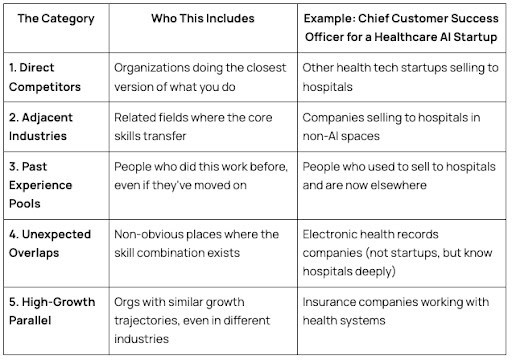
A sample Market Map for a high-growth Healthcare AI Startup.
The point isn’t the categories. The point is: don’t assume the candidate looks like what you think they look like.
And the beauty is that, when you don’t assume, you end up in places you hadn’t considered. You find people you’d never have known to call.
“A common theme for nonprofit clients is that they want someone who’s done this job before at the same kind of org. And every time we encourage them to look wider — different sectors, different stages, different adjacent experiences — we find someone better than what they thought they were looking for.”
2. Treat every conversation as learning, not pitching
Here’s where most recruiting goes wrong: you’re so focused on convincing people to take the role that you stop hearing what they’re telling you.
Caroline’s approach flips that. Every conversation is intelligence gathering. She’s not just asking “are you interested?” but:
- What matters to you right now?
- What kind of role structure are you actually open to?
- What’s making you hesitant? What would make you say yes?
- What’s true for you that might also be true for other people in this space?
And then she brings what she’s learning BACK to the org. “The market is telling us X. Here’s how that might change how we’re thinking about the role. Here’s where we might need to flex. Here’s what’s shifted since we started.“
That’s the four-sided alignment in action. What she hears from candidates and the market reshapes what she tells the organization about what’s realistic, and sometimes reshapes what the role becomes.
3. Adjust as you learn (without losing the thread)
The piece that took me a while to really appreciate about Caroline’s process is that it’s iterative, but it’s not chaotic. Every week, she’s adjusting. But she’s adjusting based on real pattern recognition, not vibes.
- What language is getting responses?
- Which categories of candidates are engaging more?
- What reasons are people giving for no?
- What’s showing up over and over that nobody predicted?
Her Health of the Pipeline Tracker captures all of it — not just “where is each candidate in the process,” but “what the market is teaching us, and what are we adjusting this week because of it?”

Every time we encourage [orgs] to look wider, we find someone better than what they thought they were looking for.
What Expansive Thinking Gets You: Sebastian Johnson
The hire that still makes me laugh at how unlikely it was on paper — and how obviously right it was in practice — was Sebastian Johnson, who Caroline brought us to lead the Center for Lived Experience at Think of Us.
The Center was a new thing. We were building it to center the voices of people who’d actually been through the foster care system — not as advisors after decisions were made, but as leaders of the work itself. The person running it needed to be able to translate that work in a LOT of different directions at once: to philanthropy, to policy, to research, to media, to the field, to the young people themselves. They needed to hold real credibility with funders AND with people with lived experience. They needed to know how to run multi-party campaigns across the aisle. They needed execution chops — someone who could actually build the thing, not just talk about it.
If you’d asked me to draft the job description from scratch, I would have gone to the lived-experience world. I’d have looked at advocacy organizations. I’d have done all the obvious things.
Caroline brought us Sebastian who, at the time, was coming out of Arnold Ventures, a major philanthropy organization. On paper, the jump from being a funder to running a lived-experience-led center at a nonprofit is weird. I don’t think I would have generated him as a candidate in a hundred years of drafting.
But once Caroline pulled back the layers, it became clear that Sebastian’s proximate lived experience would be a major asset to the role. He’d been at a major funder, so he understood how philanthropy operates. He’d done deep policy work. He’d led multi-party campaigns that moved bipartisan legislation. He’d held Chief of Staff roles, so he could actually execute. He understood research. He could translate across every audience we needed.
All of the pieces were there. They just weren’t in the place I’d have thought to look.
That’s what an expansive search gets you. Not a different kind of candidate — an entirely different CATEGORY of candidate. Someone nobody in the room would have proposed if we’d started from a job description and a rolodex.
And once we saw Sebastian, we couldn’t unsee him. He was exactly right for that moment
What Rolodex-Hiring Costs You: A Cautionary Tale
I want to tell on myself here because I’ve made this mistake a lot.
At Rev Foods, we were scaling a school food company fast. We were the scrappy alternative to the giants — Sodexo, Aramark — who’d been running cafeteria food in schools for decades and whose entire model we were trying to disrupt. We cooked real food. We sourced local. We worked with smaller districts and built trust one tasting at a time.
We were hiring new account managers after a restructure, and I felt SO clear on what we were hiring for. We wanted to “professionalize” a little. We wanted experience, discipline, diligence.
I met a woman who checked every box. Older than our team. Industry background. Very professional. She felt like a safe hire.
By the third round of interviews, I knew. She wasn’t going to be a fit. She wasn’t scrappy. She wasn’t creative. She knew the process, AND she couldn’t mix and match — which was basically the entire job at Rev Foods.
I went to my general manager and said I wasn’t sure. They said, “I’ve gone to bat for her. You have to hire her.”
So we did. And every single day, it felt like a mistake.
The same pattern played out again and again before I clocked it: we’d say “we need someone from Sodexo or Aramark, they know school food, they’ll come teach us.” We’d get them. They were good humans. And they brought the worldview of the thing we were trying to disrupt. None of them moved us forward.
Meanwhile, the hires that actually built Rev Foods? An ed reform person who understood school districts from the inside. A former Target general manager who could run operations at speed. Folks from restaurants who knew real food at scale. People I never would have pulled off a list — because no list would have had them on it.
The lesson I keep relearning: when I’m matching a checklist I drafted ahead of time, I’m hiring from scarcity. When I’m actually curious about who might do this work brilliantly, I’m hiring from abundance. Those are completely different searches. They produce completely different humans.
When to do this Yourself vs Bring Someone in
Everything Caroline does? Pieces of it, you can absolutely do yourself. Start with a fresh market map instead of your rolodex. Listen for what the market is telling you, not just what you want to hear. Let every conversation shape how you think about the next one.
You might want to work with Caroline (or someone who runs searches like she does) when:
- The role is unusual, cross-functional, or sits at an intersection you don’t fully understand yet
- You’ve been searching on your own and keep hitting the same wall
- You need someone who’ll push your thinking about what you’re hiring for, not just find candidates for the JD you drafted
- The stakes are high and the team you’re hiring into can’t absorb a mis-hire
- You want a thought partner on the whole search — not just a list of names
If you’re earlier in the thinking — like, “wait, do I even know what role I need?” — start with our article, The Right Role at the Right Level, first. And, if you find yourself hiding your real culture from candidates in the past, Different Cultures Need Different Humans is where to go. Caroline does her best work when you’ve done that upstream thinking.
If You Want Help
Caroline Fitz-Roy and her team at Fitz-Roy and Associates partner with social sector and purpose-driven organizations on searches where getting it right matters, and where the “obvious” candidate isn’t the one you actually need. She’s the search firm Helia goes to when we want someone who treats the search as a learning process, not a placement process.
She’s a good fit if:
- You’re hiring for a senior role with real complexity (cross-functional, new function, unusual intersection)
- You want a recruiting partner who’ll stretch your thinking, not just work their rolodex
- You’ve been searching for months and aren’t finding the right candidates
- You need someone who’ll help you map where the right person actually is — even if it’s somewhere you hadn’t thought to look
Connect with Caroline !
Try it Yourself
Caroline’s Custom Search Toolkit
- Four-Sided Alignment Map — A worksheet to map the role, the org, the candidate, and the market on every search. Use it before you write the JD, and come back to it every week of the search.
- LinkedIn Outreach Examples — Caroline’s actual multi-touch outreach messages across different role types, with what made each one work.
- Health of the Pipeline Tracker — The weekly tool Caroline uses to track candidates AND market intelligence — what’s landing, what’s not, what to adjust.
Questions to Sit With
- When I’m hiring, am I drafting from who I already know — or actually mapping who might be out there?
- Where in my last search did I cling to a “safe” candidate because I couldn’t see what else was possible?
- What’s a hire I’m proud of where the person didn’t look like anything I’d originally drafted? What did that teach me?
- Am I treating every candidate conversation as intelligence — or just as a pitch?
- What’s the difference between hiring from scarcity and hiring from abundance in my own patterns?
Not sure Caroline ‘s the right fit? Talk to Helia directly!
This article comes from a coffee chat with Caroline in June 2025, a follow-up resource brainstorm in October 2025, and 15+ years of me watching her do this brilliantly in hundreds of contexts. These conversations form the heart of the Helia Library — because we’ve learned the most from doing and from talking with other doers willing to share their wisdom. We don’t need to start from blank pages or do everything alone.
As always, take what’s helpful, leave what’s not, and make it your own.

About Caroline
Caroline Fitz-Roy is the founder of Fitz-Roy and Associates, a search firm specializing in purpose-driven organizations across nonprofits, social ventures, and healthcare. She got her start by cold-calling every recruiting firm in the San Francisco Yellow Pages, worked corporate recruiting at Gap and Schwab, and followed her passion for food access to Revolution Foods as employee number four before launching her own practice. She believes great searches are equal parts research and real curiosity — and that the magic happens when you never stop learning from every conversation.
Work with Caroline