Long Story Short
With one LinkedIn post now pulling in hundreds (even thousands?!) of applicants in a day, the decisions you make BEFORE anyone applies matter more than ever. Sophia Zisook’s approach makes the job description, the pay, the posting, and the screen do the work for you, so you’re not drowning by the time you get to the interview. Check out Sophia’s Hiring Foundations Toolkit if you want a head start.
Jump to How!
One of our clients recently posted a Chief of Staff role on LinkedIn. Just one post. By the end of that same day, they had over 200 applicants, with resumes pouring in at 10 an hour. I’m guessing here, but I wouldn’t be surprised if they end up with hundreds (possibly even thousands?!) of applications before they pull it down.
This is where we are now.
A few years back, I posted a fractional Chief of Staff role myself. Three months. Interim. Very specific. I sent it to 10 folks I knew and put up a LinkedIn post because it felt “equitable.” 195 thoughtful applications came in within a few days. I got through about 15, found my person pretty quickly, and then just legit did not have the time to go back through the rest. (I told myself I would. I didn’t. And I still feel bad about it.)
Here’s the thing — for a long time, I did everything “technically right.” I’d made up all sorts of rules in my head about how to vet candidates. And honestly? I was pretty good at it. But I’d do things like:
- If they didn’t have a cover letter, I’d pass (I loved PDF cover letters over Word or Google Docs versions)
- I’d also very much think about who we knew with shared history and connections, especially with a hundred candidates, or into the hundreds, thousands, etcetera type of range. Do I recognize anywhere they worked? Do I think highly of it? That kind of thing.
I realize now just how much bias I was bringing in, and how limiting that was. Both for the candidates who deserved a real look and for us.
At Think of Us, we were trying to figure out how to do this better. One of my colleagues there really wanted to post on Idealist for maximum reach and awareness. It brought in thousands and thousands of candidates — of which less than 1% were even a mild fit. Then, even when we did figure out how to go through that pile in ways that felt much more equitable than my “do I recognize anywhere you ever worked or think highly of it” version, it was still really hard to weed out some of the things that actually mattered.
Eventually, in one hiring process where we had SO many candidates, we developed a pre-screen questionnaire. That’s what finally shifted things.
The questionnaire was designed to give candidates AGENCY. To share who they were and what mattered to them, instead of me trying to intuit it from a resume. It had two kinds of questions that really made the difference.
- Rating and ranking. If the role had a team reporting in, we’d list a range of things — hiring a team, developing a team, one-on-one management, team culture, holding folks accountable, building relationships — and ask candidates to rate and rank what they really liked about running a team. That gave us a sense of alignment with where we were. If someone really loved developing an existing team and we were still in build mode? Probably not as good a fit as someone who wanted to BUILD a team. Not a judgment. Just real information.
- My favorite question ever: What are your pet peeves? People were so honest about this, which I LOVE. A lot of what we’d hear was about time and place. Being on time to meetings, following processes that were aligned, things changing. At Think of Us we really were an entrepreneurial, responsive place. We were regularly a few minutes late to meetings, back-to-back all day, consistently responding to what was in front of us. So folks who wanted on-time meetings and aligned processes? We were not their home. A candidate who said “I love when things are changing, I love problem-solving, I love fast iteration?” Come sit with us.
A good friend of mine ran an organization that was very tight and buttoned-up. They’d done a big national scale process and really fine-tuned their model. They were in a different stage, and those same candidates who wanted on-time meetings and aligned processes would be in a much better place with her. Same humans, different orgs, different answers to “right fit.”
Certainly not perfect, but it gave us a way better foundation to decide who to interview than me trying to figure it out from someone’s resume or where they worked before. It gave humans agency to say “this is who I am, this is what I’m excited about.” Maybe more importantly — it was getting rid of some of the biases I was bringing in. The PDF cover letter thing, or the shared-connections thing. The “do I recognize anywhere they worked” thing. Finally, the process got driven by the candidate’s voice instead of mine.
Good hiring, especially at this volume, isn’t about running more interviews or building more gates. It’s about creating the conditions, BEFORE anyone applies, where candidates can tell you who they are — and you can actually hear them.
A great hire starts long before the interview — it starts with a process that’s actually built to work.
The Person Who Helped Me Turn This Into An Actual Process
A friend told me she’d worked with Sophia Zisook and described her as someone who brought both heart and strategy to hiring. Of course, I was wildly excited to connect. When folks have actually done the work AND their intention lines up with what we care about at Helia — supporting doers trying to build a world we want to live in — I’m always ready to learn.
Sophia turned out to be exactly that kind of human.
Her background matters. She got into this work through her MSW at the University of Chicago, studying the wage gap — specifically the research showing that women, people of color, queer folks, and folks with disabilities were BOTH less likely to negotiate AND less likely to succeed when they did. She’s a social science nerd who turned her obsession with why we keep getting inequitable outcomes into a business helping humans negotiate for themselves AND helping orgs hire in a way that doesn’t keep replicating the same problems.
What I loved about her lens: “Most organizations are really small and nimble and scrappy and are building the plane as we fly it,” and that’s exactly who she works with. She’s not selling you a corporate HR process. She’s helping you put equitable hiring into practice “without breaking the bank or scaling in a way that isn’t realistic.”
Here’s what pulled the whole thing together for me. She frames the job description as the anchor: “It feels like a simple step,” she told me, “but is actually such a predictor of the type of candidate that you’re going to get AND the way that you present yourself as an organization.” Her two words for what it needs to be: compelling and transparent. Then everything downstream — the pay band, where you post, how you screen — builds from there.
The upstream process — the JD, the pay, where you post, the screen — is one long invitation to the right humans, and one long honest out for everyone else. Designed with care, it lets candidates tell you who they are, so you don’t have to guess.
The Key Takeaway
Most hiring mistakes happen before the interview. Every decision made before anyone applies is either pulling the right candidates in or letting the wrong fits out. By the time you sit across from a candidate, most of the real work is already done.
Sophia’s solution to this? Get really specific about the job description, the pay, where you post, and how you score the pile before the interview and a LOT of what feels impossibly hard about hiring right now gets easier.
Sophia’s Hiring Foundations
If you’re a “just give me the template, I’m ready to get started” kind of person (aka Helia’s COO Libby), Sophia’s Hiring Foundations Toolkit has what you need:
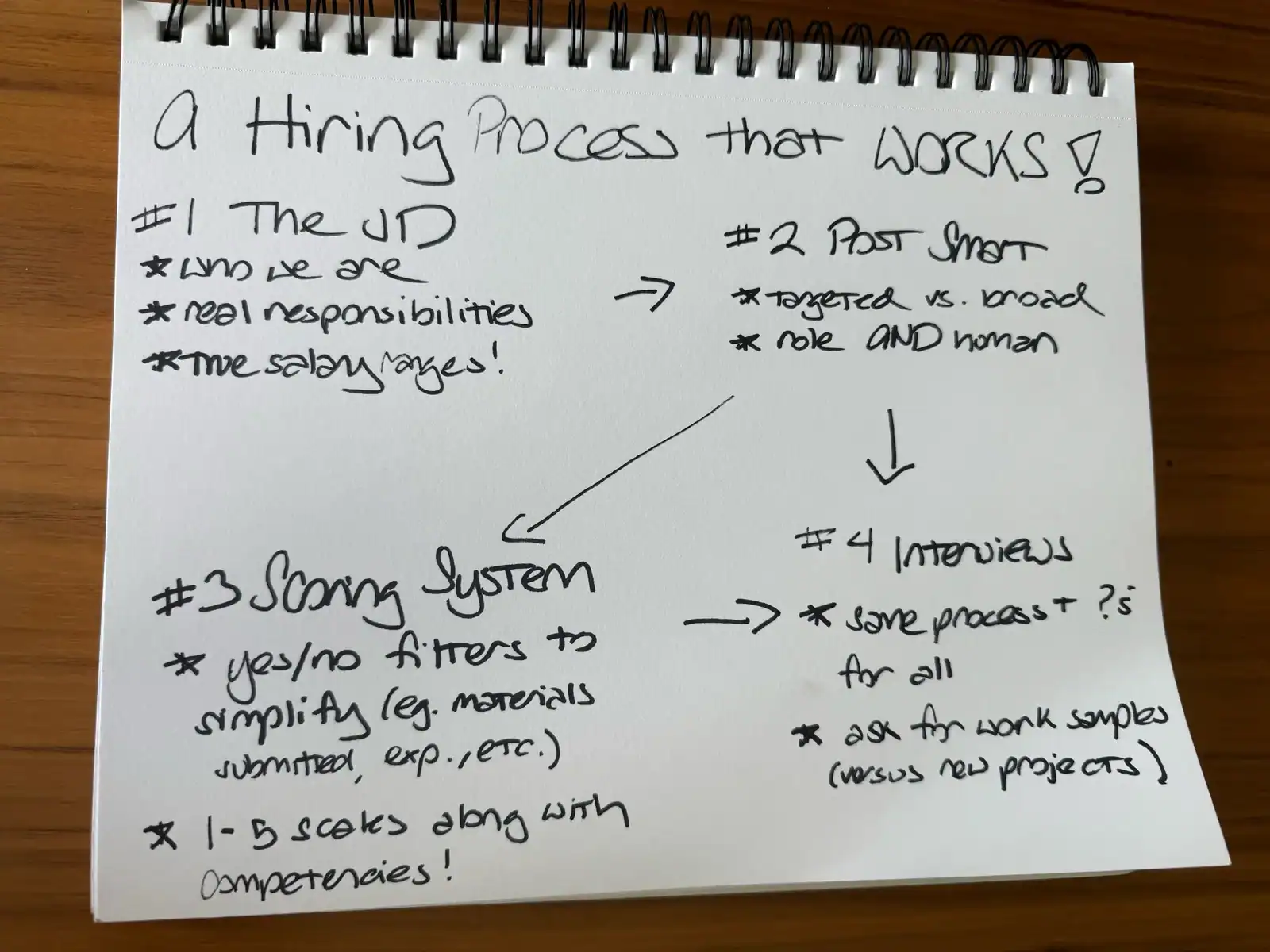
- Step 1: Write the JD like every section matters (because it does) — who you are, what this role is and why NOW, responsibilities as an outline (not a wish list), and the pay range, right there on the page
- Step 2: Post strategically, not broadly — because “the most eyeballs” is exactly what you DON’T want right now
- Step 3: Build a scoring system that protects you from yourself — yes/no filters first, 1-5 competency scoring second, two reviewers always
If you’re a “tell me the thinking behind each step so I actually use it” kind of person (aka our Founder Jess), read on for the good stuff!
How These Steps Make Hiring Less of a Slog
Step 1: Write the job description like every section matters (because it does)
The mistake most of us make? We rush this part. We copy-paste our mission statement up top, list out a wish list of responsibilities, maybe throw in a salary range if we’re feeling brave, and hit post. Sophia’s pretty clear about why that’s a problem: “It’s often something that people do really quickly. It feels like a simple step but is actually such a predictor of the type of candidate that you’re going to get.”
Her two words for what every JD should be: compelling and transparent. Here’s what that looks like, section by section.
Who we are + what we do. This is NOT the place to copy-paste your mission statement. “Take people on the journey of who we are, what we do, what’s happening right now in the organization, what’s the moment that we’re in, and how does that relate to why this role and why right now,” Sophia told me. A sentence or two on whether this is a backfill (and why — was someone promoted? Did they move on after a long tenure?) or a new role (and why NOW?). That context does real work. It signals you’ve actually thought about this role, not just decided to fill it.
Responsibilities that aren’t a wish list. This is where Sophia gets passionate. “It’s tempting to let the responsibility section become a wish list. It should be an outline that if I were hired, what are the first things I’m going to do?” If your responsibilities list is SO long it looks like three jobs in a trench coat that’s a signal to candidates that this might be a red flag, and it doesn’t help them focus when they start. Her pet peeve? Ending responsibilities with “as needed.” Like, “other administrative duties as needed.” It could mean anything and it usually does.
Competencies separate from requirements. This distinction gets mashed together in a lot of job descriptions and it’s worth pulling apart. “Competencies might be the type of person you want to hire because of the skills and values they hold. Requirements might be particular licensures, skill sets, or training.” One is about who they ARE. The other is about what they HAVE. Both matter, but confusing them makes your job description read like a wall of demands.
The pay range. On the page. Every time. Sophia advocates for salary transparency “100% of the time.” Every state has different rules on what’s required, but that’s not actually the point: “It’s not just about equity or inclusivity or for the benefit of the employee or applicant. It’s actually often very much so to the benefit of the organization. You’re saving yourself time and potential negotiating down the road.” Especially in increasingly remote environments where cost of living varies wildly. Someone in San Francisco with a spouse who brings home a second income has a very different minimum than a single parent in San Francisco with two kids. Posting the range lets people self-select out without either of you wasting time.
Where folks get tripped up here: it feels like a meaty lift because it has implications for the rest of the org. If you haven’t done a pay band analysis, posting this role might force you to confront that. Sophia’s take: “Taking that extra week to just do the most bare bones pay scale analysis across the org I think is really helpful.” Communicate with your existing team FIRST about how their pay was set, then post the new role. Otherwise you risk your team feeling resentful or confused when they see a different range posted publicly.
If your responsibilities list looks like three jobs in a trench coat, that’s a signal to candidates that this might be a red flag.
An inclusivity statement. This one is smaller but does real work. Research shows women and people of color apply less often when they don’t check every box. Adding a line acknowledging that — something like “research shows underrepresented folks often apply less when they don’t meet every qualification; we’d love to hear from you anyway” — signals that you’re aware and informed. It nudges folks to apply who might otherwise have counted themselves out.
Application instructions + deadline. Don’t assume the “Apply” button is enough. Tell folks exactly what you want — cover letter or not, any specific questions to answer, references upfront if you want them, a deadline (even just a priority deadline). Every job board displays things differently. Specificity protects you.
Step 2: Post strategically, not broadly
Here’s the trap I fell into at Think of Us. We posted on Idealist because it felt equitable. We got thousands of applications. Less than 1% were a fit. We were drowning AND we hadn’t actually served equity. Instead, we’d just created a mountain of work that we couldn’t process thoughtfully.
Sophia puts it this way: “People inaccurately equate job description visibility with being inclusive or equitable. Actually, how the job description is written and where it’s put is much more important than making sure it’s posted on the broadest possible platform.”
The shift: post to the RIGHT places, not the MOST places.
LinkedIn and Idealist are great for a mass of applications if that’s genuinely what you want. For most roles, especially specialized ones, they’re going to drown you. Sophia’s preferred approach is to find niche, industry-specific, or skill-specific job boards, and there are HUNDREDS of them in the social sector alone, catering to specific passions, values, and skill sets.
Her trick for finding them: do SEPARATE searches for each specialty. “If you’re hiring an environmental justice project manager, do one search for environmental job boards and one search for project manager job boards. Don’t mash them up because you’ll miss specialized communities.”
Some are free, some charge a small fee, and honestly? Sometimes the paid ones are worth it because they attract a more intentional pool. Cast a wide net, but make sure the net you’re casting is aligned with who you’re actually trying to reach.
There are some genuinely helpful roundups that already exist — Mana Tahaie’s Nonprofit Jobseeker Resources is one Sophia recommends and we’ve pulled into the toolkit. It’s a living list of job boards, listservs, and networks across the social sector, organized by focus area. Great place to start when you’re trying to figure out where your people actually are.

Every decision made before anyone applies is either pulling the right candidates in or letting the wrong fits out.
One more thing Sophia said that stuck with me: “The most eyeballs doesn’t necessarily mean the best candidates.” Most of what LinkedIn and Idealist give you is volume and right now, in this market, volume is the problem.
Step 3: Build a scoring system that protects you from yourself
Okay, let’s say you’ve done Steps 1 and 2. Your job description is compelling and transparent. You’ve posted to the right specialized boards, but you’ve still got a pile of applications. What now?
This is where a lot of orgs fall apart. “I often get brought in from organizations who come to me with, ‘We don’t have a full-time HR person, we want to do it right,'” Sophia told me. “The first step is deciding who to interview — which starts with a scoring process for applications to reduce bias.”
The pre-screen questionnaire I mentioned in the opening is one piece of this. What Sophia adds is a scoring system that works alongside it, so that everything you’re using to narrow the pile is actually grounded in criteria you’ve thought about on purpose, not gut feel (or, if we’re honest, the bias I was operating on for years).
Her approach has two parts.
Part 1: Yes/no filters. Before you score anyone, you run the pile through a handful of binary checks.
- Did they submit everything you asked for?
- Did they answer the specific questions you included?
- Do they have the years of experience or title you actually need for this level of role?
“If the check boxes aren’t checked, they’re out of the processes,” Sophia said. These filters alone will narrow about 80% of the application pool right away. Which matters because in this AI-everyone-can-apply-to-everything era, so many people ARE applying without paying close attention or bothering to tailor anything.
Part 2: 1-5 scoring on specific competencies. For everyone who passes the yes/no check, you score them 1-5 on a handful of different competencies and experience levels that you named in your JD. “It’s less about a gut feeling and how neat and organized the cover letter is (unless attention to detail and writing are competencies),” Sophia said. “And more about the criteria you outlined in your job description.” See how the JD keeps paying off?
Two more things that really matter here:
Use two reviewers. “Have two different individuals do that scoring for all applications so you’re not going off of just one person’s bias.” You average the scores. It’s not perfect — we all have blind spots — but two sets of eyes catch a LOT more than one.
Keep interviewers separate from scorers, if you can. The person scoring applications should probably not be the person running first-round interviews. You’re getting a different perspective and, honestly, you’re protecting the scorer from getting fatigued and the interviewer from getting attached to candidates before the conversations even start.
It’s tempting to let the responsibility section become a wish list. It should be an outline of the first things I’m going to do if hired.
One more thing I’ll layer in from my own experience: the pre-screen questionnaire really is the ‘magic’ in addition to all of this. When I’d hit a pile of hundreds, getting those questionnaire answers BEFORE I scored anything gave me so much more texture than a resume ever did. Combined with Sophia’s scoring system, it’s a one-two punch. The questionnaire gives candidates agency. The scoring system takes MY biases out of the equation. The combo makes it possible to find real candidates, and that makes all the work beforehand worth it!
When to do this Yourself vs Bring Someone in
Everything in this article? You can do it. It takes time, and it takes a willingness to slow down at the parts where you’d usually rush (the JD especially. But if you’re willing to put in that work, the downstream savings are enormous.
You might want outside help if:
- You’re hiring for a critical role and you want a thought partner on the JD, the pay band, AND the screen — not just one piece
- You’ve been drowning in applications for weeks and can’t see a way out of the pile
- You want to redesign your full hiring process to be more systematic AND more equitable — and you want someone to help you calibrate what “equitable” actually looks like in practice
- You want your whole hiring approach to be consistent across roles — and you need help building the infrastructure to make that real
If You Want Help
Sophia Zisook helps social sector organizations put equitable hiring practices into action, from JD design and pay bands through scoring rubrics and interview structure. She’s refreshingly direct about where most orgs go wrong, and especially good for small, nimble orgs that need this done well without breaking the bank.
She’s a good fit if:
- You want to redesign your hiring process from the JD down, with an equity lens built in
- You’re hiring for a role where getting it right really matters and you want a thought partner on the design
- You keep defaulting to the same approach and it’s not working anymore
- You want help designing scoring and screening that’s fair AND protects you from your own biases
Connect with Sophia !
Try This Yourself
- Sophia’s JD Template — Every section that matters, with prompts and examples so you’re not staring at a blank doc. Start here.
- Sophia’s Application Scoring Rubric — The yes/no filter + 1-5 competency framework, in a spreadsheet you can adapt for any role.
- Curated Social Sector Job Boards List — Based on Mana Tahaie’s Nonprofit Jobseeker Resources — a living list of where social sector folks actually look for roles, organized by focus area.
Questions to Sit With
- Is my JD actually compelling and transparent — or am I recycling mission statement language and hoping people read between the lines?
- What’s my honest reason for not posting the salary? And what’s the cost of that choice — for candidates AND for me?
- Am I posting broadly because it feels equitable, or because I haven’t taken the time to figure out where my actual people look for roles?
- What biases am I bringing to the pile right now that I could take out of the first round with better screening criteria?
- If I ran every application I reviewed last year through a pre-screen questionnaire and a 1-5 scoring system — who might I have noticed that I missed?
Not sure Sophia ‘s the right fit? Talk to Helia directly!
This article comes from a coffee chat with Sophia in June 2025. These conversations form the heart of the Helia Library — because we’ve learned the most from doing and from talking with other doers willing to share their wisdom. We don’t need to start from blank pages or do everything alone.
As always, take what’s helpful, leave what’s not, and make it your own.

About Sophia
Sophia Zisook got her start in the nonprofit sector by co-founding and scaling a national youth-serving nonprofit at 18 (originally called “Everybody Dance Now” — sorry for the earworm!). Now, through Negotiate with Sophia, she combines behavioral research with her experience building orgs from the ground up to create practical tools for nimble organizations trying to improve their hiring and for individuals learning to negotiate for themselves. A Licensed Social Worker who just moved to Madison, she’s the kind of person who’ll geek out about wage gap data AND give you the exact scoring rubric you can use next week.
Work with Sophia