Long Story Short
When big things are happening in the world around you (basically every day right now…), figuring out the right way to respond can be tough. What can you say? Should you say anything at all? Katelyn McArdle has two questions to help you decide if you should move forward and how: Do you have the authority to respond? Can you deliver on what you’re promising? If you do decide to respond, our Rapid Response Toolkit gives you everything you need to get started.
Hey y’all, Libby here!
Anyone remember March 2020? What a fun time!!
I was CEO of Whetstone, a software platform used by schools, when COVID hit. Like most people at the time, my only frame of reference for a pandemic was the bubonic plague. Guess what: the bubonic plague is not a helpful frame of reference for someone trying to manage their anxiety about what’s going to happen.
The nature of the pandemic — where the best thing to do was literally nothing — had me climbing the walls. I could only do so many puzzles and make so much banana bread before my nervous energy started driving me crazy. Normally when I’m stressed, I just start working and I feel better, but there was no work to do since our school customers were shut down. Oh, and it was my birthday!
Another thing about me: I’m not just a doer, I’m a helper. I could not sit still knowing that principals and superintendents and teachers were out there scrambling, trying to figure out how to keep kids learning when the world had changed overnight.
So, I did what I usually do — I got busy. I started reaching out to every school leader and partner I knew. Whetstone specializes in teacher coaching and classroom observations, so as schools were shifting to Zoom learning, I tried to think of ways we could help — creating observation forms that took teacher mental health into account and adding look-fors specific to online learning. I crafted each message personally, adjusting the tone based on where the school was located and what the COVID case counts looked like in that region on that particular day. I thought I was being helpful. I thought I was showing up.
Anddddd… crickets.
Finally, about a week later, I got a response from a partner/mentor who supports principals and superintendents. His message was kind. And clear: “You are not in a position to help right now. I’ll reach back out if there’s a way I think you can.”
I wanted to crawl under my couch. Because what he was too gracious to say — but what I absolutely heard — was: Libby, stop cluttering up people’s inboxes. They are trying to figure out how to get breakfast to kids who don’t have food. You cannot help with that and, honestly, you’re getting in the way.
He was completely right. I was inserting myself into a crisis that had nothing to do with my area of expertise, because I needed to feel useful. (Oof. Not proud of that one.)
Wanting to help and being in a position to help are two very different things.
Most doers in the social sector are also helpers — that’s probably why you’re here. But wanting to help and being in a position to help are two very different things. Having a way to objectively determine if your organization is in a position to take the lead, to support those leading, or to get out of the way — and then a plan to show up once you decide — is what separates a meaningful response from a well-intentioned distraction.
The person who taught me to slow down before speeding up
Katelyn McArdle spent over 10 years in digital strategy at nonprofits like Children’s Hospital Colorado Foundation, Denver Rescue Mission, and the Denver Art Mission. Now she consults with organizations on digital transformation—helping them figure out what they actually need before they jump into tactics.
Katelyn’s superpower is her ability to slow down in a big moment when everyone else wants to jump to action. It’s so tempting to just start running, but Katelyn has learned over the years that taking the time to stop and assess before doing leads to better outcomes for all parties.
During the early days of COVID, leaders at a large, well-established nonprofit wanted to launch an “Emergency Fund” to respond quickly to the crisis.
Internally, there was hesitation. Not because the organization didn’t want to raise money, but because the word “emergency” carried unintended risk. It could imply instability. It could raise legal concerns. It could unintentionally signal that core services were at risk.
By slowing down, the leadership team created space to rethink their approach. Instead of positioning the campaign as “emergency fundraising,” they reframed it as a “rapid response effort,” emphasizing preparedness, resilience, and their ability to mobilize resources because strong systems were already in place.
The shift protected donor trust, reduced internal risk, and ultimately strengthened the organization’s reputation at a moment when credibility mattered most.
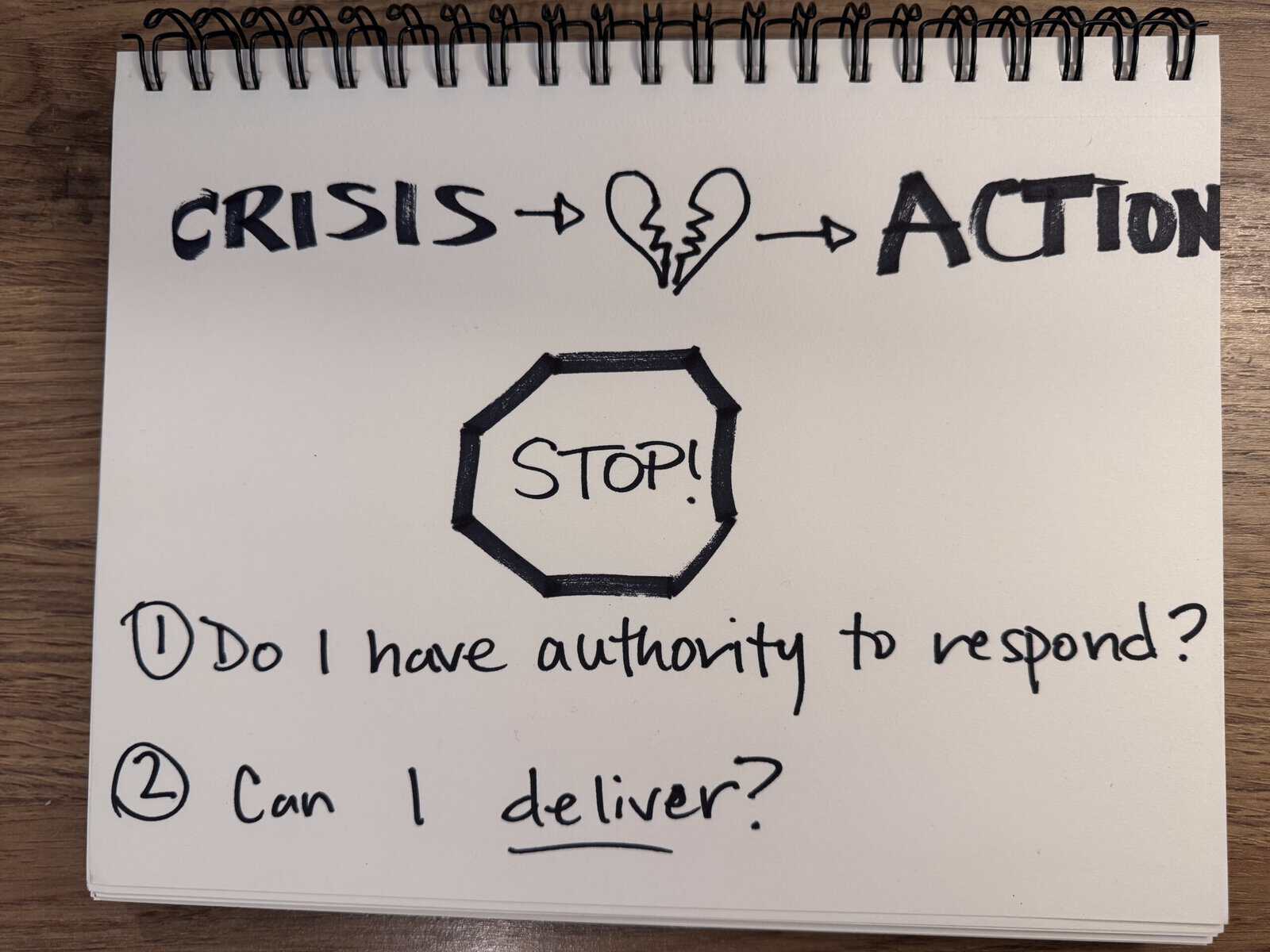
Over years of supporting organizations in these types of moments, Katelyn has translated her “stop and assess” superpower into a two-question framework that helps leaders protect trust and respond responsibly when urgency is high, without sacrificing clarity or credibility.
- Do you have the authority to respond to this?
- Can you deliver on what you’re promising?
Before anyone creates a donation form or writes an email, they must answer those questions. If the answer to either is no, they stop. Full stop.
The Key Takeaway
Most organizations jump straight to tactics when something urgent happens—they start drafting emails, creating donation forms, and planning social posts.
Katelyn’s approach flips this: assess your authority first, pressure test your ability to deliver second, and only then start executing.
Responding inappropriately damages your brand far worse than not responding at all. This applies whether you’re fundraising during a crisis, launching a product in response to breaking news, or deciding whether to weigh in on a policy change.
Katelyn’s Rapid Response Decision Framework
If you’re a “just give me the toolkit, I’m ready to get started” type of person (aka Helia’s COO Libby), we put together a Rapid Response Toolkit for you!
If you’re a “tell me why this works” person (aka our Founder Jess), read on for details on the four parts of Katelyn’s Rapid Response Decision Framework.
- Step 1: Stop and Assess — Do you have authority to respond?
- Step 2: Pressure Testing — Can you deliver on what you’re promising?
- Step 3: Execution — Focus on current supporters, lower the polish bar, and overcommunicate
- Step 4: Sustained Response — Plan for impact reporting and supporter fatigue
How Katelyn’s Rapid Response Decision Framework Works
Step 1: Stop and Assess: Do you have the authority to respond?
Katelyn starts every rapid response conversation the same way, whether it’s about SNAP benefits, wildfires, or policy changes: “Do you have the authority to respond to this?”
This isn’t about whether the situation is newsworthy or trending. It’s about whether this is truly the bread and butter of your nonprofit.
During the Eaton fires in Altadena, people who had never been to Altadena suddenly tried to set up nonprofits to “help.” The issue was that they had no authority — no relationships with the community, no knowledge of Altadena, no insight into what was needed. They ended up distracting more than helping.
Meanwhile, a local park six miles away made a simple decision: Remove all entrance fees for Altadena residents for the rest of the year. They weren’t fundraising. They weren’t inserting themselves where they didn’t belong. They were saying: “We’re nearby, we have this resource, we’re making space for the community.”
That’s an appropriate crisis response. That’s understanding your authority.
Why this matters: Moving forward without authority risks your brand reputation. As Katelyn puts it, “If you do this wrong, the negative impact on brand reputation and trust is far, far worse than if we weren’t to respond at all.”
The question to ask: Is this truly our area of expertise, or does it just feel opportunistic because it’s in the news?
2. Pressure Test: Can you deliver on what you’re promising?
In the fall of 2025, one of Katelyn’s clients—a national organization supporting communities through mental health services, transitional housing, and suicide prevention—was closely monitoring changes to SNAP benefits and food assistance programs.
The situation felt urgent. It was highly visible in the news. And it affected many people in the communities the organization served.
But when the leadership team and Katelyn assessed their current operations and partnerships, they recognized something important: while food insecurity mattered deeply, it was not an area where they had direct service infrastructure or trusted delivery partners in place.
Rather than launching a campaign they couldn’t fully operationalize, they chose a different approach. The organization monitored developments, assessed internal readiness, and strengthened relationships—so they would be prepared to act quickly if and when the situation directly impacted the populations and programs they were equipped to support.
In this case, restraint was the responsible choice. By not overextending their promises, the organization protected donor trust, staff capacity, and long-term impact.
Pressure Testing: When she’s trying to help leaders work through these decisions, Katelyn uses messaging scenarios to help them understand if the organization is the right one to respond. She drafts sample language around the following questions and tests it with stakeholders:
- “We are the organization prepared to deliver services despite all odds.” — Does that feel true?
- “Our current partners are fully equipped to respond to this crisis.” – Are they?
- “Thank you for trusting us with unrestricted support so we can respond as quickly as possible to this evolving situation.” — Can you actually back that up?
- “100% of your donation will go directly to crisis response.” If true, how will you pay for the indirect costs of crisis response?
If none of the messaging scenarios feel like promises you can keep, that’s another good place to stop.
Responding inappropriately damages your brand far worse than not responding at all.
3. Execution: Focus on current supporters first
Once you’ve decided to move forward, Katelyn’s approach is counterintuitive: Your biggest focus should be on your current supporters, not new donors.
When something is trending or highly visible, many leaders instinctively think, “This could be our moment to reach new people.” There’s pressure to position the organization as “the solution,” attract fresh attention, and expand reach quickly to amplify impact overnight.
That instinct is understandable. Visibility feels like an opportunity.
But in urgent moments, chasing new audiences first can backfire. New supporters don’t yet understand your context, capacity, or credibility. They’re more likely to take messages at face value—and more likely to disengage if expectations aren’t met.
Your existing supporters are different.
Why? Because they’re already passionate. They’re ready to respond. They trust you. And they can help spread the word. They are your insiders, and they’re your strongest advocates. When you center them first, you create a foundation of credibility that naturally attracts new supporters later.
Here’s how she recommends treating existing supporters:
Katelyn recommends approaching current supporters as part of your response team:
- Treat them like partners, not just email recipients
- Give them frequent updates (overcommunicating is appropriate here)
- Acknowledge their role: “Because of you, we’re in a position to respond quickly and responsibly.”
- Invite them to help spread the word by distributing information and resources
- Personalize communication wherever possible
For new donors, Katelyn warns against anything that looks like a marketing ploy. No paid ads. No aggressive lead generation. If people notice you’re spending money on marketing during a crisis, it damages trust.
Instead: Let your current supporters spread the word. Share public updates that provide genuine value. Make it easy for people to sign up for updates, but frame it as “here’s how you can stay informed and help” not “give us your email address.”
New donors often arrive organically when a response is credible and well-executed. Growth becomes a byproduct of integrity — not the primary goal of an urgent campaign.
4. Lower the bar on polish—raise the bar on authenticity
During rapid response, Katelyn gives permission to let go of your style guide.
Send a text-only email. Share a shaky video from the CEO recorded at home. Skip the beautiful design and polished graphics.
As she puts it: “Get out of your own way with your style guide for a moment. This is not about how polished and perfect your marketing can be, but about responding to a real situation that’s impacting the community.”
Authenticity trumps polish when the situation is real and urgent.
5. Plan for the sustained effort—and prevent supporter fatigue
Here’s what you need before you launch:
Standard Operating Procedures — How will programs and fundraising stay aligned? What’s your communication plan? What language is off-limits for legal/risk reasons?
A donation landing page — Updated or custom for this campaign
Marketing materials — Social posts, email templates, videos (remember, these can be low-polish)
A baseline calendar — Minimum touchpoints needed to tell the story
- One-week campaign: 2-4 touchpoints
- One month: Weekly updates minimum
- Longer than a month: Bi-weekly, plus consider more personal touchpoints like a virtual town hall
Impact reporting plan — How will you close the loop?
- One week: One impact report
- One month: 2-3 reports
- Quarter or longer: Shift messaging to acknowledge fatigue, reinforce your commitment
If the campaign extends beyond a month, Katelyn recommends shifting your messaging. Supporters might feel heartbroken that the situation isn’t resolved. Acknowledge that. “You’ve been with us since the beginning of this effort, so you know [the situation] is not resolved yet. We’re feeling frustrated, too. Here’s the impact that’s been made possible because of your support. Here’s the gap. And here’s our commitment: we’re still very much in this for the long haul.“
When to do this Yourself vs Bring Someone in
You can absolutely use this framework on your own if you have:
- Time to work through the assessment questions honestly
- A team that will give you direct feedback
- Authority to make quick decisions about messaging and tactics
- Existing relationships with your supporter base
You might want outside help if:
- You’re leading the response AND running your regular job — and you don’t have dedicated time to pressure test and plan
- Your leadership team is divided — some want to respond, others don’t, and you need an outside perspective
- You’ve never done rapid response before — and you want someone who’s navigated the pitfalls
- The situation is politically sensitive — and you need help thinking through messaging that won’t alienate supporters
- You want to build internal capacity — learning the approach by working alongside someone who’s done it
If you Want to Build your Delegation Muscle
Katelyn McArdle consults on digital strategy and rapid response campaigns—helping organizations assess whether and how to respond to urgent moments without damaging their brand or exhausting their team.
She’s a good fit if:
- You’re facing a moment that feels urgent, and you’re not sure if you should respond
- You’ve responded before, and it didn’t go well—supporters were confused, staff were overwhelmed, or the campaign fell flat
- You want to build a rapid response capacity internally so you’re ready next time
- You’re an enthusiastic leader who knows you sometimes jump too quickly, and you want a thought partner who’ll slow you down
What working with her can look like:
- Assessment and planning — Walk through the decision framework together, pressure test messaging, and identify what’s actually needed before anything goes live.
- Campaign development — Build a clear baseline calendar, internal SOPs, and communication materials that align programs, fundraising, and leadership.
- Embedded support — Partner alongside your team to execute responsibly, or train them to use the framework independently in future moments.
Connect with Katelyn!
What to take with you
Helia’s Rapid Response Toolkit:
- Rapid Response Planning Guide
- Rapid Response Email Sequence + Scripts
Questions to Sit With
- If I’m honest: Do we have the authority to respond to this, or does it just feel opportunistic because it’s in the news?
- What promises am I making to supporters if we launch this campaign—and can I actually deliver on them?
- Am I treating my current supporters like part of the crisis response team, or am I so focused on new donors that I’m taking my best advocates for granted?
- What would happen if we responded wrong? Is that risk worth it?
- If this campaign extends longer than expected, how will I recognize and address supporter fatigue?
Not sure Katelyn‘s the right fit? Talk to Helia directly!
This article comes from a coffee chat with Katelyn in November 2025. As always, take what’s helpful, leave what’s not, and make it your own.
About Katelyn
Katelyn McArdle spent over 10 years in digital strategy at Children’s Hospital Colorado Foundation, Denver Rescue Mission, and the Denver Art Museum before becoming a consultant. She helps nonprofits prepare for scale by figuring out what they actually need before jumping into tactics. Check out her website here.