
Long Story Short
Marketing gets more powerful when who you’re serving, where you focus, and what you measure are all connected. David’s Marketing Playbook Toolkit walks you through every step.
I’ve always been a bit skeptical of marketing. Not that I don’t get it in theory, but in practice, it always felt really disconnected from what the team was actually doing.
At Revolution Foods, we had a marketing leader who wanted to take pictures of our school meals on fancy white plates, which was obviously not how it ever showed up. My team and I would get called out as “fake marketing” in basically every school meeting and with every kid I chatted with. And then the photos all had Berkeley Farms milk that, while fine in the Bay Area, I would get BLASTED for in New Orleans, New Jersey and even the CA Central Valley. Think variations of “those fancy CA hippy folks trying to tell us how to eat!” While the approach was smart in ways — it was also really confusing for many of us working on the ground — and mostly not helpful???
While I often thought marketing had great ideas, I’ve never had the luxury of working somewhere where marketing was serving an obvious and aligned function in the business. What I always wanted was marketing that started from the business. From what the team was actually trying to do. If we’re trying to sell food to schools, what does a school actually need to say yes? That’s what I always wanted marketing to answer.
Then I had this conversation and I finally understood marketing. Not just the tactics, but how all the pieces fit together. I felt like the “insider” who finally got it AND now very much wants to do all of it.
The wisdom wasn’t new information, it was connecting pieces I already had into something that actually made sense.
What got you here won’t take your forward.
The person who helped me finally get it
That’s David deSouza.
David and I actually worked together at Revolution Foods. He led marketing for the Consumer Packaged Goods division while I ran sales and account management. (Note: David was not the marketing person that insisted on taking photos on white plates.) Getting to reconnect with him years later, as he’s refined his thinking into something really clear and practical, was such a pleasure.
Here’s what struck me about our conversation: David’s superpower is the system. He takes what can feel like a pile of disconnected marketing ideas and turns it into a clear sequence. One step builds on the next, and suddenly the whole thing makes sense.
He now works with organizations he calls “the messy middle” — ones that have found their footing, know what they’re selling, but have real questions about how to grow. Not startups trying everything. Not giant teams with unlimited budgets, but the ones in between, where — as he puts it, “what got you here won’t take you forward.”
And what I loved most: he’s not just a theorist. He spent 20 years at Kellogg across three countries, then moved into smaller and mid-sized organizations and learned, mostly from making mistakes, what actually works at that scale. This playbook is the distillation of that.

The Key Takeaway
Marketing gets more powerful when the strategy, the channel, and the execution are pointed in the same direction. David’s framework starts with who you’re actually serving — not who you think you’re serving — then builds a focused system around the channel that makes the most sense for YOUR business, and measures what actually matters.
Get those three things connected, and the tactics finally start driving the things you want to see.
David’s Process
If you’re a “just give me the template, I’m ready to get started” kind of person (aka Helia’s COO Libby), the David’s Marketing Playbook Toolkit walks you through:
- Step 1 — Get clear on who you’re actually serving (segmentation, targeting, positioning)
- Step 2 — Choose your channel — inbound, referral, or outbound (not all three!)
- Step 3 — Build your system and measure what matters
- Step 4 — Rinse, repeat, and refine
If you’re a “tell me why this works” kind of person (aka our Founder Jess), read on for the good stuff!
How these steps make marketing stick
Step 1: Get clear on who you’re actually serving before you touch anything else
This is where most marketing efforts go sideways — not because the tactics are wrong, but because this step got skipped.
“People use the word marketing, but this is really about starting at business strategy, and making sure that the business strategy is right,” said David. “Because if the business strategy isn’t right… the marketing is going to be pissing in the wind.”
I laughed out loud when he said that. But also — YES.
The foundation has three parts:
- Segmentation: who are all the groups you’re actually serving?
- Targeting: which ones will you focus on?
- Positioning: what matters most to them?
Here’s how David figured this out at Monterey Bay Herb Co, and why it completely changed their approach:
They took their top 4,000 customers and had someone categorize them: personal use or business? “We quickly found that 90% of the revenue was coming from business customers which we hadn’t realized. We thought we were selling to people and businesses equally.”
Then they dug deeper with 10 different types of businesses. They did the math on addressable market size to decide which five to focus on. And then — this is the part I love — David just picked up the phone: “I was the CEO. We didn’t have a marketing person. I just organized 30 calls, video calls, with our top customers in those segments and asked them, Why do you buy from us? What’s important to you?“
What they discovered completely shifted their approach. Being in stock was critical. Volume discounts mattered (they’d been structuring discounts for individual consumers, not business orders). And the supporting content they needed wasn’t about home cooking, it was about industrial applications.
They rebuilt everything with just those three insights. And then they saw their numbers go way up.
Step 2: Choose your channel — and don’t try to do all three
Once your foundation is set, David’s framework is beautifully simple: three channels cover 90% of what you need.
- Inbound — Anyone who comes to you without you reaching out: website visitors, people who find you through search, folks who see your content and reach out.
- Referral — Anyone referred by a current customer: word-of-mouth, formal referral programs, partnerships.
- Outbound — Anyone you reach out to purposefully: emails, calls, LinkedIn outreach.
Here’s the critical insight: “Very often businesses will focus on inbound because that’s the popular, and I would dare to say glamorous, view of marketing… That may not be true for your particular business situation. It might be that referral or outbound is the best way to start. In which case, it’s not really important to have a great website. Your website needs to be serviceable, but what needs to be great is your leads list or your referral program.”
I found this SO freeing. You don’t have to do everything. You figure out which channel makes the most sense for YOUR business and you focus there.

They rebuilt everything with just those three insights. And then they saw their numbers go way up.
Step 3: Build your system and measure what matters
Once you’ve chosen your channel, here’s what to build.
If inbound is your focus:
Your website needs three things, and only three things.
Above-the-fold content that tells people immediately what you are, who you’re for, and why you’re different. In ONE short line. David’s examples: Shopify’s “one e-commerce platform behind it all.” Drift’s “convert website visitors into pipeline.” Clear, specific, immediate.
“If you get this wrong, they won’t scroll down, so getting this right is pretty important.”
Then: who it’s for and who it’s NOT for. This one I loved. “I love saying who it’s not for because it’s sort of a sneaky way to reinforce who it’s for.” David’s consulting client developing online cooking courses made it crystal clear: NOT for restaurant chefs, NOT for home chefs, NOT for corporate dining where they’re not doing scratch cooking.
“Does that mean his target market is very small? Hell yes. But if I’m a corporate dining chef and I see those three things, I immediately start to think, oh, this guy really knows what he’s about.”
And finally: pain points and benefits. Talk about benefits, not features. Put a clear call to action above the fold AND at the bottom.
Then you measure three things:
- Traffic — Where are people coming from?
- Engagement — Where do they spend time, where do they bounce?
- Conversion — Did they fill out the form?
If referral is your focus:
The magic is in the timing. “For my IT consulting company, it made sense to ask for the referral when the job was complete and the certificate of compliance was being issued because that’s the moment of extreme joy for the customer.”
The moment of extreme joy!!! I love that so much.
A human asking for a referral beats an email. An email from the person they worked with beats one from marketing. And above all: “Don’t overthink it. Try, see what happens, and if it doesn’t work, try something else.”
If outbound is your focus:
The list matters more than you think. David’s trick before buying any list: send the provider your current customer list first and ask what percentage match there is. You want 5-10%. “What that means is that your current customers are like the customers that are on the list AND that 90% of folks on that list aren’t in your current customer set.”
Then test your outreach. Send one email to 500 people, a different version to 500 others. Measure click rate. Anywhere from 3-5% is decent. And then? Rinse and repeat.
Step 4: Give it six months then refine
“The basics get you a long way. Rinse and repeat gets you a long way.”
Six months of consistent data tells you a lot. You’ll know where people are coming from, what’s resonating, and what’s actually converting. That’s the whole system. Nothing fancy, just connected.
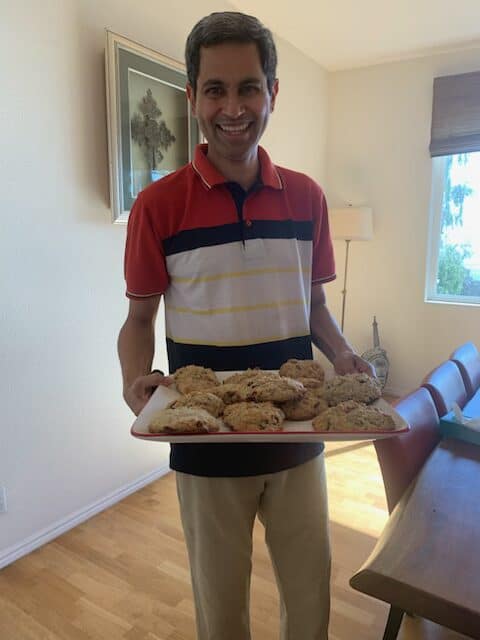
David is also an incredible baker of scones!
When to do this Yourself vs Bring Someone in
Everything in this article and in David’s Marketing Playbook Toolkit — you can work through yourself with dedicated time. The resources are built for exactly that.
You might want outside help if:
- You’ve been “doing marketing” for a while, but genuinely can’t say what’s actually working
- You’re not sure which channel to focus on, or you’re currently trying to do all three at once
- You want someone to pressure-test your segmentation, targeting, and positioning before you invest in tactics
- You’re ready to shift from experimenting to building something systematic
If you want help
David deSouza works directly with organizations in the messy middle — ones that have found their footing and are ready to grow systematically. He’s a good fit if:
- You have product-market fit, but your marketing feels scattered or disconnected from your actual business goals
- You want someone who’s been in the seat — in big organizations AND small ones — and knows what works at your scale
- You’re ready to get specific: about who you’re serving, where to focus, and how to measure it
- You want a thought partner who will tell you the truth, not just validate what you’re already doing
Connect with David!
Try it Yourself
David’s Marketing Playbook Toolkit
- Helia’s AI Guide: How to Segment Your Market 10 Different Ways — David deSouza’s recommendation as a starting point!
- The Complete Messy Middle Marketing Playbook — David’s full framework with step-by-step implementation, templates, and a six-month plan.
- The Above-the-Fold Website Conversion Checklist — The essential elements David uses to convert visitors (with credit to Nik Sharma)
Recommended Reads & Listens:
- Dave Gerhardt runs a B2B marketing community called Exit Five and has great content on LinkedIn and the Exit Five podcast/webinars
- Nerd Marketing is another good podcast
Go Deeper
- Looking for a list provider, especially one that offers matching services? David’s preferred vendor recommendation is Data Axle.
- Need a full-service web developer with a strategic marketing brain? Jesse Hodges at twoloonsoftware.com. Jesse won’t do a one-off Google Analytics setup but he’s a great resource for a slightly more comprehensive web project.
- For specific Google Analytics work or a smaller, more targeted website project: David recommends MarketerHire. Tell them what you need and they’ll have a bespoke, cost-effective solution.
Questions to Sit With
- If I asked five people on my team what our top customer segments are, would they give the same answer?
- Which of the three channels — inbound, referral, outbound — is most likely to drive new customer acquisition for our specific business?
- Do I have six months of consistent data to know what’s actually working in my marketing?
- Can someone understand what we do and who we serve within 10 seconds of visiting our website?
- Am I measuring traffic, engagement, AND conversion — or just one piece of the puzzle?
Not sure David‘s the right fit? Talk to Helia directly!
This article comes from a coffee chat with David in July 2025. These conversations form the heart of the Helia Library — because I’ve learned the most from doing and from talking with other doers willing to share their wisdom. We don’t need to start from blank pages or do everything alone.

About David
David is a president and business leader with a track record of scaling consumer brands, from mid-sized to Fortune 100. Most recently, as President of Monterey Bay Herb Co., he led a four-year transformation that doubled revenue, increased profit margins, and significantly improved cash flow.
David thrives in the “messy middle” of growth-stage companies where complexity needs simplification and culture is being shaped to deliver results. What struck me most about our conversation was his generosity in sharing what he’s learned, combined with the practical wisdom that comes from making mistakes and refining his approach over decades. He’s someone who genuinely wants to help others succeed and brings both the strategic insight and tactical knowledge to make it happen.