Long Story Short
Sometimes closing an organization or merging with another is the best way to move the mission forward. Words like merger, joint venture, fiscal sponsorship, or closure can sound intimidating, but really they’re just different “vehicles” (of many!) that a social sector organization can drive to reach its destination. If you’re wondering whether you’re driving the right vehicle, Helia Collective Member Kate Harris can help.
I recently heard a story I absolutely loved.
A women’s arts organization had been around for 75 years. This org had been instrumental in building the entire arts culture in their community — they were the ones coordinating with coffee shops and restaurants to feature local artists on their walls, making sure artists knew what kind of tape to use, facilitating the whole ecosystem. Over the years they’d expanded to include men and non-binary folks, and they did a LOT beyond just gallery coordination.
But coming out of the pandemic, the resources dried up. Ironically, their own success was part of the problem. They’d created such a robust arts community that there were now dozens of arts organizations in the area. Their legacy was the fact that the ecosystem no longer depended solely on them. AND they hadn’t evolved fast enough — they didn’t invite men in until about 10 years ago, and in the meantime male artists had created their own organizations.
So, they needed an exit strategy. They found a newer organization doing summer youth programming in the performing arts — one that had a huge campus with tons of unused studio space and energy to burn. What if they joined forces, but with the newer organization clearly at the helm? The negotiation made sense for both sides: the newer organization could expand into visual arts without having to start from scratch, and the older organization could give its members, programming, and resources a graceful landing.
They went for it. The older organization exited gracefully while its mission continued under the umbrella of the newer organization.
Did it go exactly as planned? No. Not all the members stuck around. Not all the programs continued in the same exact form. And yet, the mission lived on and new possibilities were created. At the first gallery opening of the combined entity, live musicians played for the first time — because the visual arts org was now connected to a whole performing arts community.
The part that gets me most: the board chair had poured years into keeping the organization alive, and felt like she was failing the founders by letting it end. She had seen her job as keeping the organization alive, but the process reframed things for her. Combining organizations not only meant the original mission could live on and evolve, but she finally had time for her own art again. She’s a sculptor. She got involved because she was an artist — and then spent years being an operations manager for an arts organization instead of making art.
Her best legacy for the women who founded that org? Being a working female artist in her community. She’s now back in her sculpting studio working with formerly incarcerated women, using sculpture as a means to access self-expression.
From spending her days on Zoom meetings to sculpting with formerly incarcerated women? If that doesn’t make the case that it’s okay for organizations to change, I don’t know what does.
What I just described has a name. It’s called an asset transfer — one organization dissolving and moving its resources and programming into another. It’s one of several structural moves the nonprofit sector almost never talks about: mergers, dissolutions, shared services, spin-offs. We treat them like failure or last resort, when actually they’re just… options. New ways to continue the work. New vehicles to get to our destination.
Because here’s the frame I can’t stop thinking about: every organization is a vehicle. Your mission is the destination. And the question we almost never ask — until we’re in crisis — is whether the vehicle we’re driving can actually make the trip.
I want us to normalize mergers, shared services, and closures as natural ways of evolving our work — and I want us to get genuinely excited about what being open to new organizational structures might make possible.
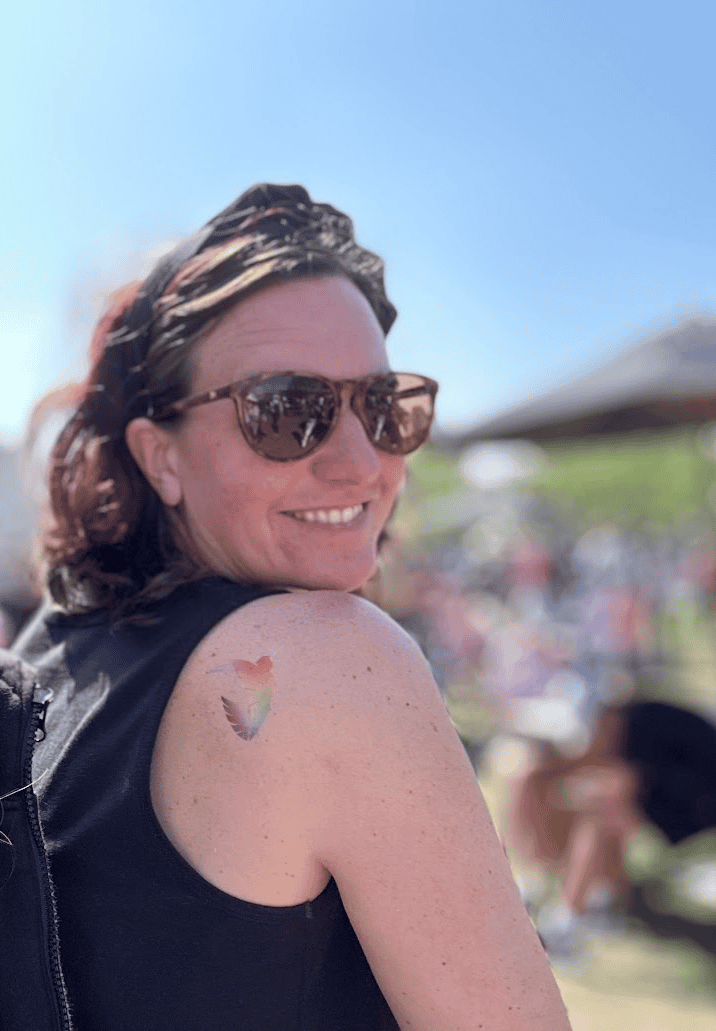
The person who brought me this story — and changed how I think about organizational structure
Kate Harris is the one who told me that story. She was the consultant who helped that non-profit find a new vehicle to carry on their mission.
Kate didn’t take the traditional finance pathway into Mergers and Acquisitions (M&A) work. In fact, she spent a good deal of her career running from M&A when she kept finding herself at organizations in the middle of structural transitions: as director of development when her organization acquired another one, working with healthcare clients going through mergers. Finally she asked, “Instead of changing jobs every time I come up against this, what if I just turned around and ran towards it?” Now she helps others navigate M&A.
What struck me most about Kate wasn’t just her expertise — it was her WHY. People sometimes assume that because Kate helps organizations close and merge, she’s trying to make the nonprofit sector smaller. Her response? “I’m actually trying to make the sector bigger. I’m trying to make the sector more influential and more effective. I’m trying to make it louder and bigger and stronger.”
Kate pushes back hard on the idea that closing or merging equals failure: it’s only failure if you believe keeping an organization open matters more than the mission it serves.
That reframe stopped me. And it’s the lens through which I think all social sector organizations should be thinking about their organizational structure.
The Key Takeaway
Kate’s core insight is that your organizational structure is the vehicle that carries your mission forward. If your mission and vision are the destination you’re trying to get to, the vehicle that gets you there is the structure. It determines who’s on the bus, what kind of bus you need, and whether you’re even driving the right thing for the journey ahead.
You can have the most compelling vision in the world, but if you’re trying to get there in a vehicle that can’t make the trip, you’re not going to make it. And sometimes — as the board chair of the arts organization learned — the most powerful thing you can do for the mission is to sell your vehicle, hop in someone else’s, and use the extra money for more gas or a faster engine.
How Kate’s process works
Step 1: Name your vehicle — give your structure a language everyone can use
You already know Kate’s core insight: if your mission is the destination, the vehicle that gets you there is your structure. What makes this more than a cute metaphor is what happens when you actually use it with your team.
Kate does this with organizations all the time — helping them think about “not only who needs to be on the bus but also what kind of a bus do we need? And is it a bus at all? Maybe we need a jet plane to get where we are going.”
She’s also pretty direct when the vision and the vehicle don’t match: “I hear organizations proclaim, ‘We’re going to solve homelessness.’ Yes, of course, let’s do that. That’s necessary. We need people to be housed, but we’re not going to get everybody there on your little scooter.” (I love that she said scooter. 😂)
And sometimes the answer isn’t a bigger vehicle for one organization — it’s pooling resources across organizations. “If you’ve got multiple organizations with multiple little scooters, what happens if you all pool your resources and buy a big old bus? Now we might actually get somewhere.”
This is where structure stops being abstract and starts being something your whole team can talk about. And that conversation alone? It’s worth the time.
Step 2: Do a check-up — inventory your organization using the Four Ps
- People — everybody who cares about, is connected to, or is affected by your mission. Staff, board, volunteers, the communities you serve.
- Processes — the back-end systems that make your organization move forward. HR, fundraising, bookkeeping, evaluation — all the operational stuff.
- Programs — what you do every day. The actual work connected to your mission.
- Purpose — your mission, vision, values. The reason all the other Ps exist.
“When all of those gears are spinning in sync with each other, that purpose wheel moves and that’s how you actually get impact coming out of your organization.”
You don’t need to overengineer this. Kate is clear about that. “It can literally be you sitting down with a pencil and a piece of paper and saying, ‘All right, if I were to think about all the different aspects of my organization right now on a scale of 1 to 10, where are we really firing on all cylinders? Where are we not doing well? What are some things that are kind of in the middle?’ And include in that list our structure.”
That’s it. Pen. Paper. Honest assessment. Kate compares it to a 27-point safety check on your car — this is that safety check on your organization so that we don’t run into a problem down the road.
Step 3: If you decide to collaborate with another vehicle on the road, set it up like a marriage, not a handshake
This one hit me. Kate says that sometimes when organizations start mapping their road trip, they notice they’re not the only car on the road. Sometimes you sell your car and get in someone else’s. Sometimes you throw your scooter in the back of a pickup and use it for special side trips on narrow roads. Sometimes you simply find another car to take the trip with and take turns drafting off the other so that the trip is sustainable.
Collaboration can look a lot of different ways. It’s an incredible tool for increasing impact — AND it has to be set up well from the beginning.
Kate loves an analogy (see all the vehicle talk), and she thinks of collaboration like a marriage. “There’s a reason why we have weddings. It’s a big deal that you’re going to do this thing with somebody else. You should probably think a little bit about it. Do some planning. Bring the people you trust into the decision and have them bless it.”
How many of us have been in collaborations that started with a handshake and good intentions and then slowly unraveled because nobody answered the hard questions upfront? (Raising my hand here.)
Kate’s point is that hard questions are going to come up whether you plan for them or not, so you might as well plan for them. The alternative is to spend time backtracking, explaining missteps, apologizing for misunderstandings — all of which could have been avoided by just sitting down together at the beginning.
The questions to answer before you start:
- How’s the money going to move?
- Who gets to make decisions about what?
- Can your partner direct your staff on shared projects?
- How will you measure impact?
- How will you determine if this collaboration is working?
- And — the one nobody wants to ask — what happens if it isn’t?
When all of those gears are spinning in sync with each other, that purpose wheel moves and that’s how you actually get impact coming out of your organization.
Step 4: Treat organizational change as preventive care — not crisis management
This is the piece that ties everything together — and brings us back to why the work matters more than any individual organization.
Most of us only ask the big questions in crisis — the funding dried up, the ED left, the government cut our contracts. Kate’s approach flips this: ask these questions when things are going well, as part of your regular strategic planning. Include “Should we exist in our current form?” and “Are we still relevant?” as regular strategic planning questions. Don’t wait for a crisis to ask whether your current setup serves your mission.
This helps normalize organizational transitions — including dissolution — as normal, necessary parts of a healthy social sector. “Our world is constantly changing and things are ephemeral. To assume that you can create an entity that doesn’t have seasons — that never changes and lives on into infinity the way it was originally set up — is really remarkable to me.”
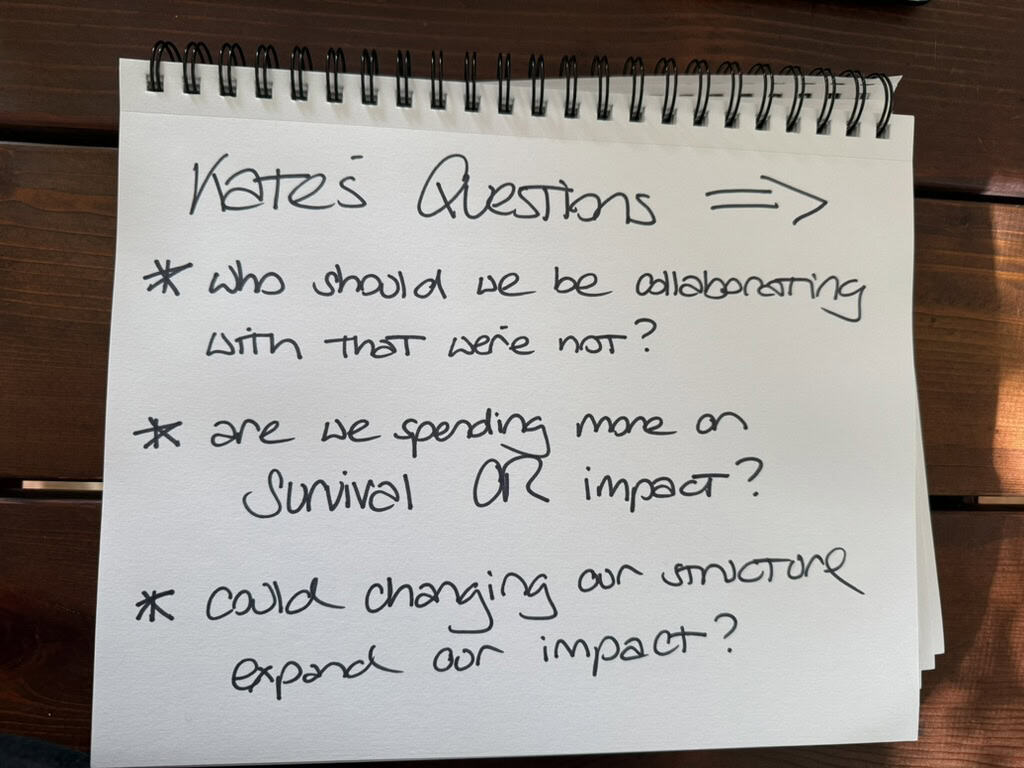
The gut check: Are you spending more energy on organizational survival than mission impact? If the answer is yes — or even maybe — that’s the signal to start having this conversation.
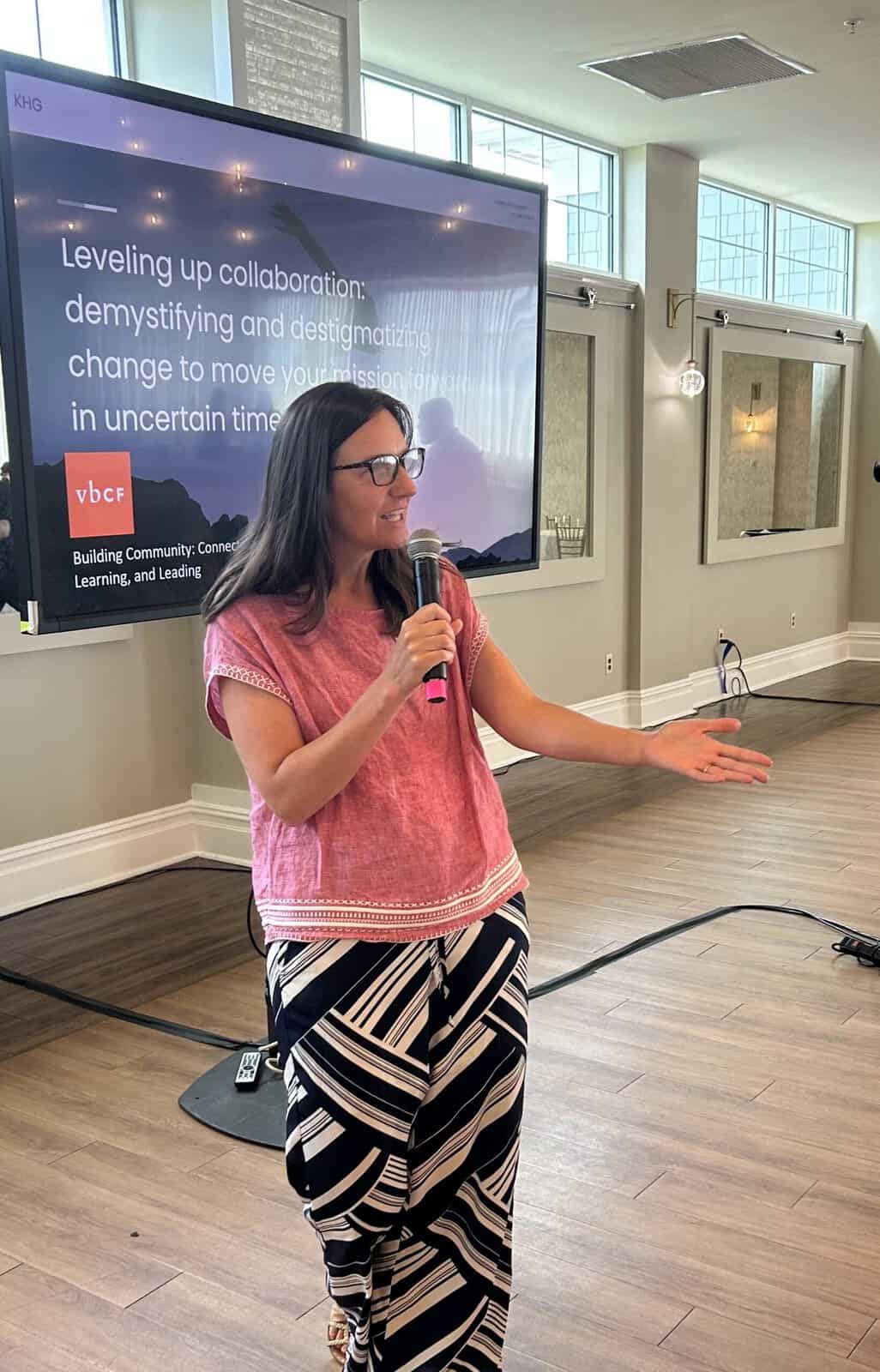
Kate leading a demystifying and destigmatization session for non-profits.
When to do this Yourself vs Bring Someone in
A lot of what Kate describes — naming your vehicle, doing a pen-and-paper Four Ps assessment, having honest conversations with your team about structure — you can absolutely do on your own. You don’t need permission or a consultant to start asking better questions about whether your organization’s setup matches your mission. Most of you reading this are probably in the pen-and-paper stage, not the merger stage — and that’s exactly right. Start there.
Consider bringing someone in when:
- You’re actively exploring a merger, dissolution, or asset transfer and need someone to walk you through the legal and operational process
- You’ve tried to have the structure conversation internally but it keeps getting stuck because people are too emotionally invested (understandable!)
- You’re in a collaboration that’s not working and need help figuring out whether it’s a clarity problem or a structural one
- You’re in crisis — funding has been cut, leadership has changed, the ground is shifting — and you need to move quickly AND thoughtfully
If You Want Help
Kate Harris helps organizations think through structural transitions — from self-assessment to collaboration agreements to mergers and dissolutions. She brings both the human side (attending to how people respond emotionally to change) and the technical side (spending an hour with a lawyer walking through bylaws clauses).
She’s a good fit if:
- You’re lying awake, wondering whether your org should merge with the group down the street
- You want to do a comprehensive organizational health check as part of strategic planning
- You’re entering a collaboration and want to set it up well from the beginning
- You want your whole team using the same language and approach
- You need someone who can hold both the emotional complexity AND the project management
Connect with Kate!
Try it Yourself
Start here (free):
- Kate Harris Group — Kate’s website with resources and her approach to organizational structure
- Sustained Collaboration Network — a roadmap for organizational transitions, plus a funder collaborative that offers grants to support structural change work
- The Wind Down Resources — Camille Acey’s collection, including the self-assessment, Closure Calls, the Museum of Closed NGOs, and more
- Kate’s Merger Mondays on LinkedIn — weekly real-world examples of nonprofit mergers and dissolutions
Recommended reading:
- Considering Closure — Kate’s article with Kate Piatt-Eckert (the piece that led me to her!)
- The Leadership Mosaic podcast Kate referenced — on seeing your career as a mosaic rather than a path
Questions to Sit With
- If your mission is the destination, what kind of vehicle are you driving right now? Is it actually built for the journey you’re trying to take?
- When’s the last time you asked “Should we exist in our current form?” — not in a crisis, but as part of regular planning?
- Is there a collaboration that’s bubbling informally that would benefit from real clarity and structure? What would change if you actually sat down and answered the hard questions together?
- Are you spending more energy keeping the organization alive than doing the work it was built to do?
- What would it look like to steward your mission well — even if it meant the organization took a different form?
Not sure Kate‘s the right fit? Talk to Helia directly!
This article comes from a coffee chat with Kate Harris in September 2025. These conversations form the heart of the Helia Library — because we’ve learned the most from doing and from talking with other doers willing to share their wisdom. We don’t need to start from blank pages or do everything alone.

About Kate
Kate Harris realized her career was more like a mosaic than a path when she kept finding herself in organizations during transitions — until she stopped running from the chaos and decided to run toward it instead. She’s a self-described nerd who can go all day on processes and leadership structures and decision-making models. Her dog is named Atlas, which feels perfect for someone helping organizations figure out how to carry the weight of big structural questions with more intention and less overwhelm.