
Long Story Short
Good 1:1 meetings aren’t about checking in — they’re about building the foundation where real feedback, real accountability, and real trust actually happen. If you’re looking to improve your 1:1s, we built you a 1:1 Toolkit with the most effective 1:1 template we’ve ever used, and guidance on how to use it well!
Jump to How!
Jess here!
At one point, I was managing 15 direct reports. Fifteen! And as I’m sure is surprising to absolutely no one, I was, well… ineffective!
While some of this was just the sheer number of humans, it was also very much my approach, which at the core, consisted of letting each person own their 1:1 time (weekly OR every other week) and use it however they needed. Some wanted to vent. Some wanted to problem-solve. Some wanted to go deep on one thing.
In part, giving folks carte blanche with how and when their 1:1s happened helped me stay afloat (especially when folks chose the every other week option), but I also thought I was being supportive — giving them agency, meeting them where they were, giving them autonomy.
Here’s the thing: even though my team was strong and we had solid relationships, I was failing them and the organization by not taking the lead about how we were going to work together as, well, their manager and the person tasked with, well, leading!!!!
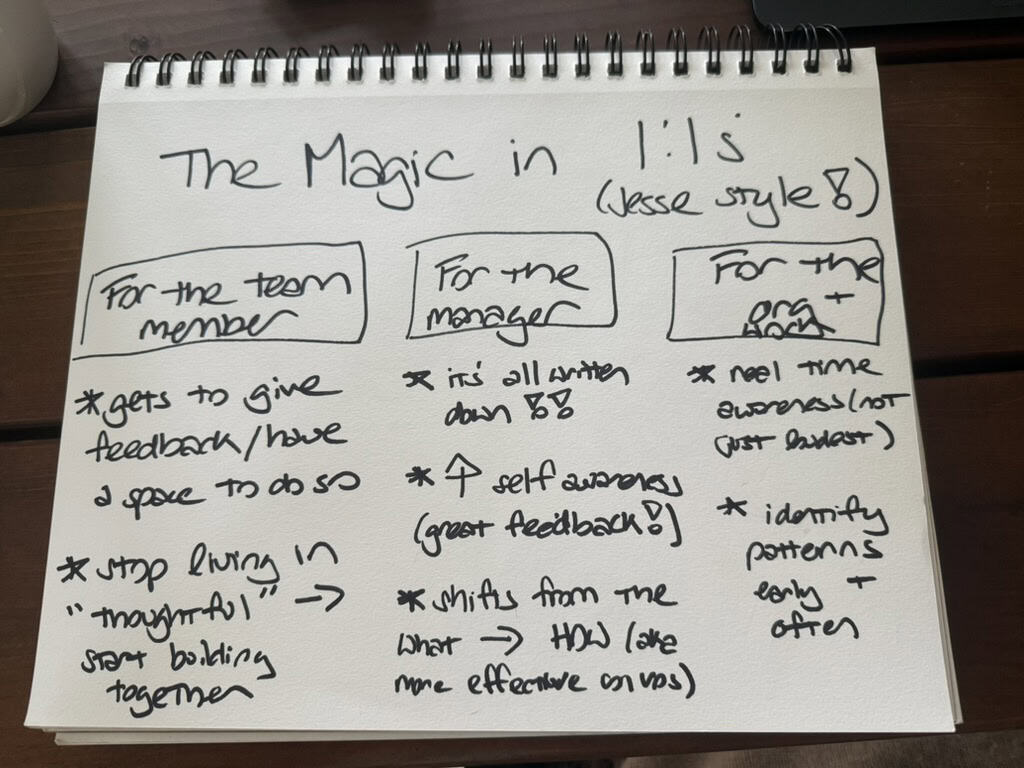
Over time, the cracks started showing:
One person wanted to solve everything herself. She’d give me an update that something was “a little off,” and I’d say “Okay,” and let her manage it. From everything she shared with me, she sounded like she had it handled. But by the time I finally dug in, she’d been struggling for months, and the situation was way harder to pull out of with way more people and clients impacted than I had understood.
Another spent our time going deep on specific team members and/or customers but never on overall goals or progress. So, shockingly, we weren’t actually making any progress.
A third only brought up technical challenges week after week. I fully jumped into solving them with her because it felt great to check things off the list. I had no idea her team was frustrated with new federal reporting requirements until it became a full-on crisis in regions across the country.
Memory and intuition can’t replace a true process that helps unearth the core issues.
The list went on. While I knew it probably wasn’t quite right, I sincerely thought that good relationships and my instincts were enough. And while both are definitely helpful, what I was actually doing was flying blind!! Memory and intuition and personality can’t replace having a true foundation and process that helps unearth the core issues so that our energy and support can be directed at the things that matter most.
The Person With A 1:1 Template That Solves Everything (no, really, she promises that it really does!)
I’ve worked with probably hundreds of managers in my career, and Jesse Noonan is one of the best I’ve seen. Seriously. She’s BRILLIANT.
When I asked her to share her secret sauce for building and leading teams, she said: “MY ONE-ON-ONE DOC!”
I was skeptical. How is a document the secret to her seriously fabulous management style? I started listing out questions and challenges managers face:
- How do you approach feedback when someone doesn’t want to hear it? “My 1:1 doc.”
- How do you push for high standards without burning people out? “My 1:1 doc.”
- How do you know when someone’s struggling before it becomes a crisis? “My 1:1 doc.”
- How do you build real trust — especially with folks who don’t open up easily? “My 1:1 doc.”

She just kept saying it. And after a few weeks of using it myself, I understood why. (I also wished she’d taught me this when we worked together at Think of Us — I could have been using it for YEARS!)
Jesse’s 1:1 Template is a simple, structured tool that brings together everything — the human check-ins, the feedback, the priorities, the data, the goals — so both people can show up prepared, have a real conversation, and actually support each other in doing good work.
The Key Takeaway
When 1:1 meetings aren’t getting the job done, it’s not because managers don’t care, but because there’s no shared structure for the things that actually matter — feedback that goes both ways, accountability that doesn’t feel like a gotcha, and space to figure out the tough stuff before it becomes a crisis.
Jesse’s 1:1 template not only creates the space for those things, it also protects the relationship between direct report and manager. When both people show up prepared, when feedback has a dedicated home every single week, and when outcomes (not just activities) drive the conversation — the relationship deepens because of the structure, not in spite of it.
Jesse’s Template
If you’re a “just give me the template, I’m ready to get started” kind of person (aka Helia’s COO Libby), you can find Jesse’s 1:1 Agenda Template in the toolkit we created for you — it walks you through everything, and we’ve included a filled-in real-life example so you can see what it looks like in practice.
If you’re a “tell me the magic behind each step” kind of person (aka our Founder Jess), read on. Here’s what we’re going to cover:
- Check In / Check Out — Set the human tone before the work starts
- 2-Way Feedback (Snaps + Deltas) — The heart of the whole thing
- Previous Meeting Action Items — So nothing falls through the cracks
- Priority Updates + Items for Your Thoughts/Help — Updates vs. actual discussion: not the same thing
- Manager Topics — The manager’s turn, near the end (on purpose)
- Data Accountability — Keeping outcomes tied to real numbers
- Outcomes for Next Week + This Meeting Action Items — Close the loop before you leave
- Backburner / Long-Term Planning — The section that keeps the big stuff from disappearing
How each section of the template makes 1:1s actually work
Section 1: Check In / Check Out — set the human tone before the work starts
Every 1:1 starts with one word or one sentence. How are you actually doing? (Note: “Fine” is not an acceptable response.)
Jesse is intentional about this. The first time she does a 1:1 with someone, she introduces it directly: “Tell me if you’re having a terrible day so we can adjust. I’ll do the same.” It’s quick. It’s human. And it sets the tone for everything that follows.
The check-out at the end mirrors this — and it matters more than it sounds. “Sometimes you start with ‘frustrated’ and end with ‘options,'” Jesse told me. That shift — from stuck to having a path forward — is exactly what a good 1:1 should do. Naming it out loud, even in one word, makes it real.
Section 2: 2-Way Feedback (Snaps + Deltas) — the heart of the whole thing
This is the section Jesse comes back to again and again. And it’s the hardest one to do well.
The structure is simple: everyone gives a snap (what’s working) AND a delta (what needs to shift). The individual goes first — feedback to their manager. Then the manager gives feedback to the individual. No skipping either one. No “everything’s great.”
“The structure creates safety,” Jesse explained. “There’s a dedicated time to say ‘This isn’t working for me.’ When people know that space exists every single week, they’re more likely to bring it up before it becomes a crisis. And on the flip side, I as a manager can say, ‘You’ve missed the mark here. Let’s talk about it.’ There’s no scary ‘See-me-in-my-office moment.'”
What Jesse didn’t expect: how much it would change her. “It grew me even more than my staff. There is nothing more valuable than getting this feedback from the folks I spend the most time with.” She laughed telling me about the direct report who could never give her a delta — every week, nothing. “I finally asked her directly: there has to be something. And eventually I realized — maybe I wasn’t engaging deeply enough with her work for her to have anything to say.” (Oof. That’s the kind of thing you only learn if you keep asking.)
A few things to know going in:
- It generally takes 1-2 months to get into the flow. Stick with it.
- Examples of deltas: “You moved too fast in that meeting.” “You didn’t articulate the project goal clearly enough.” “I needed more context before that client call.”
- Pro tip: Feed your accumulated Snaps and Deltas into your favorite AI at performance review time and ask for a draft. It’s a great starting place.
Section 3: Previous Meeting Action Items — so nothing falls through the cracks
This one is simple and easy to skip. Don’t.
Copy the action items from last week’s meeting into this week’s doc. Review them live together: “Did this happen? Great. Did this not happen? Okay — what’s the plan?” If something isn’t completed, that’s fine. Build a plan. The point isn’t to create a gotcha moment — it’s to make sure things don’t quietly disappear.
Jesse is clear-eyed about what happens without this: “I’m a person who defers to relationships. This document really helps me stay disciplined on accountability — and makes that easier.” Having it written down, agreed on together, means the accountability belongs to both people. Not just the manager.
The point isn’t to create a “gotcha moment.” It’s to make sure things don’t quietly disappear.
Section 4: Priority Updates + Items for Your Thoughts/Help — updates vs. actual discussion (not the same thing)
These two sections live next to each other in the template, and they’re intentionally different — a distinction Jesse considers essential.
Priority Updates are one-way. Two or three things the direct report wants their manager to know about, even if there’s nothing to discuss. This keeps the manager in the loop and — across a whole team — helps surface patterns they wouldn’t otherwise see.
Items for Your Thoughts/Help is where the real conversation happens. This section is for anything the direct report needs action, feedback, or a thought partner on. Jesse tries to save at least 15 minutes for this every single meeting. And critically: it has to be filled in
ahead of time, not figured out on the fly.
“Folks will sit on things and want to solve them themselves,” Jesse told me. “By the time they finally bring it, it’s charged. They’re already frustrated, sometimes to the point of tears.” The template creates a natural pressure valve — a place to at least name something as a priority update before it’s ready to become a full discussion item. That alone can keep things from blowing up.
(Note: some weeks this section will be blank. That’s fine — it means things are smooth.)
Section 5: Manager Topics — the manager’s turn, near the end (on purpose)
The manager fills this section out ahead of time, just like the direct report fills out theirs. But it goes near the end of the agenda — and that placement is deliberate.
The goal is for the direct report to be driving the conversation. Their priorities, their updates, their asks come first. Manager Topics is where the manager brings what they need to cover — but only after the direct report has had the floor.
This sequencing changes the dynamic of the whole meeting. It signals: your agenda matters here. You’re not just here to receive updates from me.
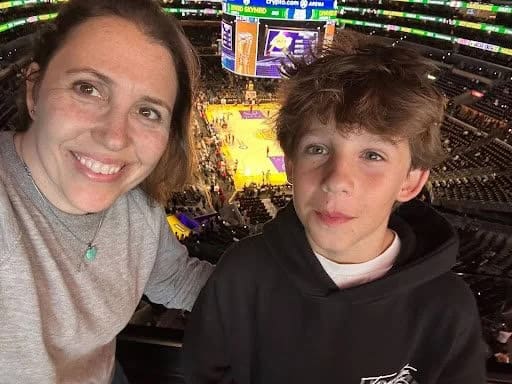
Jesse and her native Angeleno son at their first Lakers Game.
Section 6: Data Accountability — keeping outcomes tied to real numbers
Jesse added this section specifically because of her training in the Results Count framework — and it’s one of the things that makes her template distinct.
The idea: every 1:1 should include a moment where you look at actual data together, not just anecdotal updates. What do the numbers show? What are the action plans connected to them? Are we making progress, or are we just busy?
“Every single employee has grown in their ability to leverage data and set goals for next week on outcomes,” Jesse told me. “Every single one.” That’s not an accident — it’s what happens when data review is a regular, expected part of every conversation instead of something that only happens at quarterly reviews.
Customize this section based on what data the individual is actually responsible for. If your program team reviews a shared dashboard weekly as a group, this might be where you pull that dashboard into the 1:1 and connect it to individual action plans.
Section 7: Outcomes for Next Week + This Meeting Action Items — close the loop before you leave
Two sections, one goal: make sure you both leave knowing what happens next.
Outcomes for Next Week is where the direct report names what they intend to accomplish — not just what they’ll be doing. The difference matters. A list of activities doesn’t tell you if the work moved forward. An outcome does.
Here’s Jesse’s key move at the end of every 1:1: “Based on our conversation today, is this still the most important thing to achieve in the next week?” The conversation itself might have shifted priorities. This question makes sure the outcomes reflect that.
This Meeting Action Items gets filled in during the meeting, not at the end. Whenever something comes up that needs to happen — capture it right then. Before you wrap, do a quick scan together to make sure nothing got missed.
Section 8: Backburner / Long-Term Planning — so the big stuff doesn’t disappear
Every 1:1 is focused on the week ahead. This section is for everything that matters but isn’t urgent right now — the things that tend to quietly fall off the radar because they’re never the most pressing thing in the moment.
Think of it as a running list of things you want to revisit. Checking it at least weekly keeps bigger-picture goals, longer-term development questions, and slow-burn challenges from disappearing until they become a crisis.
Jesse uses this section to hold things that aren’t ready for a full conversation yet — but need to stay in both people’s line of sight.
When to do this Yourself vs Bring Someone in
Everything above? You can do it. Grab Jesse’s template, start with your direct reports, and give it three months. The structure will make you better.
You might want outside help if:
- Your managers are struggling, and you’re not sure why — it’s not just you, it’s a pattern across the team
- You’ve got first-time managers who never learned how to actually manage (and don’t have good models)
- You’re rolling out a new structure org-wide and want support making it stick (not just announcing it)
- You want a diagnostic — someone to look at your management practices and tell you what’s working and what’s not
If You Want Help Coaching or Developing Your Managers
Our contributor, Jesse, does not currently have the capacity for new clients. However, Helia Collective Member Nina Jacinto is AMAZING at this. Nina spent years as a VP of People, figuring out what actually makes managers effective (hint: it’s not HR certifications). She does meeting audits, first-time manager trainings, and helps leaders build the kind of management culture where feedback flows and people grow.
She’s a good fit if:
- Your managers are struggling and you’re not sure why
- You’re rolling out a new check-in structure and want support making it stick
- You’ve got first-time managers who never learned how to actually manage
- You want someone to look at your management practices and tell you what’s working and what’s not
What working with her can look like:
- Meeting audits and diagnostic conversations
- First-time manager training
- 1:1 coaching for leaders
Try it Yourself
Toolkit: The 1:1 That Solves Everything (Seriously!)
- Jesse’s 1:1 Agenda Template: The actual template Jesse uses with her team.
- The 1:1 in Real Life: A Filled-In Example: An anonymized, real-life example of the template in action — so you can see what good looks like before you try it yourself.
- How To Use The 1:1 Template: An annotated version of the template with guidance for new managers on each section.
Recommended reading:
- Managing to Change the World by Alison Green — The book that changed how Jesse thinks about management
- Radical Candor by Kim Scott — On caring personally while challenging directly
- Thanks for the Feedback by Douglas Stone & Sheila Heen — Essential for the receiving side
- Check-In wisdom + resources from The Management Center
Questions to Sit With
- Am I having weekly 1:1s — and actually making space for them?
- When’s the last time I got real feedback from a direct report about how I’m showing up as a manager? What did I do with it?
- Is there someone on my team who’s struggling that I haven’t really dug into yet — because they said they had it handled?
- What would be different if my team and I prepped for our 1:1s instead of just showing up?
- If I looked back at my last month of check-ins, would I see patterns? Or would I not remember what we talked about?
This article comes from a coffee chat with Jesse Noonan in March 2025 — and from my own years of being “pretty good” at delegation while never quite getting it right.

About Jesse
Jesse Noonan is one of the best team builders I’ve worked with. I’ve seen firsthand how she raises expectations, deepens trust, and leads teams with the kind of clarity and care that transforms both people and outcomes.
She’s currently the Executive Vice President of Program Success at YouthBuild Global and brings decades of experience leading people, programs, and strategy across sectors. Jesse is known for raising the bar, building trust, and keeping teams (and senior leaders) focused on what really matters.