Long Story Short
If your delegated tasks are boomeranging back to you, chances are you didn’t delegate well enough. Don’t have time to read the full article? Check out our Delegation Toolkit to find Helia Collective Member Laila Plamondon’s brilliant Delegation Template and other tools to to set your team up to delegate.
Jump to How!
The Thing I Kept Getting Wrong
Jess here!
Some peers think I’m pretty good at delegation. AND many of the people I’ve managed would probably tell you that I’ve never quite gotten it right.
My chief of staff of 2+ years basically had to train me to add context at the top of every single thing I shared. The project background. Who else was touching this work. What funders or partners were expecting. Which teams would need to be looped in.
Before she trained me, I always thought that somehow, magically, folks would just know all the things in my brain! The conversations I’d had. The context I’d read. The moment of clarity in the middle of the night when pieces fit together. Everyone was following along, right?!?!?!
Without sharing out the full context, the work boomeranged. Every question came back to me. Every decision needed me. I had to catch all the pieces and connect all the dots. The work technically got “delegated” — but I was constantly a bottleneck.
While there are SO many ways to be bad at delegation, mine was never one of not wanting to do it. It was that I didn’t tee folks up well enough to be able to take the work and run. (Oof, not proud of that!)
I know I’m not alone here. Some folks hand off work but keep the decisions. Some get really clear on what they want but not on why it matters. Some move so quickly they skip the part where they check if the person actually has what they need to succeed — and then are surprised when that person comes back with questions they thought were obvious (raising my hand here too!).
I didn’t tee folks up well enough to be able to take the work and run.
The result? None of these work — they’re all a version of boomerang delegation. Tasks that keep coming back. Decisions that pile up on your desk. And that creeping feeling that you should just do it yourself because it would be faster.
If you’re not lucky enough to have a chief of staff who will work tirelessly to train you how to delegate, learn from my mistake: Take 15 minutes to get the information out of your brain and down on paper!
The Person who Finally Gave me a Delegation Framework
When I heard that Laila Plamondon had a delegation template that was her pride and joy, I knew I had to talk to her. The skeptical side of me wanted to know if a template — which Laila credits with much of her success in running departments and supporting teams and individuals — could really do all that. But mostly I was intrigued to find something to solve this delegation problem of mine. Something that would FORCE me to get all that context and thinking and intention out there so that my team could truly run when I handed things off.
Note that I’m often “nervous” about extensive frameworks and forms to fill out. I know their value, AND I have a bias that they slow everything down. Laila immediately changed that when she described how she sees her role in the world: “I think of myself as a setter,” Laila told me. “Like in volleyball. I was a setter in high school and I was never great. But I loved the role because I could get to know my team really well and set them up to make the spike.”
She learned who liked the ball close to the net and who liked it far. “This is who I am as a professional. I have built my entire career figuring out, ‘Who do I set up next? How do I put each person in just the spot they want to be so that they’re making the spike?’“
When I heard that, I was like, YES, that is who I want to be!!!!!!

Lai is now the Senior Director of IT at Uncommon Schools, leading a team of 20. When I asked how often we should be using her delegation process, her answer was simple: “I have never regretted spending the time on creating a delegation AND I have often regretted not having the delegation.”
So, well, basically, JUST DO IT!!!!
The Key Takeaway
Most delegation conversations focus on the WHAT: here’s the task, here’s the deadline, go do it.
Laila’s approach incorporates the WHY, the HOW and the WHAT—making sure folks have all that they need so that the person can actually OWN the work—not just do it.
Laila’s Brilliant Delegation Template
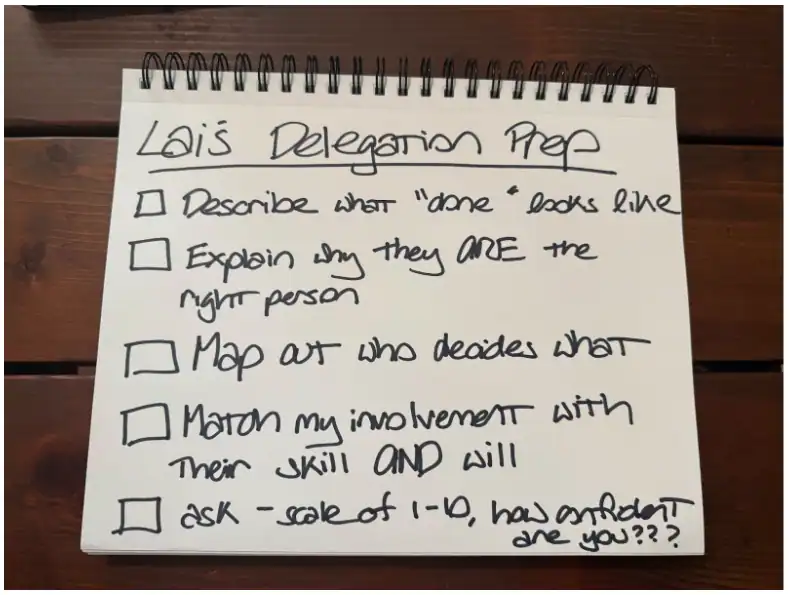
If you’re a “Just give me the template, I’m ready to get started” kind of person (aka, Helia’s COO, Libby), Lai’s Delegation Template in our Delegation Toolkit walks you through the following:
- Outcomes – What does “done” look like?
- Why This Matters
- Necessary Context
- Potential Decisions
- Priorities and Trade-offs
- Check-In Plan
- The Magic Question
If you’re a “Tell me the magic behind each step that makes this work” kind of person (a Jess), read on for the good stuff…
How these Steps Make Delegation Stick
Most delegation conversations focus on the WHAT: here’s the task, here’s the deadline, go do it.
Laila’s approach incorporates the WHY, the HOW, and the WHAT—making sure folks have all that they need so that the person can actually OWN the work—not just do it.
1. Begin at the end – get crystal clear on outcomes
“What does done look like? What is the end result?”
For Laila, especially as she manages IT project managers, she has a starting list for every project: stakeholder management plan, risk register, decision log, issue log, communication plan. But she’s also looking at the end goal of the project itself.
“This section often is the majority of the document. Even though it’s one little question, when filled in, it can be the whole first page.”
You can’t delegate what you can’t describe. If you don’t know what done and quality look like, your team definitely doesn’t.
2. Explain why this matters — AND why they’re the right person
“Most managers stop at explaining why the task is important. Laila takes it further: “A next level that I like to include is why this particular person is the right one to tackle this.”
Sometimes it’s squarely in their job description. But sometimes it’s: “I’ve seen you use communication skills that we could really benefit from in this project,” or “You have the ability to think strategically about this year and three years down the line.”
3. Lay out decisions AND name your biases upfront
“This is where Laila does something most people skip.
She lists potential decisions that might come up during the project AND clarifies who owns each one. Not for the whole org, but for this specific project.
“I start to lay out what are the potential decisions that we will have in this project. And then by decision, I start to lay out who has the decision, who’s going to recommend, and who’s going to agree.”
Then she names her bias using the iron triangle (time, budget, scope, quality):
“I could say time is everything. I need this in my hands by Tuesday. I don’t care what it takes to get there. It can be B+ quality, but Tuesday is the end goal.”
Or: “I suspect you’re going to get halfway through and need more hands on this project. I will get you resources and people power. Money’s not the issue here. It’s high quality.”

I have never regretted spending the
time on creating a delegation AND I have often regretted not having the delegation.
“My being clear about that upfront gives the owner of the work a much better sense of what I’m expecting and where I’m willing to give and take.”
Without this, people are guessing. They don’t know if you’ll be mad about a missed deadline or a B+ deliverable — so they either ask you constantly, or they guess wrong.
4. Match your involvement to their skill and will
“Think about the skill and the will of the person that you’re delegating to when determining whether you’re going to be hands-on, hands off, moderately hands-on.”
Laila maps it out: high skill (they’ve done this before, know the tools) or low skill (new to them, there’s a gap). Then high will (engaged, excited) versus nervous/uncertain.
If someone is lower skill and/or nervous, Laila is very hands-on: “I say, ‘We’re actually going to do the first hour of work together and then I’m going to send you off to do the rest.’ And because I have laid this out clearly from the beginning, it’s not a surprise when I say, ‘I want to work on this together.'”
When someone has high skill and high will? “I’ll say, ‘Run as fast and as far as you can. These are the deliverables I expect to see. I’ll pull you back if I see anything that needs pulling back.’ That’s my aim for everyone on the team.”
The key is being intentional — not hovering because you’re anxious, not disappearing because you’re busy.
5. The magic question – close the gap before you start
On a scale of 1 to 10, where 10 is completely confident, how confident are you in your ability to complete this work by the due date?”
The number doesn’t matter. It’s about the gap to 10.
“Most people say 8 or 9. And then I’ll say: ‘So I’m hearing there’s nothing else I could provide you to ensure that you’re successful because I really want you to be successful at this project.’ This usually prompts them to think of one or two more things.”
Here’s the brilliance: this becomes something you can come back to.
“When you hit all the triggers that the delegation isn’t working — work is boomeranging, quality is off — you pull up this document and say, ‘Remember when you said you were at a nine? Let’s take a moment to think about what we could have done differently.'”
And in performance situations: “In the case where you have someone on a performance plan, I believe you need to have a delegation for every single task in that performance plan and you need to get to the point where they are at a nine and you’ve documented that you have given them everything that they need.”

Leading professional development
When to do this Yourself vs Bring Someone in
Everything I’ve shared here? You can do it. If you’re willing to slow down and take 15 minutes to get as far as you can on this template, your delegation will improve.
You might want outside help if:
- Your whole team struggles with delegation — it’s not just you, it’s a pattern, and you want to build the skill across the organization
- You’re a first-time manager — and you don’t have a model for what good delegation looks like
- You’re taking on a bigger team — and what worked with 3 people isn’t working with 10
- Delegation is masking a deeper issue — you’re holding on because you don’t trust people, or because the work isn’t clearly defined, or because you’re afraid to let go
If You Want Help
Laila Plamondon coaches managers on delegation, feedback, and team leadership through Rare Bird Coach. Her approach: turn intuition into skill — step-by-step methods that make you better, not just busier.
She’s a good fit if:
- You’re a new manager and no one taught you how to actually delegate (not just assign tasks)
- You’ve been managing for years but things still boomerang back and you can’t figure out why
- You’re taking on a bigger team and what worked with 3 people isn’t working with 10
- You want your whole team using the same language and approach
- You’re stuck in the “it’s faster if I just do it myself” trap
What working with her can look like:
- 1:1 coaching
- Team training – including this delegation resource – from a half-day crash course to 4-week paced program)
Connect with Laila!
Try it Yourself
Here’s our Delegation Toolkit to help you get started:
- Laila’s Delegation Toolkit — The full framework: outcomes, decisions, biases, skill/will, and the magic question. Set a timer for 15 minutes and fill out as much as you can.
- Delegation Self-Assessment — 25 questions to pinpoint where your delegation is breaking down: behaviors (what you’re doing) or mindset (what you’re believing).
- Delegation Conversation Scripts – Language for handoffs, check-ins, and course corrections when things aren’t landing.
Recommended reading:
- Radical Candor by Kim Scott — On caring personally while challenging directly (Laila calls this foundational)
- Giving Positive Feedback – from Rare Bird — “Your job as a manager is to help your person go from intuition or happenstance to skill by locking it in.”
Questions to Sit With
- When was the last time a project I thought I delegated boomeranged back to me? What was actually missing?
- What am I holding onto that I could delegate if I spent 15 minutes setting someone up properly?
- Is my bias on each project clear to me AND to my team — time, budget, scope, or quality?
- Where am I hovering because I wasn’t clear upfront about when I wanted to check in?
- If someone else has final say on what I’m working on, have I gotten aligned with them on the parameters — or just the process?
Not sure Laila‘s the right fit? Talk to Helia directly!
This article comes from a coffee chat with Laila in October 2025 — and from my own years of being “pretty good” at delegation while never quite getting it right.

About Laila
Laila Plamondon grew up in Bangladesh as the daughter of an American diplomat, studied psychology, briefly tried being a singer in New York, and eventually found her way to technology and education. She’s now Senior Director of IT at Uncommon Schools, leading a team of 20. But what lights her up most is coaching and managing people — that setter energy, figuring out who to set up next and how.
What I loved about our conversation: her insistence that delegation isn’t about getting work off your plate — it’s about setting people up to spike.