Long Story Short
Most of us have been taught that tense moments are problems to solve — someone’s right, someone’s wrong, someone wins. Dianna Tremblay has spent years learning a different way into these moments: get curious before you get defensive, check your own regulation before you wade in, and swap “help me understand” for something that actually opens doors. In this piece, she shares the specific phrases she uses, the three types of tension she watches for, and the gut check she does every single time before she says a word.
Why We’re Sharing This Story
Jess here. I’ve been paying a lot of attention lately to what happens to me in tense moments — and what I’ve noticed is that the situation almost never determines how I show up. My internal state does.
When I’m grounded, when I’m rested, when I’m not carrying too much — hard conversations feel interesting. Like something to lean into. I get curious. I want to understand what the other person is really saying, what’s underneath it, what might open up if I ask one more question.
But when I’ve lost my center? When I’m running on empty, or I’ve got that low hum of anxiety, or I’m already behind on seventeen things, and something comes up in a meeting that rubs me wrong? I go straight to defense mode. To “I need to be right about this.” To building the perfect response in my head before the other person has even finished their sentence.
I’ve written about this — the way emotional reactivity isn’t actually about the thing in front of you, it’s almost always a sign that something is off. A sign that I’ve stopped listening from a grounded place and started performing from a defended one. AND the harder truth I keep sitting with: that even when I’m not reactive in the big, visible way, I can still be running a quieter version of the same pattern. The impulse to jump in with ideas before I’ve really listened. The need to be seen as good at this. The tiny defensiveness that shows up not as anger but as an unwillingness to be changed by what someone else says.
What struck me most about Helia Collective Member Dianna Tremblay was how none of this is theoretical for her — she has actual phrases, actual practices, and an actual gut check she runs before she says a word in a tense moment. It’s not just wisdom about conflict, but a working system she’s built over years of paying close attention to herself.
She calls it “tell me more words,” and I want to be clear — this isn’t about being nice or keeping the peace or managing your way through awkward moments. This is about genuinely expanding what’s possible in a room when something goes sideways. About refusing to let a moment collapse into who’s right and who’s wrong when it doesn’t have to.
I called her up to talk about revenue strategies, and we ended up here, and I’m so glad we did.
Dianna’s Story
This is Dianna’s story — co-written with Helia and told from her perspective!
I will say, even as a kid, I was not conflict averse. Not in an “I’m going to fight you” way — more like, “I know who I am, I know how I feel, and you’re going to hear it from me.” Which is funny because I was a really quiet kid. Like really, really quiet. I grew up in Oakland, went to school down the street, just loved hanging out with people.
There are a few things about myself that have always been true: I never lie about anything. I always want to be of service. And I’m fine with being uncomfortable — but that last part didn’t happen until I got older and finally figured out what living in discomfort actually felt like.
I learned early that not all conflict is created equal, and you don’t need to wade into all of it — especially if it has a detrimental effect on you as a person. In elementary school, I told the truth when a teacher asked who said a bad word, and the whole class stopped talking to me for almost a month. I stopped wanting to go to school. Eventually my mom helped sort it out, but that experience stayed with me: being yourself and having your values doesn’t automatically protect you from the consequences. I learned something important about when to protect myself, and what conflict is actually yours to engage.
Later, working in e-commerce, I had the highest performing team — and I would pull back from healthy conflict and debate with my boss because I felt like I was getting rolled over in terms of my value to the business. He’d say things like, “If we had more money, I’d give you a bonus, but I don’t have any money.” And I would just say “okay.” Instead of: “Let’s talk about that. What can we do? How can we work through this?” I wish I could have waded into it. But I didn’t have the confidence, or the experience yet to know what I’d say.
Now, after 11 years atICA and a lot of learning, I’m the connector. I’m the person who can pull two teams together and get to the other side. I love helping people move things forward — and when people are feeling stuck, I help them see all the layers and all the different perspectives.
One of my co-workers says this is her year to make people uncomfortable. I feel like that’s been my last two years — diving into healthy conflict. It makes me so happy. I don’t like feeling stuck, and I assume other people don’t like feeling stuck either. But not just being uncomfortable for no reason — the kind of discomfort that actually moves something forward.
What she’s learned about expanding conversations
Dianna’s approach centers on one thing: moving beyond the impulse to figure out who’s right, and instead getting genuinely curious about what’s happening underneath the surface.
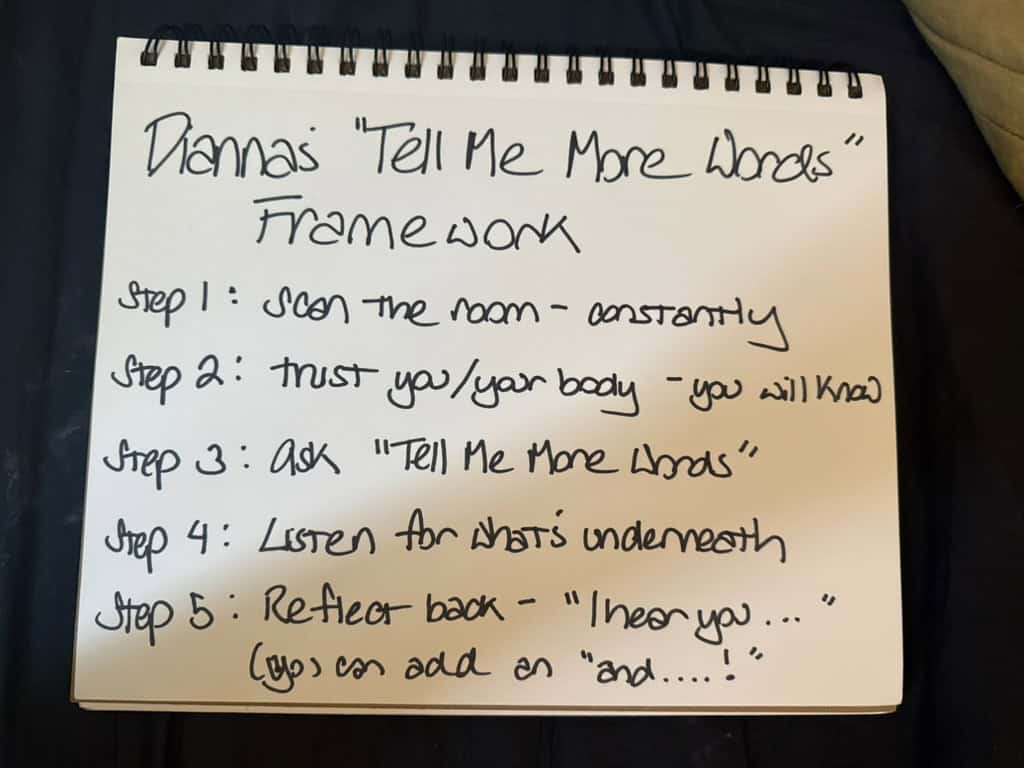
She scans constantly for what’s going unsaid. “I’m always scanning for reactions and how people are feeling. I did a DISC assessment and I’m a pure ‘I’ — the inspiring/innovator type — and part of my personality is I want everyone to have as much fun as I’m having. Most people don’t have poker faces. I can see what’s happening.” She does this not just for herself, but for the group — if she’s comfortable enough to say something, that doesn’t mean everyone else is.
She trusts her body’s signals about when to dig deeper. “It’s a feeling in my body — this uncomfortable feeling when I’m unsure if a comment is said with positive intent or negative intent. When I can’t decipher that, that’s when I know to say ‘tell me more.’”
She’s developed specific language that opens rather than closes. “I’m the first one to say, ‘Tell me more about that’ or ‘Say more words.’ I don’t say ‘help me understand’ because that can feel passive aggressive — like you’ve already decided they’re wrong. I want them to actually share more so I can feel out where they’re coming from.”
She listens for what’s underneath the words. “The words between the words, body language, what they’re actually trying to say — that’s what matters. Were they just not articulate? Are they an external processor working something out? Are they making assumptions because they’re missing context? Do they have the context but just see it differently?” Every answer points to a different response.
She reflects back before adding her perspective. “People at work say this about me: ‘You always do this thing — I hear you, I hear everything you’re saying — and then you say AND, and then you say your piece.’ I want to make sure people know I heard them. I might not agree with you, but I heard you and I respect what you said.”
I learned something important about when to protect myself, and what conflict is actually yours to engage.
Navigating different types of tension
What makes Dianna’s approach actually useful is how she’s learned to recognize three different scenarios — and respond to each differently.
When everyone agrees but something feels off (fake harmony).
This is when everyone just agrees and no one voices dissent. “Not devil’s advocate stuff — I hate that phrase — but the introduction of other perspectives with appropriate context. We don’t all need to agree on everything. That turns into groupthink and we lose the diversity of ideas.” Here are some scripts to help navigate these moments.
In the moment:
- I’m noticing we moved through that pretty quickly — does anyone want to add anything before we move on?
- I don’t know that we need to do that. Can we talk about it more?
- Are we solving something we don’t need to solve?
After the meeting: Hey, can I grab you for a conversation about what just happened?
Why it works: Sometimes fake harmony needs to be named gently. And sometimes the real conversation happens after the meeting ends.
When someone says something sideways (simmering tension).
This is the cringe “ooh” moment when someone makes a comment and everyone looks at each other. “I immediately say ‘tell me more words’ to understand the intent. Often they just weren’t articulate, or are missing context I have access to as someone on the exec team.” AND — this part matters — “even if the intent wasn’t malicious, their comments may still have had a negative impact. When that happens, I share the impact in real time. Because if you don’t, it just simmers and turns into anger or annoyance — and it will 100% of the time affect your working relationship.”
When people are already going at it (active conflict).
“I had two co-workers who cannot agree on anything — opposite sides, opposite personalities — and they were actually arguing right in front of me. I said, ‘Hey y’all, can we pause?’ and they said, ‘No.’ I realized: this is not my place at all. I’ve learned not to insert myself into every tension just because I want everyone to be comfortable.” (Note: when these are folks she’s managing, she engages more directly — not to stop the conversation but to help them navigate it.)
Dianna’s gut check before wading into any tense moment:
Ask yourself:
- Is this going to further the conversation — or get us in a rabbit hole?
- Am I entering this because it serves the work? Or because I’m annoyed/having a bad day / don’t like how they said it?
- Is my nervous system regulated right now — or am I all the way up here?
If you’re not regulated: Try 4-4-6 breathing (breathe in for 4, hold for 4, exhale for 6). Dianna does this in meetings and says no one can tell.
The key insight she keeps coming back to: “My goal isn’t to change minds. It’s adding a different piece of perception — something that might help them think through what they’re doing in a different way, or just have an expanded perspective for the future. Not to say my perception of things is 100% right all the time. I like when people challenge me too. It makes me wildly uncomfortable — and I like it.”
If You Want Help
Dianna Tremblay works with leaders and teams who want to move things forward — whether that’s navigating a transition, untangling communication breakdowns, or building the kind of culture where people actually say what they think.
She’s a good fit if:
- You’re carrying the weight of being the only one in the room willing to name what’s actually happening
- Your team has plenty of meetings but not enough real conversation — and you’re not sure how to change that
- You want to build your own capacity to wade into healthy conflict, not just hire someone to do it for you
- You’re leading through change and the gap between what your metrics show and what your people experience keeps growing
Connect with Dianna!
Try it Yourself
Templates & Guides
- DISC Assessment — Understanding your natural communication style can inform how you approach difficult conversations. Dianna’s “pure I” (inspiring/innovator) helps explain why she scans the room and wants everyone to speak up
- 4-4-6 breathing — Dianna’s in-meeting nervous system reset: breathe in for 4 counts, hold for 4, exhale for 6. “No one can tell I’m doing it.”
- Level 2 Listening — The difference between listening to respond and listening to understand
Want to use AI as a thought partner?
Copy Dianna’s phrases from the Phrase Bank into Claude or ChatGPT, then say: “I’m navigating a tense situation and want to think it through using Dianna’s approach from Helia. Interview me about what’s happening — what I’m noticing in the room, what my body is telling me, and whether this is a conflict that’s mine to engage in. Ask me one question at a time.”
Recommended Reads / Listens
- Podcast: This is Uncomfortable — Real stories about the uncomfortable parts of being human. Dianna says this helps her build a “discomfort reserve.”
- Book: Dare to Lead by Brené Brown — “You need so much personal awareness to wade into conflict. If you’re not vulnerable and courageous, you really can’t do it.”
- Book: The 15 Commitments of Conscious Leadership by Jim Dethmer, Diana Chapman, and Kaley Warner Klemp — “This was a mirror for me to explore how and why I do things and if I was approaching situations from above the line or below the line.”
Connections
- Dianna Tremblay spent over 10 years building programming, tools, and resources to help organizations grow and evolve — always with an eye toward what’s possible when people actually talk to each other. She LOVES using data to build solutions that are right-sized and reflective of the community that will use them. Connect with Dianna on LinkedIn or email her at [email protected] with subject line “Helia Connection.”
Questions to Sit With
Here are some questions or ideas to sit with after reading this story…
- What’s your internal state when you’re in tense moments — are you grounded and curious, or defended and already building your response?
- What are the conditions that throw you off center before you even get to the conversation? (Tired? Overwhelmed? Behind?)
- When was the last time you said “tell me more” instead of jumping to defend your position?
- Is there a tense situation you’ve been avoiding that might actually move something forward if you waded in?
- What could your version of “tell me more words” be — the phrase that feels like you, not a script?
- Who on your team wants to say something but isn’t comfortable saying it? What might open the door for them?
Not sure Dianna‘s the right fit? Talk to Helia directly!
This article comes from a coffee chat with Dianna in July 2025. These conversations form the heart of the Helia Library — because I’ve learned the most from doing and from talking with other doers willing to share their wisdom. We don’t need to start from blank pages or do everything alone.
As always, take what’s helpful, leave what’s not, and make it your own.
About Dianna
Dianna Tremblay is the former Chief Program Officer at ICA in Oakland, where she spent 11 years helping the organization grow and evolve. She’s the kind of person who will clean out a closet on vacation (and love it), gets genuinely excited about connecting dots between people and projects, and has perfected the art of being direct and kind at the same time.
When she’s not pulling teams together or diving into healthy conflict, she’s hanging out with rescue horses who apparently know exactly where the front door is, traveling to cabins with her family, or working with ChatGPT to make her notes more efficient.