Long Story Short
Most job leveling frameworks get built, announced, and then quietly never referenced again. Rachel Kleban’s became the backbone for everything in HR — reviews, promotions, feedback, bonuses — and the drama went down. We built you a Job Leveling Toolkit to help you tailor a job leveling framework to your organization AND roll it out.
Jump to How!
Hey, y’all! Libby here.
I spent several years as CEO of Whetstone, and I thought I was a pretty good people manager. I cared deeply about my team. I wanted them to feel valued. I gave thoughtful feedback. And when review time came around, I had a rubric — values-based, carefully constructed — and a process:
- What were your goals this year?
- Did you hit them?
- What got in the way?
What I didn’t have was any real definition of what “good” looked like at each level. And so, almost without realizing it, I did what a lot of managers do when the bar isn’t written down anywhere: I gave everyone 5/5 on everything.
My team was genuinely great. AND… not everyone was a 5/5 on everything, every day. I just didn’t have the language to say so.
The cost of that showed up slowly, in the form of one person. A leader on my team who was talented, who added real value to the organization, who I genuinely would have been gutted to lose — and who was always pushing for the next promotion, always asking for more compensation. And every time they did, I dreaded the conversation. I deflected. I gave vague answers and hoped they’d drop it, because as a human I wanted them to feel heard and valued, and as their boss I knew they weren’t ready — I just couldn’t say why.
That went on for about a year. We got acquired before I ever resolved it, and I’ll be honest: I never fixed the problem, I just passed the buck. There was no dramatic explosion, just a constant low-grade stress, a nagging distraction, and the quiet knowledge that I wasn’t being fair to someone who deserved better.
(NOTE: I’ve watched this person grow into an extraordinary leader in the years since. They got there. I just wish I’d been able to show them the path sooner.)
What I wish I could have said — what I should have been able to say — was this: “Here’s where you are today. Here’s what work at the next level actually looks like. If you want to get there, I need to see these specific things, consistently, over the next two quarters. And then we revisit.”
What I needed wasn’t a harder conversation. I needed something written down — a shared definition of what “ready” actually looked like, so we could both see it. So that we could have co-created a pathway to grow them to that next level.
The Person Who Made Job Leveling Frameworks Her Superpower
Jess got to work with Rachel Kleban during her brief stint out of tech and into nonprofits. What she remembers most is how clear Rachel was. Not harsh, not cold — just really, genuinely clear. She had this ability to name exactly what was happening and exactly what needed to change, and somehow it felt like a relief every time.
When she told Jess that her “superpower” is writing leveling frameworks, I was immediately curious AND, I’ll be honest, a little skeptical. (A framework? That’s the magic?) But then she described what she meant by it. Rachel has spent her career, from retail at Gap and Mervyns, to deep anti-bias research at Airbnb, trying to answer one question: How do you fairly and accurately assess performance? What she landed on is deceptively simple. You write down what “good” looks like, at every level, before you try to evaluate anyone against it.
She built her first real leveling framework at VSCO, a 120-person startup that finally handed her the keys: “Do whatever you want. We hired you to do this.” That’s when everything clicked and she discovered what a leveling framework could actually become in the right hands.
The moment she knew it was working, she went back to VSCO to get feedback on the new review process and talked with the employee who always had something to complain about. That employee said: “Oh, it was great. I know exactly what’s expected of me in my job and I now know exactly what I need to do to get promoted.”
“That was my HR ‘mic drop moment’ of all time,” Rachel laughed. “That’s all we want for people. Show up to work, know what you’re supposed to do, know how to do a good job today, and if you want to grow, know how to get there.”
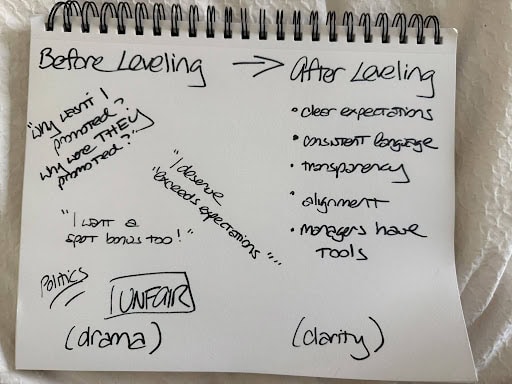
Three things. That’s the whole game: I know what’s expected of me. I know how to perform my job. And I know how to grow.
The Key Takeaway
Most performance conversations happen against a moving bar. Managers have a vague sense of what “good” looks like. Employees have a vague sense of whether they’re meeting it. So, when review time comes, that bar shifts based on who’s doing the assessing, what’s happening with the budget, or just what kind of mood everyone’s in.
To ensure you’re fairly and accurately assessing performance, write the bar down. At every level. For every competency that matters in the culture. Make that document the backbone for everything: reviews, feedback conversations, promotions, spot bonuses — all of it.
Rachel’s Process
If you’re a “just show me the framework, I’m ready to build” kind of person (aka Helia’s COO, Libby), we made you a Job Leveling Toolkit to get started.
If you’re a “tell me why each step works first” kind of person (aka our Founder Jess), read on. Here’s what we’re covering:
- Step 1 — Start with purpose: what’s different a year from now?
- Step 2 — Collect the DNA: what does “good” actually look like in your culture?
- Step 3 — Build the grid: levels × competencies = your operating system
- Step 4 — Roll it out right: train managers on translation AND the ESBI feedback model
- Step 5 — Use it incessantly: build everything on top of it
How Rachel’s Process Works
Step 1: Start with purpose — What’s different a year from now?
Rachel never starts by asking what levels you need. She starts by asking why you’re doing this at all.
“I always ask: It’s a year from now and your leveling framework’s been a huge success. What’s different in the organization?”
The answers are usually the same across organizations:
- Employees don’t complain anymore.
- Everyone knows what’s expected.
- Managers actually feel like they know how to give feedback.
That picture becomes the purpose and principles that guide everything that comes next. AND it becomes what you say to employees when you roll it out, which makes the whole thing land so differently.
“A leveling framework’s like a super gnarly HR bureaucratic thing if it’s just plunked on people,” Rachel said. “But when you say, ‘Our purpose in doing this is to make sure we can assess you fairly, and help you grow,’ it’s so much more impactful.”
This is also when you start collecting the DNA of your culture:
- Who are your most successful people, and what do you specifically see in them?
- What are your core values, and what do they look like in actual behavior?
- What skills do you need in order to hit your goals three years from now? (A lot of organizations are adding AI fluency to their frameworks right now. The ability to use new technology and adapt wasn’t on most leveling frameworks even a few months ago.)
What I needed wasn’t a harder conversation. I needed something written down — a shared definition of what ‘ready’ actually looked like, so we could both see it.
Step 2: Collect the DNA — What does “good” actually look like here?
Once the purpose is clear, you dig into the substance: what are the behaviors, skills, and outcomes that genuinely matter in your organization?
This is the research phase, and it’s more human than it sounds. Rachel spends time talking with people, reviewing values and operating principles, and asking:
- What are the things we want to measure and reward?
- What does excellent execution look like for someone brand new versus someone senior?
- What are the intangibles — communication, adaptability, growth mindset — that make someone genuinely great here?
This is also where the equity piece comes in, and it’s not a footnote for Rachel, it’s foundational. Her background in anti-bias research shapes everything she does. “Any process where humans assess other humans is inherently biased because we are inherently biased,” she said. “You can do all the bias training you want, but the most impactful thing you can do is design systems that mitigate that bias.”
Consistent criteria — the same expectations, clearly written, for everyone at each level — is what actually moves the needle. When you have them, managers assess people against a shared standard, not against each other or a vague internal gut feeling. The bar stops moving.
Step 3: Build the grid — Levels + Competencies = Your HR Backbone
Here’s what a leveling framework actually is, structurally: a grid.
- Levels across the top (IC1, IC2, IC3… Manager 1, Manager 2…).
- Competencies or behaviors down the side (scope of work, execution, communication, collaboration, growth mindset — whatever matters most in your culture).
- And in every cell: a definition of what good looks like at that level.
That’s it. That’s the whole thing.
Rachel writes hers in the second person. “You communicate clearly and concisely with your coworkers” rather than “Employee communicates clearly and concisely,” so employees see themselves in it. It needs to read like a description of a real person, not an institutional checklist.
One thing to get out of the way now: you almost certainly don’t need separate frameworks for every team or department. Rachel has watched this pattern derail projects over and over. At Airbnb, she made a company-wide framework and then asked every HRBP what functional frameworks their teams would need. The list came back at 98. “I said, ‘No thank you.'”
Start with one company-wide framework. Build for the levels you’ll eventually need, even if you’re only using three of them now. Write it simply enough that managers can do the translation in conversation: “As a level three, you’re expected to own projects end-to-end. As a marketer, that means owning a campaign from ideation through execution.” No separate framework needed for marketing.
You CAN add a single function-specific row if a team genuinely needs it — engineering’s technical expertise, HR’s competency around influencing without authority. But the expectations at each level should stay consistent across the org. The whole point is that a director in programs and a director in development are held to the same standard.
The whole point is that a director in programs and a director in development are held to the same standard.
Step 4: Roll it out right — Train managers on translation AND the ESBI model
Rachel is direct about this: “You can have a kind of shitty leveling framework, but if you lean into it and roll it out, it will have more impact than a beautiful leveling framework that you never reference.”
The rollout has two parts.
First: sit down with every person and tell them what level they are, what that means, and why you put them there. This is not optional. Especially if your organization has never had levels before. People need to hear it from a human, not just receive a spreadsheet.
Second: train your managers on two things specifically. One — how to translate general framework expectations into specific, relevant examples for their team. “As a level three, you’re expected to own projects end to end. In your role as a development coordinator, that means owning a grant cycle from research through submission and reporting.” And two — how to anchor feedback in the framework using the ESBI model.
Most managers know SBI: Situation, Behavior, Impact. Rachel recommends ESBI: Expectation, Situation, Behavior, Impact. Starting with the expectation anchors everything to something that already exists. Something the person already knows. Not “I thought you should do it this way,” but “the expectation is you do it this way, and here’s what I noticed.”
“There are no gotchas with it,” Rachel said. “Everything feels anchored in something that has already been set.”
Step 5: Use it incessantly: build everything on top of it
This is the step most organizations skip. They build the framework. They roll it out. It sits in a folder until next review season.
Rachel built spot bonuses around the framework at VSCO. Three categories:
- Scope (for people taking on significantly more than their role)
- “Building VSCO” (for ERG leaders, interview panelists, the glue work that usually goes unrecognized)
- Collaboration (no explanation needed)
Managers submitted quarterly nominations. The bonuses lived inside the framework language, which meant every time someone got recognized, it reinforced the same shared vocabulary.
For promotions? She had people fill out a self-assessment of the leveling framework at their current level AND the next level and turn it in as their business case. One document. Anchored to expectations everyone already knew.
When review time came, managers had seven competencies to rate instead of one overall score, which meant more room for specific, honest feedback that didn’t tank someone’s pay or stick to them permanently. “You’re exceeding in scope and execution, but in growth mindset you’re not quite meeting expectations.” The conversation becomes more nuanced AND more honest, because managers can be real about specific areas without feeling like they’re torpedoing someone’s livelihood.
“Talk about it all the time,” Rachel says. “Find a million ways to bring it out and use it throughout the year. Build your performance review on top of it. And then everything’s going to be peachy.”
When to do this Yourself vs Bring Someone in
You can absolutely build a solid leveling framework on your own especially with our Job Leveling Toolkit and the sample frameworks below, and a few focused sessions. It doesn’t have to be a months-long project with a big consulting price tag.
Consider bringing in outside support when:
- You’re doing this for the first time with 50+ people and need it to land with credibility
- You’ve had significant performance-related conflict and want the framework to feel neutral and fair from day one
- You want the rollout plan, manager training decks, and communication plan built for you — not just the framework itself
- You’ve been putting this off for years and just need someone to make it happen
If You Want Help
Our author, Rachel, is not currently taking on new clients, but Helia Collective Member Nina Jacinto is an incredible talent strategist.
Nina’s a good fit if:
- You’ve been putting this off because it feels too complicated or too “corporate.”
- You want a framework with anti-bias research genuinely baked in
- You need the rollout support, not just the document
- You want something that will actually get used
Connect with Nina!
Try it Yourself
Job Leveling Framework Toolkit:
- DIY AI Job Level Framework —A step-by-step guide for using AI to build a leveling framework tailored to your organization, complete with prompts for every stage of the process.
- Guide to Rolling Out Your Leveling Framework — A structured walkthrough for introducing your new framework to your team — from preparing managers to hosting individual conversations.
- Helia’s Sample Job Level Framework — Helia’s actual Job Level Framework with success criteria for roles from Associate all the way to Executive.
Recommended reads:
- Leveling Frameworks: A Step-By-Step Approach — Rachel’s own blog post on the philosophy and the how-to
- Beyond SBI: How Adding Expectations Transforms Feedback — Rachel’s piece on ESBI
- The SBI Feedback Model — the original model from CCL
Questions to Sit With
- What “noise” are you currently hearing around performance, promotions, or fairness — and how much time are you spending managing it?
- If you asked five people on your team what “good” looks like at their level, would they give you the same answer?
- When was the last time someone got promoted and others were surprised — or quietly frustrated — by it? What was missing from that conversation?
- Are your managers giving feedback anchored to clear expectations, or to their own shifting sense of what good looks like?
- What would change for your team if everyone could say: “I know what’s expected of me. I know how to perform my job. And I know how to grow”?
Not sure Nina‘s the right fit? Talk to Helia directly!
This article comes from a coffee chat with Rachel in June 2025. These conversations form the heart of the Helia Library — because we’ve learned the most from doing and from talking with other doers willing to share their wisdom. We don’t need to start from blank pages or do everything alone.
As always, take what’s helpful, leave what’s not, and make it your own.

About Rachel
Rachel Kleban has been in HR longer than she wants to admit — from retail to tech to building her own company. She’s that rare combination of deeply practical and refreshingly direct: the person who can tell you exactly where you are, AND exactly what it takes to get to the next level.
Connect with Rachel