Long Story Short
Most leaders care deeply about their teams and want to do right by them, but the gap between wanting to and actually doing it often comes down to systems and structures. Jump to How to see the structures Adanta Ahanonu uses to build a culture with her team, and check out her Thriving Teams Toolkit!
Jess here!
One of the things I’m most proud of in my career is the team I built at Revolution Foods. We were doing hard, important work, and I cared deeply about the people doing it alongside me. I mean, I was on a call after every single team meeting, mapping out every hard conversation that might need to happen, and thinking through how to design the next thing so we could keep building together. My heart was absolutely there.
AND, I had zero structure for any of it.
It was pure momentum. Pure instinct. Pure “this is what matters and I will pour everything I have into it.” Which worked, until it didn’t. Because when you’re running on heart and drive and no framework, you either burn yourself out or you burn out the people around you. All because they can’t keep up with the pace of your caring. I wanted so badly for our team to be great that I sometimes outran everyone, including myself.
I look back on those years and I think about those people. The ones who showed up every day to do genuinely meaningful work. I wonder how much more I could have given them if I’d had the how to match the why. How much more energy we all might have had. How much further we could have gone together.
These days, I’ll be honest. I love my small team. Like, a-team-of-five-feels-like-the-right-size-for-me-right-now love it. The season of leading big teams and doing all the things feels, in many ways, behind me. But a recent conversation made me think: maybe, someday, I’d have it in me again. That surprised me. Because the person I’m about to introduce has figured out something I never quite did. She has the heart AND the how. And it makes me wish I’d known her about 15 years ago.
The person who has the heart AND the how
When Connie Mistler, Helia’s first Chief of Staff and one of the people whose judgment I trust most, introduced me to Adanta Ahanonu, she said this: “Adanta is amazing at many things, particularly building really effective, fun, and inspired team culture. She’s the first person I thought of when you said you wanted to do an article on good teams.” That’s a high bar, and Adanta cleared it easily.
Adanta is the first Chief Program Officer at COOP Career — an organization helping upskill first-generation and low-income college grads so they can broaden their career trajectory — where she leads strategy and programs across multiple cities and nearly 2,000 fellows a year. Before that, she spent six years at Year Up United, another national nonprofit that scaled its impact from 10 to 30 cities during her tenure.
She grew up in Arizona as the oldest of four, the daughter of immigrants from East and West Africa. She’ll tell you that the mentors who showed up for her family— the ones who gave them access to information and opportunities they wouldn’t have otherwise known existed — are the reason why her work building teams where people feel seen and supported isn’t just a management philosophy. It’s personal.
Here’s what makes my conversation with Adanta different from every other “great team culture” conversation I’ve had: she doesn’t just care deeply about her team, but has built deliberate systems so that care shows up consistently, even on a hard week, even in a virtual environment, even through a reorg. Systems like:
- The color-coded calendar.
- The Slack shoutout channel, to which she responds to every message.
- The way she organizes the rest of her Slack channels to help prioritize her replies.
- The warm-up question with rotating facilitators at every meeting.
- The structured one-on-one agenda templates that start with a human check in.
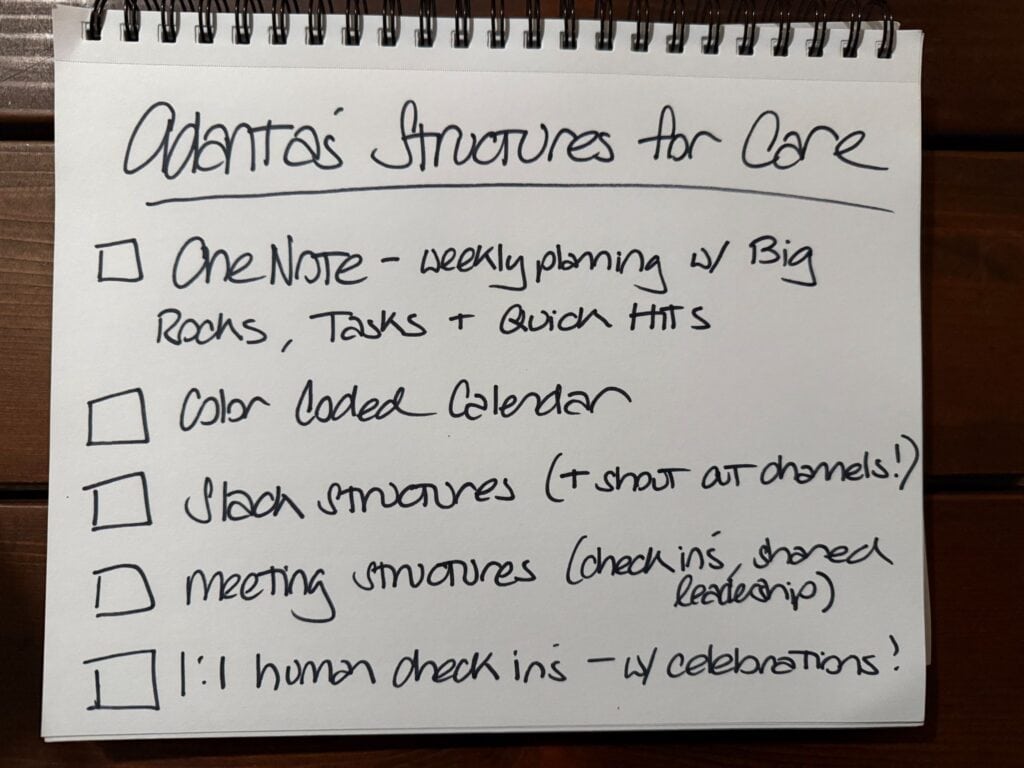
- The OneNote big rocks/tasks/quick hits system she shares with every new hire.
The structures aren’t separate from the love. The structures ARE the love.
The Key Takeaway
Most leaders care deeply about their teams and want to do right by them. But the gap between wanting to and actually doing it consistently? That often comes down to the systems and structures that make it possible, especially when there are a million priorities and fires to put out.
Adanta’s approach is built on exactly that. She doesn’t hope connection happens on her team. She builds a structure to ensure connection happens every single day (sometimes, every single touchpoint!), regardless of what the week throws at her.
Adanta’s Approach
If you’re a “just give me the steps, I’m ready to get started” kind of person (aka Helia’s COO, Libby), here they are:
- Step 1 — Build your own structure first: the personal systems that enable you to show up consistently for your team
- Step 2 — Design for human connection: create deliberate rituals that make people feel seen, not just managed
- Step 3 — Create clarity so people can fly: role clarity practices that reduce confusion and build trust.
If you’re a “tell me why this works” kind of person (aka our Founder, Jess), read on for the good stuff!
Step 1: Build your own structure first
Here’s something I didn’t expect from this conversation: Adanta starts with herself.
Before she talks about team rituals or meeting design or culture-building, she talks about the systems she built for her own work. The ones that let her show up consistently, follow through reliably, and build credibility with her team before she ever asks anything of them. Because you can’t pour from an empty cup, and you can’t build trust with others if you haven’t built the structures that help you keep your word.
For Adanta, that starts with her weekly planning system. Every day, in her OneNote there are three sections: big rocks, tasks, and quick hits. This is a prioritization framework she learned during a professional development training for staff early in her career.
“At the beginning of each week, I look at my calendar and my priorities, and then for every day that week I will note, ‘Okay, here’s what I want my big rocks to be.’ These are the top three to five things that I cannot close my laptop until they are done. Tasks are things that generally might be able to move back and forth a day or two. Quick hits are usually things that take under five minutes.”
Simple? Yes. The point isn’t the system itself, but what the system does. “Setting that structure up helps hold me accountable for deliverables I need to get to other people. Am I meeting that expectation, or proactively following up to say, ‘Hey, actually, I’m not going to be able to get to you until this date’?” Credibility, she says, is built through consistency and follow-through.
The second piece of her personal system is her color-coded calendar. For example,
- Yellow for external meetings
- Red for 1:1s
- Purple for team meetings
“I can start my day and say, ‘Wow, I have a lot of red today, that means I have a ton of one-on-one meetings. Or, oh, I have a lot of external-facing meetings.’” It sounds like a small thing. It’s not. It means she’s never going into a meeting cold. That she’s already in the right headspace, and already thinking about what needs prep and what needs follow-up.
Then there’s Slack. At COOP, Slack is where the work currently lives — staff, fellows, alumni, all of it. When Adanta joined, she immediately organized her channels into sections:
- Exec team
- Direct reports
- Program success
- Recruiting, and
- “Interest groups” — a bucket for things like the good news and shared knowledge channels
- And so on!
“That helps me throughout my day to understand how to prioritize the urgency with which I’m reviewing the message and following up. If I see something under interest groups, I know that’s not an immediate priority — I can look at that at the end of the day. If I see something under my direct reports section light up, that’s an indication: that one of my directors may need a response from me to proceed with their work.”
And here’s the move that makes this feel like Helia: when she onboards a new team member, she shares all of it. Not as a mandate but as an offering. Here’s what works for me. Adapt it if it’s helpful. “I’ll introduce them to my color-coded calendar, to the OneNote, to my Slack sections — so that they too, can implement those resources to stay organized within our org’s context.”
You model what you want to see. And you need a solid foundation first. You can only model it if you’ve built it.
Step 2: Design for human connection
This is the part people either love immediately or eye-roll at first. The Welcome Buddies. The warm up questions. The affirmations. The shoutouts.
“Getting to know each other on a human level often feels so simple it’s silly, but it is core for building a foundation of trust and respect.”
So let’s talk about what it actually looks like.
When a new staff member joins COOP, they’re assigned a Welcome Buddy — someone from a different team and sometimes a different level, whose whole job is to help that person acclimate. Not to their role, but to the culture, the norms, the acronyms, the humans. This is a practice she brought from her time at Year Up United and has now become operationalized at COOP. “The whole purpose is for the new hire to actually get to know someone, to start to build that connection, and also build an understanding of how other teams function at the organization.”
Next, every team meeting starts with a warm-up question and closes with an affirmation, a responsibility that rotates. Everyone gets a turn to set the tone. This is an organizational norm at COOP that Adanta has been intentional in continuing to model as a leader.
For her Monday Directors Standup Meeting, instead of going around verbally, she puts everyone’s team name at the top of the agenda and invites each attendee to write in their name and a weekend highlight if they want to share. “It gives people the space to open up and connect”. Last week, someone wrote that it had been an unexpectedly hard weekend and that it would be a tender week ahead. “It just allows us to come together in a way that supports and honors all the different ways people want to show up.”
And in every 1:1, Adanta starts the same way: a human check-in.
- Where is your energy meter this week? Full / Semi-full / Half / Semi-empty / Empty?
- What’s one achievement you’re most proud of recently?
- Individual/team wins to shout out and/or post on Slack?
That last question? It’s not just nice. It’s strategic. “These are opportunities to champion and celebrate my team publicly, and help folks stay motivated in the work they’re getting to do.” When one of her leaders names a specific colleague on their team in a 1:1, Adanta doesn’t just file it away. She sends that colleague a direct Slack: ‘Hey, I just heard from your supervisor what you did in that meeting. Thank you.’
“Those little moments then help that team member feel motivated because wow, my boss is talking about me in a meeting with their boss, and now that person took the time to reach out to me.”
There’s also a #Shoutouts channel in Slack. A place for quick, public appreciation across teams and departments. “Really beautiful ways for folks, even in this virtual space, to feel seen in just the day-to-day wins that are happening.” At Adanta’s former organization, they called this the #Gratitude Channel and it was a meaningful way to elevate and celebrate team members. “I was excited to champion this channel at COOP and I love how frequently it’s now used to shout out team members across all levels of the organization”.
Now — what about the folks who aren’t immediately on board? (Because there are always those folks.) Adanta has a move for that too. She assigns them the warm-up at the start of the team meeting. “I’ll say, it can be asking folks about a TV show, or about a recent vacation, but I am going to ask everyone, in each meeting, to identify a way to bring others into this space.” People who were initially like no way end up highly competitive in a team Kahoot game, or asking everyone about the last plant they bought as their warm-up question, or, and this is a real story, participating in a lip sync battle that the whole team (and students!) rehearsed for after work. “I still can’t believe we convinced our entire site to do that at the time! But people committed, and then the next program cycle, staff were like — Wait, are we doing the lip sync battle again?!”
She always shares the why. Not as a lecture, but as an invitation. “We spend a lot of our lives with the people we work with. That means we need to know each other as humans — beyond the weather, beyond the weekend.” Initially, maybe the first two people are uncertain, then people kind of start to get into it more. Most of the time, folks have come around to it but it must feel genuine and first meet them where they are at.”
Humans are tribal beings and are oriented towards community. When people find moments of shared commonality, they yearn for that in ways they sometimes forget.
The connection isn’t the reward for doing the work. It’s the fuel.
Humans are tribal beings and are oriented towards community. When people find moments of shared commonality, they yearn for that in ways they sometimes forget.
Step 3: Create clarity so people can fly
Connection without clarity is just vibes. Adanta insists both are required for a team to fly.
“I was finding for a while that we’d be finishing a project, or we’d be in the middle of a project, and we weren’t clear on who owned what.” So she did what she always does: she went to her network. She asked peers and mentors what their organizations used, and one framework kept coming up: RAPID — a decision-making tool that clarifies who Recommends, who Agrees, who Performs, who Inputs, and who Decides on any given decision.
She then brought it to COOP and once a decision was made, she layered in The Management Center’s MOCHA framework for project role clarity — who’s Managing, Owning, Consulted, Helping, and Approving. (There’s an easy explainer in the toolkit!)
What she’ll tell you right now is this: it’s not about perfect implementation. “We’re still continuing to improve on how we leverage the framework”. It is about having a shared language so that when things get murky, you can get clear fast. “Someone can be in a meeting with me and say. Wait, Adanta, who’s the D on that? And then we’ll quickly, in two seconds, type out: okay, RAPID. We think this person’s R, this person’s I, this person’s D. Great. Now that person shares with their team.”
It’s a norm now, not a perfect process. And that’s the goal — not a framework people follow dutifully for every single decision (although COOP works hard to prioritize documentation for all large decisions), but a language people reach for naturally when they need it.
Clarity isn’t bureaucracy. It’s a gift you give your team so they can do their best work without having to guess.
When you do the structure work, here’s what happens
What this looks like in practice is a team that has real resilience. The strength to do good work when things are smooth AND to stay grounded and trusting when things get hard. This works because the foundation is already there — built in the ordinary moments, available when the extraordinary ones arrive.
When COOP went through a reorg, something unexpected happened. “The number of people, even those who were impacted, were like: ‘This is really hard, this is really sad. AND I trust you.” Not because of any single gesture. Because of accumulated evidence that I do everything in my power to do right by them. Because the foundation was already there. “I trusted you before and I still trust you, even though this is really hard.”
What this means for how you lead: the trust you build in the good times is the trust that carries everyone through the hard ones. Trust creates high retention. It creates teams that weather storms without falling apart. It creates staff who show up for each other within and across departments because they genuinely know each other. None of it comes from one single initiative or one well-designed offsite, but from a leader who decided this mattered, built the structures to make it real, and then stayed the course.
The culture you build in the ordinary moments is what carries everyone — including you — through the extraordinary ones.
When to do this yourself vs bring someone in
The good news: almost everything Adanta shares here, you can start on your own. Pick one thing from her toolkit. The weekly planning system, a warm-up question at your next meeting, a shoutout channel in Slack and just begin. You don’t need to overhaul your whole approach at once. You need to start somewhere and stay consistent.
That said, there are moments where a thought partner makes all the difference:
- You’re stepping into a new leadership role and want to build the culture intentionally from day one
- You’re managing a virtual or hybrid team and the connection keeps feeling thin no matter what you try
- You’ve been through a hard organizational moment — a reorg, a leadership change, a team that’s lost trust — and you’re not sure how to rebuild
- You want to implement something like RAPID or MOCHA and aren’t sure how to introduce it in a way that actually sticks
- You’re a strong leader who genuinely cares AND you have a nagging sense that the “how” isn’t quite matching the “why”
If you want help
Adanta has her hands full at COOP but fear not: Helia Collective Member Leah Peters is amazing at building and repairing culture.
If you’re reading this and thinking “I want to build this foundation but I’m not sure we’re starting from a great place,” or if you already know your team dynamics are off and you need to reset before you can build, Leah is extraordinary at exactly that. She’s spent nearly two decades leading and resetting teams, and she will tell you straight: the leader is always the primary contributing factor. (Ouch. Also: good news, because it means you can do something about it!)
She’s a good fit if:
- You want to intentionally set up structures to drive human connection
- Something is clearly off on your team and you’re not sure where to start
- You’ve been through organizational change and trust needs rebuilding
- You keep having the same conversations over and over and nothing is shifting
- You want someone who will help you own your part and then give you a real path forward
Connect with Leah!
Try it Yourself
Here’s Adanta’s Thriving Team’s Toolkit to help you get started:
- Adanta’s 1:1 Agenda: Her ongoing 1:1 template, with the human check-in built into the top of the page.
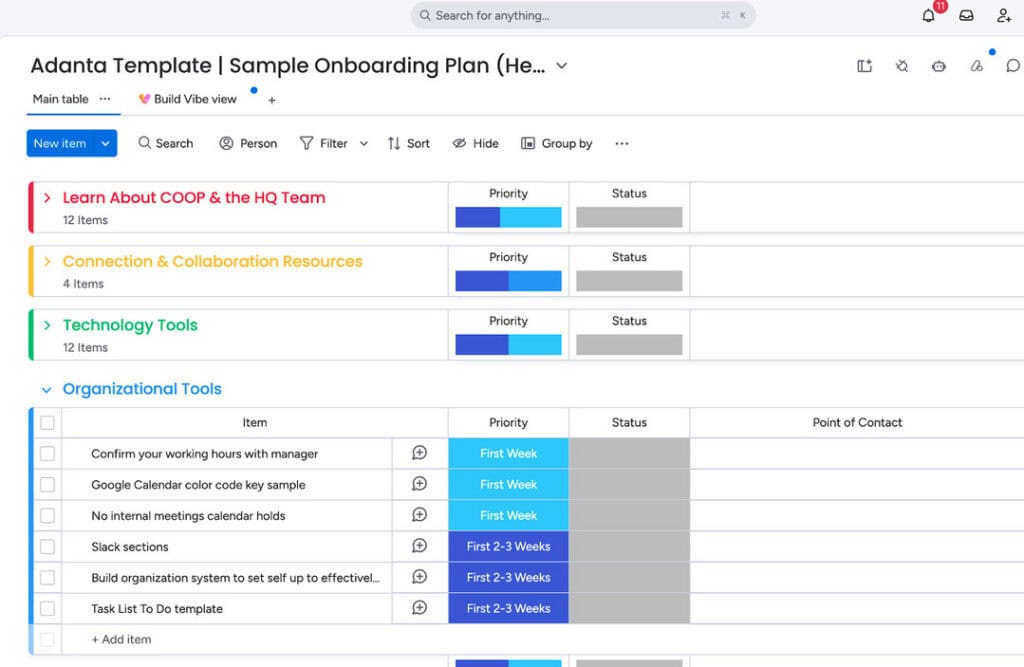
- Adanta’s 30-Day Onboarding Plan: The Monday.com board she builds for every new hire — grouped by week and by category, with owners, priority levels, and the actual files attached.
- Adanta’s RAPID + MOCHA Explainer: The one-pager she wrote when she introduced both frameworks at COOP, explaining which one does what and why the order matters.
Questions to Sit With
- Where in your leadership are you relying on intention without the structure to back it up — and what’s one thing you could build this week to change that?
- When did someone on your team last feel genuinely seen by you — not for their work output, but as a human? How do you know?
- If your team went through something really hard tomorrow, what foundation would they be standing on? Is that the foundation you want them to have?
- What’s one thing you do consistently enough that your team could count on it? What’s one thing you mean to do but keep letting slip?
- What would it look like to model, for your team, the kind of leader you want them to become?
Not sure Leah‘s the right fit? Talk to Helia directly!
This article comes from a coffee chat with Adanta Ahanonu in February 2026. These conversations form the heart of the Helia Library — because we’ve learned the most from doing and from talking with other doers willing to share their wisdom. We don’t need to start from blank pages or do everything alone.
As always, take what’s helpful, leave what’s not, and make it your own.
About Adanta
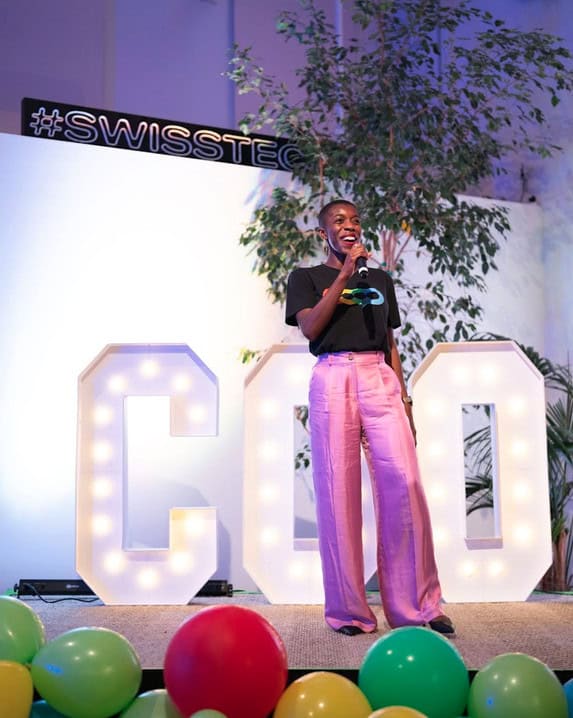
Adanta Ahanonu is a nonprofit executive leader with expertise in program management at the intersection of workforce development and higher education, passionate about creating pathways for underrepresented young adults to access the careers they deserve. She currently serves as the first Chief Program Officer at COOP Careers, a national nonprofit focused on overcoming underemployment for first-generation and low-income college graduates by helping them build the skills, networks, and confidence they need to land their first high quality job.
She grew up in Arizona as the oldest of four, the daughter of immigrants from East and West Africa, and she’ll tell you that the mentors who showed up for her is exactly why building teams where people feel seen and valued isn’t just a leadership approach for her. It’s a through line that runs from kindergarten (yes, she once offered to watch her class while the teacher stepped out — she was five) all the way to the work she does today.