Long Story Short
Long story short: Layoffs happen. They are messy and hard on everyone involved. Having a game plan for before and after will help you navigate a tough reality of organizational leadership while maintaining your integrity and ensuring those let go are taken care of. Helia Collective Member, Nina Jacinto, created a Layoff Guide to get you started.
I’ve been on both sides of layoffs, and I can tell you: they are brutal every single time. No version of this is easy.
The first time it happened to me was at Rev Foods. I loved that job. Everything from the mission to the team. I loved that we were actually changing what school food looked like at scale. And I worked hard. We’re talking 100+ hour weeks. I gave it everything. One particular year, we really hit our goals: customer retention, sales targets, all while keeping our teams intact. Things that I was genuinely proud of. Things that were not the norm. And layoffs happened anyway.
That one hit differently. I’d worked so hard, the system was working, and it still happened; the rug, pulled out from underneath me. It changed my relationship with work and with Rev Foods in ways that were hard to name at the time. I felt unseen. Like what I’d built didn’t quite count. Like the job I thought I had and the job I actually had were two different things.
What it taught me, slowly and a little painfully, was something I’ve held onto ever since: an organization’s job is not to employ people. It’s to further its mission. Rev Foods’ work was to make and serve healthy school meals. To change what school food could be. They offered me a salary to do a job in support of that mission, and I said yes. That’s the arrangement. And within that arrangement, there was a question that mattered enormously. How do you treat people when hard things happen?
Years later, when I was the one planning layoffs — sitting on the other side of the table, figuring out the how — I thought about that feeling a lot. I had thicker skin by then. I was more grounded, but I also understood, from the inside out, why it matters so much to do this well. Not just for the people leaving. For everyone who stays. For the culture that has to keep going after.
All organizations face tough realities and, at some point, you’ll have to do the hard thing. But you get to decide how you do it. And that decision, that commitment to integrity even when no one will thank you for it, is everything.
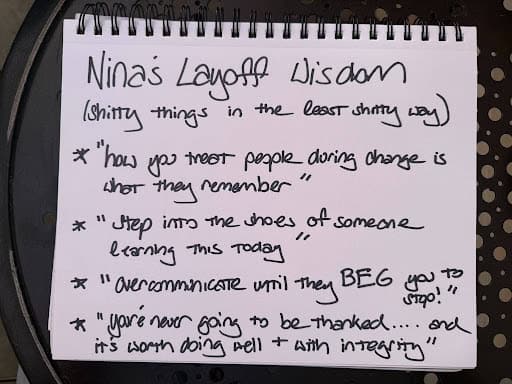
The person who wrote the guide for doing a shitty thing in the least shitty way
Nina Jacinto and I go way back. We worked together around 2009, when we were both very young and probably figuring out a lot more than we let on. I have watched her career from afar ever since, so when I saw some of the work she was sharing with clients recently, I was like: ‘Nina!’ and immediately reached out.
She didn’t plan to become the person organizations call when they need to do layoffs with integrity. It happened the hard way: she managed five layoffs in five years, starting in 2015, and just kept learning about what works and what doesn’t. About what people remember, and what actually helps organizations come out the other side. She’s now a people operations strategist who works with nonprofits and startups on the hardest parts of organizational life: performance management, reorganizations, and change that actually sticks. Her background is deep in the social sector. She came up through grant writing, internal operations, and culture work. She brings a perspective that holds true to both human reality and organizational necessity.
Then there’s the guide she created. She named it exactly what it is: “The Layoff Guide: A guide for HR Professionals to do a Shitty Thing in the Least Shitty Way Possible.” As titles go, I think it might be my favorite thing. Because that’s the reality. No sugarcoating. No pretending this is a good day. Just: here’s how to do it with integrity, because that part is within your control.
Overcommunicate until they BEG you to stop.
The Key Takeaway
Here’s the thing Nina says that I keep turning over: “No one will ever thank you for doing a layoff in a good way. BUT it is still worth doing it well.”
That BUT is doing a lot of work.
Because it’s true on both sides. The way you handle it is what defines your organization’s culture going forward. It’s what the people who stay remember. It’s what the people who leave tell others. It makes the difference between a team that recovers and rallies and one that quietly unravels.
If you’re a “just get me the framework” kind of person (aka Helia’s COO Libby), Nina’s Layoff Guide walks you through:
- Decision-making frameworks for determining who to lay off and how to document rationale equitably
- A communication strategy built around overcommunication — town halls, anonymous Q&As, team lead follow-ups
- Scripts for the hardest conversations, for both departing employees and the team staying behind
- Separation package guidance: what to offer, how to think about it, and why generosity is strategy
- A full offboarding checklist and a “taking care of you” section for the HR and people ops folks carrying this
If you’re a “tell me why this works” kind of person (aka Founder Jess), read on.
What Makes Nina’s Approach Work
Step 1: Build your whole process around the people who are staying
This is Nina’s most counterintuitive piece and also the one that reframes everything else.
Most organizations spend the bulk of their energy on the logistics of the layoff: who’s leaving, the paperwork, the offboarding, the legal sign-off. All of that matters. But Nina’s first question is always: what about Sally, who has been here for four years, who you absolutely want to keep, and who is about to have a very hard day?
“I’ve been thinking a lot about organizations getting so scared of the folks who are leaving,” she says. “And I’m like, you need to understand that takes away from the people who are doing a good job. Put your attention into the people you want to retain. It’s actually extremely strategic to pay attention to the people you want to hold onto.”
This shapes everything from who’s on your planning team (small, need-to-know, people who know your culture and your high performers) to how you document rationale. Nina is specific here: document not just who’s leaving and why, but how you anticipate each individual will receive the news so you can tailor follow-up thoughtfully. The question underneath all of it: is Sally still going to be here in a year? Did I get her on board?
Step 2: Remember — announcement day is their day one, not your finish line
One of Nina’s most important reframes: leadership has been sitting with this decision for months. They’ve processed it, grieved it, gotten clear on it. They might feel, by the time they announce it, like they’re wrapping something up.
They’re not. For everyone else, it’s day one.
That reframe matters because it changes how you think about communication. The temptation for leaders who’ve been carrying this for a while is to say it once, clearly, and move on. Nina’s approach is the opposite: overcommunicate until people ask you to stop.
- Meet with every person you can on the day of.
- Give people a heads-up so changes aren’t coming out of nowhere.
- Weekly town halls and an anonymous question form, every week.
- Team leads who follow up with their people not just the day in question, but the week after and the week after that.
- Choosing your launch day deliberately: who’s on vacation? What deadlines are looming? Is leadership actually available for the two weeks that follow?
“What you want is for people to be so annoyed that you’re still talking about these changes and still willing to address questions that they’re like, ‘Stop. We’re done. We understand.'” The goal isn’t to eliminate discomfort. It’s to make sure no one is sitting with unanswered questions or feeling like their concerns don’t matter.
One practical tool: prepare two sets of FAQs. One for the people who are leaving (focused on severance, timing, logistics) and one for the people staying (focused on what this means for them, their teams, the work going forward). Having consistent talking points that team leads can use across the organization means people are getting the same clear, accurate information, not rumors and speculation. Nina’s Layoff Guide includes templates for both.
Step 3: Move people through the three phases — and don’t let them get to the third one
Nina’s change management framework is simple and useful: I don’t get it → I don’t like it → I don’t like you. The goal is to get people through the first two phases. The third one is the one you can’t recover from.
“If they stop liking you, they’ve stopped trusting you. And you’re not coming back from that.”
Getting people from confusion to acceptance requires clarity above all else. “People are looking for clarity,” Nina says. “Once they have that clarity, they often really bounce back and feel great about going forward.” You’ll always lose a few people who genuinely can’t get over the decision. That’s real, and it’s okay. But most people, given time and enough honest communication, can find their way to: I understand why this happened, and I still want to be here.
The tone of the actual layoff conversations matters as much as the content. Nina’s guidance: get right to the point, be serious but kind, and follow a script. A real one (she includes a full script template in the guide, and she means it.) Practice it beforehand. Practice it on your cat if you have to. Her do’s and don’ts are built around dignity: make it private, present the news sensitively, don’t make it about your feelings, don’t over-apologize, don’t use platitudes. And get right to it — don’t bury the lead. It’s kinder.
On separation packages: be generous. Not just as kindness, but as strategy. “Given this reality, you still have an opportunity to support people who are affected by poor business decisions.” Severance, extended benefits, career coaching, immigration support if relevant, accelerated vesting. These things matter, and they’re within your control. Keep it consistent across the board: if you increase severance for someone who asked, you owe yourself an honest answer for why you’re not doing that for everyone.
If they stop liking you, they’ve stopped trusting you. And you’re not coming back from that.
Step 4: Take care of yourself, too
This one doesn’t show up in most layoff playbooks, but Nina put it in hers at the very end, after the offboarding checklist, in a section she called “Taking Care of You.”
She knows firsthand what happens when you skip it. Five consecutive years of leading layoffs. And then, in the spring of 2023, burnout.
“There is a toll that laying people off takes on your own well-being,” she writes in the guide. “I mentioned that you shouldn’t complain to your reports or to laid-off people about how hard you have it, but that doesn’t mean it isn’t hard. Connect with your support system and try to carve out some time for yourself after layoff day.”
For the HR and people ops folks, the managers, the leaders who carry the weight of these moments: you don’t have to pretend this didn’t cost you something. Reach out to others on your planning team. Take PTO when the dust settles. And if you find yourself in this work year after year, notice that too.
What This Looks Like in Real Life
At one of Nina’s early VP of People roles, she was working through layoffs with a founding leadership team that would have self-described as pretty low EQ. The fear wasn’t about feelings, it was about the organization: are we going to lose our early-stage culture? Will our workforce stall?
So Nina met them where they were. She translated the human piece into the business stakes they understood. And then she built the communication strategy: weekly town halls, an anonymous Q&A link every week, an almost exhausting level of “we are still talking about this” — until people finally said: okay, we’re done, we’re ready to move forward. Not because she forced it, but because she created enough space that people felt genuinely heard.
More recently, with a small mission-driven organization navigating a reorg, the prep looked different. The team was close. They wanted to understand why this person and not that one. The work there was about helping leadership get clear on their own reasoning and then coaching them to communicate it honestly. Not just talking points. Real answers to real questions. “Overpreparing has gone a long way,” she says. The signals she looked for in the weeks that followed: are people still showing up? Still asking questions? Still engaged? In a remote organization especially, that’s how you know it’s working.
When to do this Yourself vs Bring Someone in
If you’re facing a small, straightforward reduction and have solid internal HR support, Nina’s guide gives you the framework to move through it thoughtfully. Read it, adapt it, and lean on your legal advisor throughout. That part is non-negotiable.
Where outside support makes a real difference:
- You’ve never done a layoff before and don’t want to learn by making mistakes on real people
- You have a complex org structure, a close-knit team, or a particularly high-stakes communication challenge
- You’re doing a reorg that involves both cuts and structural changes — and the two things are tangled
- Your leadership team is emotionally close to the decision and needs someone to hold the strategic thread while they navigate the human one
- You want someone who can project-manage the process and coach you through the harder judgment calls, not just hand you a checklist
If You Want Help
Nina Jacinto is a people operations strategist with deep experience in layoffs, reorgs, and organizational change in nonprofits and startups. She’s been in the room for five layoffs in five years and built the guide from what she learned.
She’s a good fit if:
- You’re facing a layoff or reorg and want someone who’s done this before, not someone who’s going to learn alongside you
- You want to do it in a way that actually preserves your culture and your people — not just survives it legally
- You need help thinking through the communication strategy, not just the logistics
- You’re a small, mission-driven team where the personal stakes are high and every conversation counts
Connect with Nina!
Try it Yourself
Start here:
- Nina’s Layoff Guide — the full framework, with decision-making tools, scripts, FAQ templates, separation package guidance, a full offboarding checklist, and Nina’s own reminder: “My guide can help you do something in a less shitty way but it can’t help you be a less shitty person, so don’t be a bigot. Have a fair and rational set of criteria.”
- The Management Center’s Layoff Toolkit for Leaders — a solid checklist and framework for decision-makers, especially useful alongside Nina’s guide
Recommended reads:
- Buffer’s “Tough News” layoff announcement — a gold standard example of how a founder took public accountability for a hard decision with real transparency
- Netflix Culture Deck — one of Helia’s favorites on how one company thought intentionally about their team as they grew and evolved
Go deeper:
- The Justice Studio — licensed in WA State, consistently recommended as a legal partner with real social sector understanding (and we’d love recommendations for attorneys in other states who get this work!)
Questions to Sit With
- If I think about the last hard change my organization went through: what do I think people actually remember about how it was handled?
- Am I building my layoff process around the people who are leaving, or around the people who are staying?
- Have I prepared answers for the questions I can almost guarantee will come up, even if I don’t have all the answers yet?
- What would it look like to overcommunicate to the point where people actually ask me to stop?
- Is there someone on my team — a “Sally who’s been here for four years” — whose continued presence I need to actively work to secure through this?
- And for the HR and people ops folks: who’s taking care of you through this?
Not sure Nina‘s the right fit? Talk to Helia directly!
This article comes from a coffee chat with Nina in June 2025. These conversations form the heart of the Helia Library because we’ve learned the most from doing and from talking with other doers willing to share their wisdom. We don’t need to start from blank pages or do everything alone.
As always, take what’s helpful, leave what’s not, and make it your own.

About Nina
Nina Jacinto has spent a decade leading people operations in nonprofits and startups, and now provides strategic consulting to organizations and teams. After managing five layoffs in five years, she figured out how to help organizations and their leaders make changes without losing their humanity and now helps others do hard things with integrity.
Nina started the Long Beach Crochet Club for “introverts who like hobbies” when she moved to the city, has attended members’ weddings, and earned 117 five-star reviews for ‘creating a community where people actually want to show up.’ She still uses “cheers” as her email sign-off.