Long Story Short
The best time to get a coach isn’t when you’re in crisis — it’s when you can see the storm forming on the horizon. We built you a When To Get A Coach Toolkit to help you find the best coach for you.
I remember the exact moment it hit me at Think of Us.
Something had gone sideways. Honestly, I don’t even remember what it was now. Some combination of work crisis and personal chaos, because that was just… a typical Tuesday. I was navigating leadership of an organization that mattered deeply to me, AND doing the single-ish mom thing (their dad lived six hours away, down one or two weekends a month), AND carrying approximately seventeen other things I’d said yes to. And I remember sitting with the realization that anything good OR bad was all mine. All of it. Just mine.
The thing is, it wasn’t completely true. I had co-leaders. I had a best friend down the street. There were people I could have called, but I’d gotten so used to carrying everything alone that I’d stopped seeing the support that was actually there. Somewhere underneath all of it — though I wouldn’t have admitted this for years — was a fear that needing help meant I couldn’t manage. Or, that if I said it out loud, I’d have to face the possibility that there wasn’t anyone there who wanted to help me.
I’ve been doing a lot of thinking lately about what it means to feel held. There was a version of me not so long ago who couldn’t even say the words “I need help.” I couldn’t let them out, because it felt too dangerous, too much like admitting something that would make everything worse. My biggest mistakes, in leadership and in life, have almost always come from trying to hold too much alone. Not because I’m a martyr, but because I’d convinced myself that good leaders figure it out. That needing support was a sign something was wrong with me.
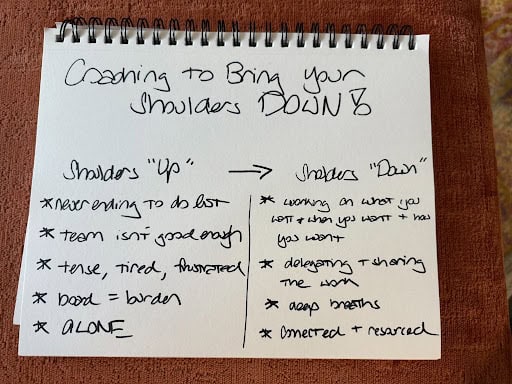
My first foray into asking for help was to get a coach, and here’s what I know now: my shoulders have been down for the past couple of years, genuinely down, and the difference is something I don’t quite have words for.
A coach doesn’t just help you survive the hard moments, they hold you up to do your best work and the question isn’t whether you’d benefit from that support. It’s knowing when you’re ready to use it.
Everything feels more possible. I can move farther and faster. The work is better. It is my deepest wish for every human, and especially for those shouldering the teams, organizations, and missions that are building our world — that they get to feel what it’s like to put their shoulders down.
The person who helps leaders put their shoulders down
Nancy Fournier has spent over fifteen years working exclusively with women in the nonprofit and government leadership sector. What she’s noticed is that the leaders she works with are carrying more than anyone sees, and they’ve usually been carrying it alone for longer than they should have.
She stumbled into understanding this not through research but through listening. When she was starting her practice, she reached out to friends and colleagues and asked them to send her names of women running nonprofits. Women, she could talk to and learn from. Those fifteen-minute interviews turned into conversations with thirty-eight women across the country. Even with countless differences — different ages, different races, different issue areas, different-sized organizations — she heard almost the same things:
- Leadership is incredibly isolating.
- I can’t share everything with my staff.
- My board has no idea what I truly do.
- My service partners are also my competitors.
- I am exhausted.
That wasn’t just loneliness. It was professional isolation. The specific, grinding experience of being the person everyone looks to, with no one to be honest with about how hard it actually is. “They carry so much on their shoulders and have no one to share the full scope of what they are juggling,” Nancy says. “So you never have your guard totally down, and you’re alone. You just feel alone. It’s in that isolation that you begin to second-guess yourself.”
Nancy’s whole approach starts from that reality. Her signature approach: helping leaders recognize when their shoulders have crept up and creating the conditions for them to finally come back down.

The Key Takeaway
Here’s Nancy’s go-to analogy: the time to invest in a generator is when there’s a hurricane in the forecast — not after the power’s already out.
The same is true for coaching. The leaders who get the most out of it aren’t the ones who finally broke down and called someone. They’re the ones who noticed the storm forming, who felt their shoulders starting to rise and said: I want support now, while I can actually use it. While I can still run. Before I get to the point where I’m just trying to survive.
Because here’s what Nancy has watched happen again and again: leaders wait. They tell themselves they’ll get support when things calm down, when they’re less busy, when this particular crisis passes. By the time they finally reach out, they’re not moving forward anymore. They’re trying to get back to standing.
The goal of coaching isn’t to rescue you from the hard moments, but to have a partner to work through things with when you’re in a place to actually leverage the support.
Nancy’s Coaching Approach
If you’re the type of person who is ready to get a coach after that intro (aka Helia’s COO, Libby), Nancy’s When to Get a Coach Toolkit gives you Interview Questions as you vet potential coaches and a Delegation Self-Assessment to help narrow in on the things causing your shoulders to tense up.
If you’re a “tell me why this works” kind of person (aka our Founder Jess), read on to understand how Nancy’s coaching approach works!
How Nancy’s Coaching Approach Works
Step 1: Learn to read your own shoulders
Before anything else, like finding a coach or thinking about timing. Nancy wants leaders to develop one simple diagnostic: notice when your shoulders are up.
Literally. Are you tensing through your neck and shoulders on the drive home? Are you bracing for the next thing before the current thing is even done? Do you feel like you’re wearing a cape you can’t take off?
“If you constantly feel like your shoulders are up when you get in your car to drive home, there’s something going on,” Nancy says. “Get your shoulders down.”
The problem is that most leaders normalize this feeling. They’ve been carrying so much for so long that ‘braced’ has started to feel like ‘baseline’. So they wait until something breaks: they get sick, a major conflict erupts, or their board says enough. By then, they’re not just tired. They’re depleted.
These are some signals worth paying attention to early. Not “I’m overwhelmed, I need help”, but something quieter.
- Your to-do list never really shrinks.
- You’re frustrated with your team more than usual.
- You feel like you’re constantly putting on a cape going into work and a different mask going home, and there’s nowhere in between to just be you.
These aren’t signs of failure. They’re signs it’s time.
Step 2: Know when the timing is actually right
Here’s something Nancy says that I haven’t heard elsewhere: there are moments when coaching isn’t the right move. Not because you don’t need the support, but because you won’t be able to use it.
“I think it’s got to do with personal bandwidth,” she says. Major organizational transitions, the very beginning of a new leadership role, huge personal losses — these are moments when you’re already at capacity.
Coaching requires something of you. You have to be present enough, stable enough, to actually do the work. “While coaches focus on the professional,” Nancy notes, “you bring your personal life into your job.” When there’s a huge emotional weight that’s already consuming you, coaching can be hard to absorb. It doesn’t mean you don’t deserve support. It just means the conditions aren’t there yet for it to land.
Her analogy: “We’ve got to date a few times before you go to the marriage counselor. You have to let yourself be in it.” If you’re about to merge with another organization, or just started a co-director relationship, or you’re three weeks into a new ED role — give it a few months. Let the dust settle. Let yourself find the bathroom.
The sweet spot? When you can feel the storm forming, but haven’t been knocked down yet. When your shoulders are starting to rise, but you haven’t completely lost the ground under your feet. That’s when coaching goes from helpful to genuinely transformative.
If you constantly feel like your shoulders are up when you get in your car to drive home, there’s something going on.
Step 3: Bring your whole self — because that’s what makes it work
Nancy is direct about this: coaching is not a formula. It’s a relationship. And like any relationship, you get out what you put in.
“When I think about all my clients for whom coaching would be called transformational, it’s maybe a third,” she says. “What they have in common is they were really committed. They did the work. They fearlessly looked at their own behavior and thought patterns and were willing to change. They did not treat it as ‘every two weeks I’ll talk to you for an hour and yeah, I’ll read your notes.’ They embraced it.”
What makes that commitment possible? Valuing yourself enough to show up fully. Being willing to look at your own patterns — the way you manage down, up, and across — with real honesty. “Leadership is not for babies,” Nancy says. “If you want to be a good leader, it’s a lot of work. And you’ve got to be self-aware. You’ve got to be willing to take your lumps and hear uncomfortable things.”
The leaders who come out transformed aren’t necessarily the ones who started in the worst shape. They’re the ones who decided: I am worth investing in. I’m going to actually do this.
And importantly: fit matters. Talk to a few coaches. Get a sense of their style. Does this person hear you? Do they get you? Can you learn from them? The relationship has to feel safe enough for you to be honest, and that’s not something you can shortcut.
What This Looks Like in Real Life
One of the most honest pieces in our Helia Library is an anonymous story from a rural nonprofit ED who found herself shutting her heart off just to survive and what happened when she finally found the right support. She describes sitting alone in her office one day and realizing: “I can’t do this by myself anymore.”
She emailed a foundation director she’d never met, said she was in crisis, and two days later was on the phone crying for an hour. That conversation led to coaching with Nancy. And her first ask was simple: “I want to love my job again. If you can do anything for me, help me love my job again.”
They got there. “I Want to Love My Job Again” is her story, and it’s worth reading, especially if you’re somewhere in the middle of wondering whether support could actually change things for you.
That’s Nancy’s work, in miniature: getting you out of the pit first, and then, once you have ground under your feet again, helping you run.

Bird watching in Belize!!!!
When to do this Yourself vs Bring Someone in
You can start by paying attention. Notice your shoulders. Notice your list. Notice the isolation. The awareness alone sometimes shifts things, and the resources below are genuinely useful for getting unstuck on your own.
Where a coach makes the real difference:
- You’ve been carrying the same patterns for a while and can’t quite interrupt them on your own
- You feel isolated in your leadership and have no real space to be honest about how hard it is
- You’re about to navigate something significant — a transition, a team rebuild, a shift in your own role — and want to do it with support rather than hoping for the best
- You want to move faster and farther, not just get through the next thing
- Your shoulders have been up for longer than you can remember, and you’re ready to put something down
If You Want Help
Nancy Fournier works exclusively with women in nonprofit and government leadership — helping them recognize the patterns that are holding them back, find their own voice, and lead from a place of genuine confidence rather than braced survival.
She’s a good fit if:
- You’re a woman leading a nonprofit, foundation, or government organization and feeling the specific isolation that comes with that
- You want a coach who will hold up a mirror, gently AND honestly, not just validate everything you’re already doing
- You’re ready to actually do the work, not just talk about it every two weeks
- You want support before the crisis, not after
Nancy also recommends two colleagues she trusts deeply:
- Katie Sternberg at Momentum Coaching — executive and personal coaching
- Ryne Martin at It’s the Impact — coaching for change-makers
Connect with Nancy!
Try it Yourself
Nancy’s When to Get A Coach Toolkit
- Coach Interview Questions — Nancy’s practical guide to finding the right match. Come to that first conversation prepared.
- Delegation Assessment — Nancy’s quick tool for pinpointing how well you’re growing your staff by handing things off
Other Coaches — Nancy recommends these coaches she trusts deeply:
- Katie Sternberg at Momentum Coaching — executive and personal coaching
- Ryne Martin at It’s the Impact — coaching for change-makers
Go deeper:
- Nancy’s Survival Guide for Nonprofits — concise and practical: protecting your funding, focusing your board, strengthening team communication, and prioritizing self-care
- The Management Center offers solid free resources on managing time effectively and delegation — including a comparative advantage worksheet — for when you want to start working on the patterns before you’re ready for coaching
Questions to Sit With
- When did your shoulders last actually come down — and what made that possible?
- What are you holding right now that you haven’t told anyone the full truth of?
- Is your to-do list running you, or are you running it?
- What would it feel like to move through your work from a place of groundedness rather than bracing?
- What’s the thing you keep telling yourself you’ll address when things calm down — and how long have you been saying that?
Not sure Nancy‘s the right fit? Talk to Helia directly!
This article comes from a coffee chat with Nancy in May 2025. These conversations form the heart of the Helia Library — because we’ve learned the most from doing and from talking with other doers willing to share their wisdom. We don’t need to start from blank pages or do everything alone.

About Nancy
Nancy Fournier works exclusively with women nonprofit leaders, helping them navigate the unique challenges of mission-driven work. She’s been doing this for over fifteen years — creating the kind of reflective space where leaders can recognize their patterns, find new strategies, and rebuild trust in their own voice. She’s the trusted corner person in a boxing match: helping you catch your breath, tend to your wounds, and step back into the ring stronger.
Nancy has been known to introduce lobster to her friend from Rome and go bird watching in Belize. She believes deeply that the work is a relationship and that the leaders doing the hardest work in our world deserve to feel genuinely held in it.