Long Story Short
When an unexpected opportunity turned into overwhelming isolation, one rural nonprofit leader found themselves shutting down emotionally just to survive. Their journey from crisis to coaching to loving their work again shows how the right support can help you find your way back to yourself — and why you don’t have to carry it all alone.
Jump to How!
Why We’re Sharing This Story
Jess here. This was one of the first conversations I had when I started Helia and it sat with me for days and days as it was so honest and relatable. I felt both really honored that the author trusted me with their story and really lucky they’re letting us share it — we’re doing so anonymously at their request to make sure there are no possible implications for their work.
It brought me to a week or so of reflection around how, yet again, I’m not alone in how hard this all can be and how powerful it can be to hear someone else honestly share their story. It made me feel all the things — really sad at how much we all tend to hold and internalize before asking for help, curious (and maybe a little angry?!?!) about all of the forces and influences and realities force us into going it alone for too long, AND grateful that, nearly always, other humans and their connections and guidance are the way through.
It also feels really special that the coach they worked with, Nancy Fournier, also shared her perspective in the companion article When to Get a Coach: How to Stop Feeling So Alone, which explores how to recognize when you need support and what makes coaching relationships work (and how they can often help us to take a deep breath and let our shoulders fall down).
Anonymou’s Story
I didn’t set out to be an Executive Director. I was 29 when the opportunity came up—totally unexpected. A community partner from the community where I grew up reached out and said, “There’s this nonprofit that’s trying to get off the ground. No staff, no ED, just a board and some vision. You interested?”
It just fell into my lap. I wasn’t pursuing ED roles—I was way too young for that. But I’ve always loved a good challenge, and I was passionate about the mission. So I took a huge pay cut and jumped in. The organization had almost no money and barely any infrastructure, but I was ready to build.
Those first few years were mostly smooth sailing. We built strong partnerships with the court system, developed programming around youth justice needs, and things were going well. Looking back, I think I fooled myself about how easy it was. There were challenges, but there always seemed to be an obvious pathway forward.
But as public health and racial equity came to the forefront in 2020, everything that had once felt manageable suddenly didn’t anymore.
Our values started clashing with our system partners’ values. At our organization, we work to help children and families overcome challenges, so we prioritize their needs and desires first. But many of our partnerships are contractual, so our partners often think, “Well, we pay you to offer a service, so we should be the priority.”
As I tried to manage these tensions and preserve the organization, I ended up—very unintentionally, but understandably—breaking trust with my staff. There were all these little moments where the trust just kept eroding while I was trying to do this dance with our partners, pushing back when our values were in conflict, but only to the point where it felt safe.
And then I became a parent for the first time.
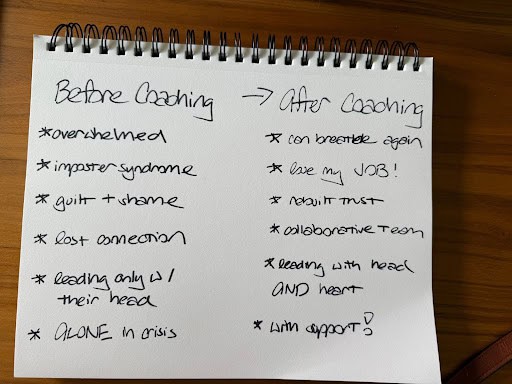
The first weeks of my daughter’s life were the most overwhelmed I’ve ever been. I shut my heart off to my professional world. It was the only way I could keep going. Good leadership balances your head and heart, but I was just trying to be as completely logical as possible because that was all I could access. When you lead with your head and shut off your heart, something gets lost. I lost connection with my team. I lost my ability to see clearly. And I lost joy in my work.
I’ll never forget sitting alone in my office one day thinking, “I can’t do this by myself anymore.” I had been trying to bring things to my board, but I realized the support I needed went beyond what any individual or the collective board could offer.
So I emailed the director of organizational effectiveness at a regional foundation—someone I’d never met before. I told them I was in crisis. Two days later, they got on the phone with me, and I cried for an hour. I put together a document summarizing what was going on, and while we talked, she said, “Yeah, this is your crisis document.” I said, “That’s a thing?” And she said, “Yeah, it’s your crisis document.”
Then she asked, “Have you ever considered getting a coach?”
I hadn’t. I’d never worked somewhere where leaders had coaches. It wasn’t something that got invested in at the small nonprofit startups where I’d worked. But when she said it out loud, it felt so obvious.
It felt urgent.
I interviewed three coaches and chose Nancy Fournier. The first year of our work together was mostly about getting me out of the pit that I was in. The anxiety, the impostor syndrome, the guilt, the shame. My shame was holding me back from moving forward. I felt so bad about the mistakes I’d made that I couldn’t focus on how to fix anything. She helped pull me out.
And then slowly, things started to shift.
Eventually, I could breathe again. I could think again. We started working on concrete things like a board engagement strategy and long-term planning. I told Nancy in one of our first sessions, “I want to love my job again. If you can do anything for me, help me love my job again.” And we accomplished that.
She helped me weather the storm. She guided me through rebuilding trust with my team, which took a long time—you can’t rush these things. She helped me restructure our management into a flatter organization where I share power with my team. Today, the communication in our organization is so good — better than it’s ever been. And we’re highly collaborative.
Coaching didn’t save me, but it gave me a way back to myself, my work, and my team.
Now, if another crisis hits, I know I don’t have to face it alone.

What Made Coaching Work
Finding the right coaching relationship was transformative for the author. Their process holds lessons for anyone seeking this kind of support – something I have learned over and over again!
- The right match matters: They interviewed multiple coaches and chose someone who led with empathy rather than immediately focusing on what they had done wrong. “I needed to be released from the amount of guilt I was carrying because it was weighing me down so much.” I love how they trusted their intuition on what they needed.
- Structure with flexibility: Their coach uses a “choose your own adventure” prep document with open-ended questions like “What was a success this week, no matter how small?” and “What else do you need from me right now?” There’s no pressure to fill out the entire thing, just what calls (which I LOVE!).
- Reciprocity in the relationship: “She expects something from me, but I also expect something from her.” Note that I also so appreciate how their coach provides detailed notes after each session. I had a coach do this for me once — and it always felt like I was “being held”, a theme these days in my world!
- Adaptive to changing needs: As they moved from crisis to growth, their coach adjusted expectations and approach, eventually setting new standards for preparation and shifting the focus to proactive planning.
Questions to Sit With
- What are you holding by yourself? What’s the cost of holding it all alone?
- What would support look like if it wasn’t about fixing, but about witnessing and guiding?
- What relationships do you have (or could you build) to bring you the support you need?
- What’s something you’ve been afraid to name?
- When have you shut your heart off to keep going?
This article comes from a coffee chat with a beautiful leader in April 2025. These conversations form the heart of the Helia Library – because I’ve learned the most from doing and from talking with other doers willing to share their wisdom. We don’t need to start from blank pages or do everything alone.
Try it Yourself
Start Here:
- Five Questions to Ask Before Hiring a Coach – Nancy’s guide to finding the right match
- While a coach is what we wish for everyone(!), sometimes we have to start on our own. The Management Center offers a great starting point on managing time effectively and a quick overview (with a comparative advantage worksheet!) to support delegating!
If You Want Help
Nancy Fournier is a leadership coach for women nonprofit executive directors — a former ED herself who now helps leaders keep their sanity and find their way back to joy in the work. Her approach balances empathy and accountability: she’ll meet you where you are, and she’ll also push you to grow.
She’s a good fit if:
- You love the mission, but the nonstop pressure and uncertainty is wearing you down
- You’re second-guessing yourself — and your passion is still there, but your energy and focus are slipping
- You’re navigating a real crisis (board, staff, funding, or all three at once) and need someone to think it through with you
- You want to strengthen your work relationships and deepen your leadership — not just survive the hard season, but actually grow through it
What working with her can look like:
- Coaching — her 5-month program to build competence, confidence, and impact
- Strategy Sessions — 90-minute sessions to work through an immediate crisis, a board impasse, or a staff situation
- Performance Evaluations — a meaningful ED review process, with as much or as little of her involvement as you need
Connect with Nancy!
Not sure Nancy‘s the right fit? Talk to Helia directly!
About the Contributor
This story comes from a nonprofit leader in the rural South who requested anonymity to protect their professional relationships. Their organization serves youth and families in their community, working to create positive change while navigating complex system partnerships. Their coach, Nancy Fournier, brought them back to loving their job.