
Long Story Short
Most of our organizations are somewhere between knowledgeable and productive on the spectrum of financial security. Knowing where you are is the first step to getting all the way there. We built you Raj’s Fiscal Practices Toolkit to find out exactly where to start.
I ran a solid org at Think of Us. I genuinely believe that. We had strong systems, good people, a culture I was proud of. I was deeply in it. And I mean in ALL the things!
AND, somehow there were still things happening that I was not as on top of as I needed to be. Not even a little bit.
Our CEO had an AmEx Black card that wasn’t connected to our financial systems. So when $40K in fraudulent charges appeared with a nearly $20K double charge, there was not enough time to get reimbursed. That sparked a very necessary moment of realization and reckoning. AND a lot of regret.
Later, when we eventually needed a proactive audit due to the volume of federal funds flowing through, we ended up buried in manual calculations and spreadsheets that took way more time and energy than they ever should have.
Day to day, tracking the financials was a massive headache. The reports and visuals weren’t all in one place, so I was clicking around trying to piece things together. And if I’m honest, I tended to default to the tools I felt most comfortable with — I LOVE me a pipeline and a budget spreadsheet. Things I was less fluent in (cash flows, net assets) were the ones I tracked the least.
All of these issues started stacking up and I found myself wishing we had invested in tighter systems from the beginning, because as we grew, it got harder and harder to hold all the pieces together. (Or more honestly, for me to be the one responsible for holding them all together. That’s a lot to carry.) We needed a better system.
I don’t want to give money an oversized importance in our world. It isn’t good for my energy, and when I approach things from a place of abundance and possibility, it genuinely flows back to me. AND, being a responsible steward — having the right information, the right structures, and the understanding of what’s actually happening — takes away the power money holds when you’re not sure exactly where you are or what you need.
Knowing what you have and what you need is what gets you to a place of being fiscally secure. And when you feel secure, that’s when the possibilities open up.
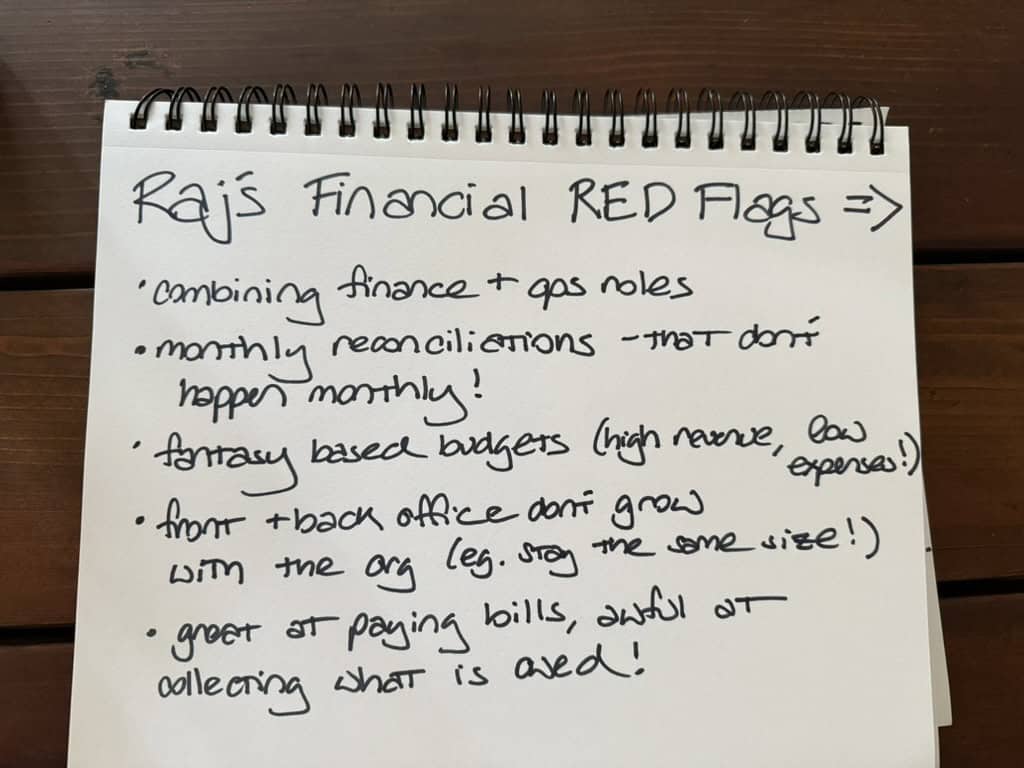
When we know which timeframe we’re working in, we know what needs attention, when, and why.
The person who helped me feel more fiscally secure
I first came across Raj Thakkar through our Joyful Impact Accelerator community when he sent around an email about a presentation on his book fiscally seCURE. What hooked me weren’t the credentials (though they are impressive), it was this line: “Please bring any and every question you have about responsible financial management, both professionally and personally. I will do my best to answer them in easy-to-understand ways, aiming to evolve your relationship with money.”
Raj has been working with numbers since he was five years old, counting stacks of singles at his family’s convenience store in Queens. There was no register, just mental math. Today he’s the founder and CEO of both Charter School Business Management and FOREsight Financial Services for Good, which supports nonprofits and social sector organizations. He’s also taught at NYU Wagner and spent years as a CFO before that.
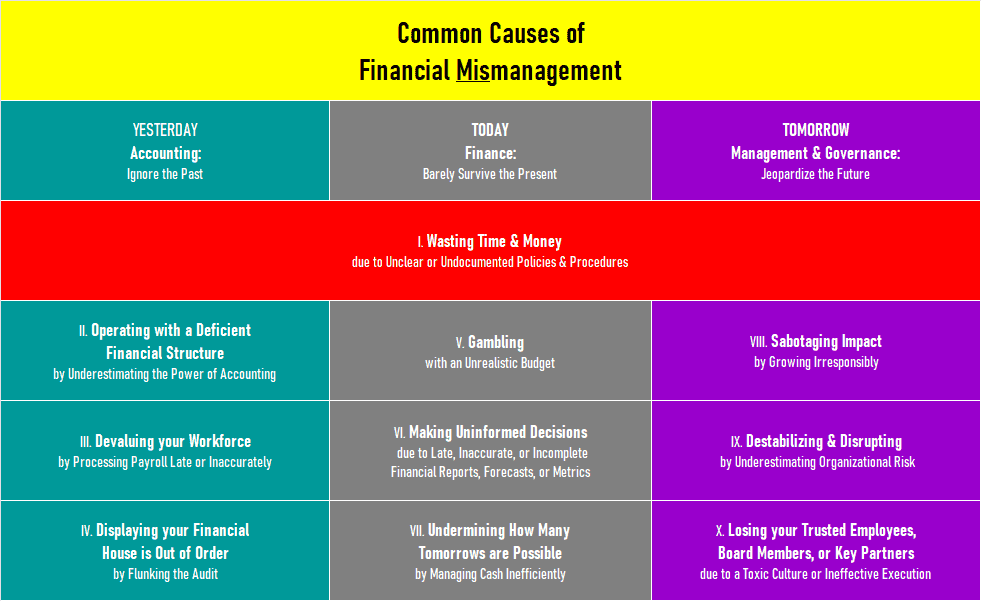
His signature move — and the framework I wish I’d had years ago — is a deceptively simple reframe: yesterday is accounting, today is finance, tomorrow is management and governance. Three timeframes. And, somehow, organizing it that way makes the whole thing feel manageable for the first time.

The Key Takeaway
Before we get into the framework, let’s start with spectrum of people’s relationships to Financial Management because it’s the thing I wish I’d had first.
Raj uses a simple matrix to help people understand their actual relationship to financial management. The x-axis is know why: do you understand the reasons behind the practices you’re using? The y-axis is can do: can you actually execute them?
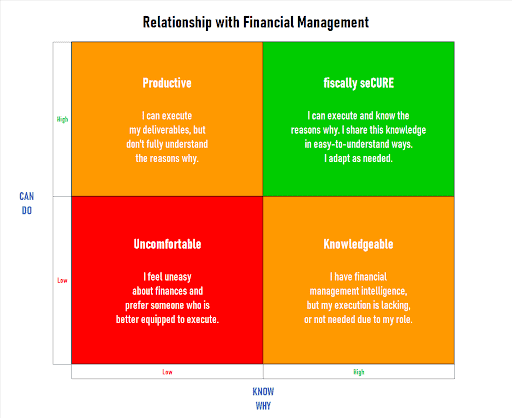
A quick translation:
- Uncomfortable (low on both): Finances feel foreign and a little scary. The preference is to hand it entirely to someone else and hope for the best.
- Knowledgeable (high know-why, low can-do): The concepts make sense, but execution is either lacking or not required for the role. A board treasurer might live here(and that’s completely appropriate for their function).
- Productive (high can-do, low know-why): Executing financial tasks competently but not fully understanding the reasons behind them. Gets things done, but struggles to adapt when something changes or goes wrong.
- Fiscally Secure (high on both): Can execute, understands why, shares knowledge in accessible ways, and adapts as rules and context evolve.
Looking back, I can see exactly where I was — right in the middle. Depending on the area, I was somewhere between knowledgeable (understanding the concepts but not always executing well) and productive (executing the parts I was comfortable with but not always understanding why or what I was missing). I was solidly in the middle range, never quite making it to secure and not across all areas at once.
Many of us are often piecing things together from the tools we know, the reports we’re comfortable with, and whatever we can hold in our heads on a given day.
When we aren’t all the way in the fiscally seCURE area,, money can hold a kind of power over us — not because it’s actually complicated, but because the uncertainty keeps us reactive instead of clear-minded.
Raj’s core insight is that financial management isn’t one overwhelming tangle of responsibility, but three distinct timeframes, each with its own focus, its own tools, and its own role in moving us toward fiscally secure.
- Yesterday — reconciling the past (accounting)
- Today — commanding the present (finance)
- Tomorrow — forecasting the future (management & governance)
When we know which timeframe we’re working in, we know what needs attention, when, and why.
The fiscally seCURE quadrant isn’t about becoming a CFO. It’s about having enough structure, enough knowledge, and the right support that your finances become a tool for your mission; rather than a source of low-grade anxiety or, worse, a quiet source of risk you’re not even seeing.
The How: Raj’s Framework for Becoming Fiscally Secure
If you’re a “just give me the worksheet” kind of person (aka Helia’s COO Libby), Raj’s assessment in our Fiscal Practices Toolkit walks you through scoring yourself on all 10 CUREs and gives you a personalized prescription for where to focus first.
If you’re a “tell me more” kind of person (aka our Founder Jess), read on. Here’s are the three financial timeframes we’re covering:
- Yesterday — reconciling the past (accounting): the foundational work that keeps your house in order and catches problems before they become disasters
- Today — commanding the present (finance): the real-time decisions that keep you healthy, including building reality-based budgets and truly understanding your current fiscal position
- Tomorrow — forecasting the future (management & governance): the forward-looking work that keeps you growing wisely instead of reactively

How Raj’s Fiscally Secure Framework works
Raj goes all in with medical references and honestly, they work! Think of it as 10 CUREs for the common causes of financial mismanagement, each organized into one of the three timeframes. Before any of them can work, though, one thing has to be in place.
The prerequisite: CURE 1 — Establish roles, responsibilities, policies, and procedures
Across all three timeframes, you need crystal clarity on who is doing what, when, where, why, and how. This sounds basic AND it’s one of the most common places things unravel, especially in growing organizations.
“When I see this role — Director of Finance and Operations — it drives me crazy,” Raj says bluntly. “They’re literally two different jobs. That’s like having one teacher teach on two different floors of the building at the same exact time.”
The result is predictable: someone dealing with operational emergencies all day, then trying to cut checks and work on budgets at 7pm. “You’re creating this disgruntled future employee because you’re giving them two jobs, they’re getting compensated barely for one, and they’ll only excel at one of those roles.” Finance and operations require different skills, different attention patterns, and different priorities. If they’re combined in one role, that’s the first thing worth examining before looking at anything else.
Yesterday — Reconciling the Past (Accounting)
Yesterday’s work is about preserving a solid financial foundation. Get this right and you’re protected. Let it slide though, and the problems compound quietly, until they’re not so quiet anymore.
CURE 2 — Set up and maintain your accounting infrastructure
This is the foundation everything else rests on. Your chart of accounts, accounting system, and your reconciliation processes live here. It’s not glamorous BUT it’s the difference between having reliable information and flying blind. Organizations that skip this step and often realize too late what they’re missing.
CURE 3 — Process payroll precisely and promptly
Nothing erodes trust faster than paycheck problems. Processing payroll accurately with the right amounts, deductions, and timing is one of the most basic ways an organization demonstrates that it respects its people.
It’s also a compliance issue. Payroll errors can become legal problems that result in tax back payments, which are far more expensive than getting it right the first time.
CURE 4 — Ace the audit
Your audit isn’t something that happens at the end of the year — it’s something you’re either preparing for all year or scrambling at the end of the year to survive. Organizations that ace their audits are doing the work throughout the fiscal year: clean books, organized records, no surprises. Those that don’t are usually doing a lot of manual calculations and late nights in the months before the auditor arrives. (Raising my hand here — I lived this one.)
This is also where monthly bank reconciliations become non-negotiable. “Unless you’re doing your bank reconciliations each month, you can’t identify fraud,” Raj says. “And there’s so much cyber fraud that can happen.” The stories Raj tells aren’t rare, they’re patterns:
“We had one organization that could have prevented a disaster with a $2,000 investment in paying an outside party to do monthly bank reconciliations. Instead, their business manager had a gambling problem, stole half a million dollars, and they had to shut down. This is all preventable stuff.”
That scenario I described earlier, an AmEx card that didn’t run through our systems, is exactly this kind of gap. Not a failure of character or care, BUT a structural miss that got expensive. Monthly reconciliations mean you catch things when there’s still time to do something about them. Finding it nine months later? The bank isn’t playing that game.
“Finance is always far under-resourced until everything has gone wrong with it,” Raj says, “and then it’s like, ‘Oh, now it’s an unlimited checkbook to try to fix it.’ Why aren’t we in the business of prevention instead of treating the ailment afterwards?”
Today — Commanding the Present (Finance)
Today’s work is about making informed decisions with budgets that reflect reality and a clear-eyed view of actual financial health. This is where strategy meets numbers.

Finance is always far under-resourced until everything has gone wrong with it.
CURE 5 — Build reality-based budgets
The most common mistake Raj sees? The fantasy budget. “Leaders are often very aggressive with revenues, as if every revenue they’re eligible for is going to come in, and then they don’t estimate high enough for all the expenses. They should do the exact opposite.”
His advice: “Be very conservative with the revenues and aggressive with the expenses. And if you can balance the budget that way, then you’re typically in the business of good news — ‘Okay, we have another surplus, what do you want to do with that?’ — instead of, ‘Oh no, we’re behind the eight-ball again.'”
The details matter more than most people realize. “I want to see assumptions for every single line item in the budget. If you said it’s going to be $200 per student, was that $200 for that line item, or was it $200 per student times a thousand students? Now you’ve got a really huge number you’re off by.” Every line item should have a reason. If you can’t explain why you budgeted a number, you don’t actually own that budget. You’re working from a guess.
This applies to revenue just as much as expenses. Those waiting lists, donor prospects, grant applications, and pipeline leads you’re excited about? The money isn’t yours until it’s in the bank. “It’s easy to get excited AND you need to be realistic about what’s actually coming in,” Raj says, “because the rubber will hit the road and you need legs, and money, to stand on.”
CURE 6 — Analyze and assess fiscal health to make informed decisions
Budget vs. actuals is a start, but it’s backward-looking only. It tells you what happened, and it assumes your original budget was solid. If it wasn’t, you’re comparing your current reality against a number you already knew was off. That’s not analysis. That’s a false sense of security.
What you need alongside budget vs. actuals is a clear read on your current fiscal health:
- Where you actually are right now
- What your key metrics are telling you
- What decisions that information should be driving
“If you’re headed towards a half a million dollar surplus, you can pull the trigger on those extra positions you’ve been meaning to hire, with confidence instead of fingers crossed,” Raj explains. That confidence comes from actually knowing, not hoping.
Tomorrow — Forecasting the Future (Management & Governance)
Tomorrow’s work is about looking forward. Not just reporting on what happened, but using what you know to make decisions before you’re in crisis mode. This is where many organizations stop short, and where the gap between feeling financially secure and actually being financially secure tends to live.
CURE 7 — Control cash carefully
Cash flow is different from profitability in ways that trip up even experienced leaders. You can be running a surplus on paper and still not be able to make payroll if the timing of money in and money out is off. “Cash rules everything around you,” Raj says. “You have to be careful about all the ins and outs.” Forecast your cash regularly. Not just your accrual position, but know what’s actually available when.
CURE 8 — Grow wisely
A large waiting list or a full pipeline feels like proof you should scale. The question isn’t just whether demand is there but whether the organization is actually ready. Is the staff ready? How about the infrastructure? Are those numbers even real?
“It’s easy to get excited but you need to be realistic,” Raj says.
Chasing growth you’re not structurally ready for is one of the most expensive mistakes an organization can make.
CURE 9 — Mitigate risk, maximize stability, and minimize disruptions
“If you’re headed towards a quarter-million dollar deficit, which positions do you cut? What programs?” Raj asks. “These are hard questions, but you have to ask them. Otherwise the news gets worse.” The organizations that catch a deficit trajectory in April have options. The ones that catch it in October are doing damage control. This is the whole point of forecasting: making hard decisions with time and information instead of in a panic. Risk mitigation also means knowing when to call a lawyer. Financial risk and legal risk are deeply interconnected. Surprises that catch organizations flat-footed often have legal dimensions that go unaddressed for too long.
CURE 10 — Value the invaluable: your talent and technology
You can’t keep throwing bodies at problems as you scale. That’s an expensive habit that doesn’t hold. The right investment is having the right people and technology to make financial management sustainable. “You have to leverage technology to help people be more productive,” Raj says, “instead of constantly just pouring hours into things.” This includes AI — used well, it can meaningfully reduce the manual work that’s currently eating your team’s time.
When to do this Yourself vs Bring Someone in
A lot of this you can genuinely start on your own, like working through Raj’s Fiscal Practices Toolkit, getting honest about which timeframe you’re weakest in, and making some structural adjustments. The framework is clear enough to be self-directed, especially if you already have financial staff and just need a better organizing structure.
That said, it’s worth bringing someone in when:
- Finance and operations are combined in one role and you’re not sure how to restructure
- You’ve had a financial surprise like fraud, a deficit, or audit finding — and need a real diagnostic, not just a gut check
- You’re scaling and not confident that your current infrastructure will hold
- Your board and management team have different reads on your financial health
- You need someone to build the systems that move you from reactive to proactive.
- You lack dedicated finance staff and need someone to manage the role while you build capacity
If You Want Help
Raj’s company, FOREsight Financial Services for Good works with nonprofits, social ventures, and mission-driven organizations, and they meet you where you are. Depending on what you need, they can serve as your entire finance department, handling everything from bookkeeping and payroll to forecasting and audit readiness. They help build and train your existing team through one-on-one coaching or group professional development. All while working across your whole organization to get your board, management, and staff, operating from the same financial foundation. Every engagement is customized, starting with a conversation about what you really need.
Connect with Raj!
Try this yourself
- Raj’s Fiscal Practices Toolkit — Raj’s Fiscal Practices Assessment, his “personalized prescription” that walks you through all 10 CUREs and tells you exactly where to focus first.
Recommended reads:
- Fiscally seCURE by Raj Thakkar — the full framework with 10 CUREs and 50 remedies (currently charter school focused with a nonprofit version coming — the framework absolutely translates)
- The Ultimate Blueprint for an Insanely Successful Business by Keith Cunningham — Raj’s pick for clear financial thinking
- The Road Less Stupid by Keith Cunningham — on the “dumb tax” you pay when you don’t do your financial homework
- Profit First by Mike Michalowicz — a cash management strategy for small organizations
- The Untethered Soul by Michael A. Singer — Raj’s pick for understanding your relationship with the voice in your head (including about money)
Also from Helia:
- Recommended accounting firms — lightly vetted firms with deep social sector experience, a solid starting place if you’re looking for day-to-day accounting support
Questions to Sit With
Take some time with these — there’s wisdom in the thinking, not just the doing.
- Which timeframe am I weakest in, yesterday, today, or tomorrow and when did I last look at the reports for that one?
- Where do I fall on the fiscally secure spectrum and is it consistent across all areas, or does it shift depending on the topic?
- Do we have someone doing finance AND operations in the same role? (Worth an honest look.)
- Are our revenue projections realistic, or are we building the budget around best-case scenarios?
- What would it feel like to not just feel more financially secure, but actually be more financially secure?
Not sure Raj‘s the right fit? Talk to Helia directly!
This article comes from a coffee chat with Raj Thakkar in 2025. These conversations form the heart of the Helia Library — because we’ve learned the most from doing and from talking with other doers willing to share their wisdom. We don’t need to start from blank pages or do everything alone.
As always, take what’s helpful, leave what’s not, and make it your own.

About Raj
Raj Thakkar has been working with numbers since he was five years old, counting stacks of singles at his family’s convenience store in Queens — no register, just math in his head. A series of family financial crises, including his father’s seven heart attacks over nineteen years, turned that natural talent into a genuine obsession with financial security and responsible stewardship. Today he leads FOREsight Financial Services for Good and Charter School Business Management and genuinely lights up every time someone says “oh, now the numbers finally make sense.”
Work with Raj