Long Story Short
Like any relationship, you get out of your board what you put into it. Helia Collective Member Nancy Fournier walks us through three foundations to lay with your board to transform your relationship!
A few years after moving to LA, I decided I wanted to get more plugged into the community and join a local board. My daughter had been in some of their programs — genuinely incredible programs — and when they sent out an email looking for new board members, it felt like a sign. I applied, went through the interview process and was selected — and EXCITED!!!!
I had a ton of experience fundraising, running external partnerships, and leading organizations. But the board asked me to join their governance committee which, given that I’m someone who has probably never read through a set of bylaws completely, was not the best plan. Even so, they were short on people so I joined the monthly governance committee meetings, where I’d offer some advice and would send over examples. At the actual board meetings, most of the “discussion” was actually a read out of reports. The actual work, whatever it was, seemed to be happening in the executive committee. After I went to an event where I knew almost no one, I realized I wasn’t actually getting to know anyone because I wasn’t in a position to meaningfully engage. Overall, I felt really disconnected.
About eight months in, the CEO resigned. And then things really fell apart. The executive committee decided not to have the COO step in as interim — they hired an outside party instead. The COO walked out, and the interim CEO walked in completely surprised by what they found and, lo and behold, resigned after a few weeks. Within a month or two, it felt like nearly the entire Board was leaving or had already resigned. A second interim came on — someone who’d been on the board before and was, honestly, not right for the job. How the decision was made was completely unclear. Desperate times perhaps??? I still didn’t know what voice I had or what made sense to do with it.
Then we started recruiting for a real new leader, and I leaned all the way in. I joined the search committee, spent at least a day a month working from the office just to meet people and hear from them, had conversations about what staff were looking for, helped hire the recruiter. I thought I had real grounding — the financials, the history, the state of things.
Turns out I was VERY VERY wrong. Almost a million dollars in COVID relief funding I’d been told was guaranteed? Not even close. The interim hadn’t been billing time against government grants, and grants were underutilized and underspent across the board. The general operating fund had been massively depleted. And the outgoing finance lead had told us it was fine that we had no visibility into next year’s revenue because, in her understanding, that’s just how nonprofits worked. Finance, as a whole, was a mess. Our incredible new CEO walked in with eleven days of cash flow and spent the next year building it back up.
I sat with a lot of shame AND bewilderment about this. I have the experience. I’ve LED organizations. I understand this work. And I still didn’t catch it. I still couldn’t catch it — because I hadn’t built the relationships that would have made it possible to actually see what was happening.
The contrast with today is everything. I feel seriously lucky to get to work alongside our new CEO. We connect regularly, we’re thought partners across the different pieces of the organization, and she has a relationship with every individual on the board. She is intentional about who comes on, what they bring, and how they’ll be able to help. It’s a completely different experience — and it flows from one thing: relationships.
Whether you’re leading an organization that needs a stronger board or sitting on a board that isn’t living up to what it could be, the question is the same: what’s the relationship like? Because that’s where everything else starts.
The person who showed me what’s actually possible
As a nonprofit leadership coach with over 20 years of experience, Nancy has worked with literally hundreds of executive directors. “I don’t have an ED that does not struggle with their board on some level,” she told me. “It can be intense like ‘My chair has always hated me and wants to fire me,’ to ‘They’re the biggest pain in the ass,’ to ‘I can’t even get to quorum.’
She’s seen everything from boards deciding the color of gala napkins to those who continually undermine the organization’s leader, but most are just clueless about how to be an effective, joyful board. “There’s just a lot,” Nancy says. But what she noticed was a pattern: “I think a lot of nonprofit leaders are ambivalent about how involved they want their board to be. They think, ‘These people don’t understand my field. They haven’t taken the time to become experts in what we do. So, I don’t really want to take the time because there’s no value added. I just want them to maybe read my emails and definitely raise money.’”
This is not a failure of those leaders. It’s just the reality of the work.
And that reframe — that the struggle is normal, AND that it doesn’t have to stay that way — is exactly what makes Nancy’s approach so useful. She’s interested in the real texture of the relationship: how you build it, how you maintain it through the hard moments, and how you make it work for everyone around that table.
“Find out what’s the value-add of that member and make it your business to leverage it,” she told me. “You can’t do that unless you take the time to get to know that person in a three-dimensional way.”
Her core insight — the thing I keep coming back to — is this: your board can be a lot of things. Fundraisers, yes, but also advisors, thought partners, connectors, community ambassadors. Which of those things they become — and whether the whole relationship stays healthy and productive — depends almost entirely on the relationship you build with them.

Nancy’s Board Relationship Approach
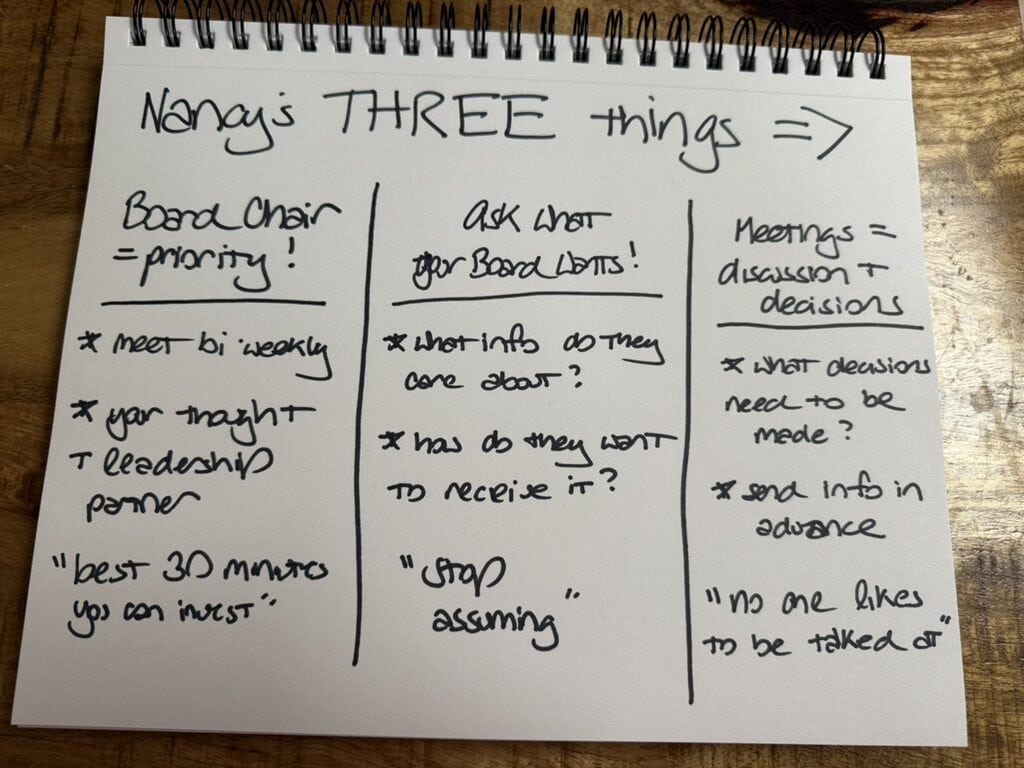
If you’re a “just tell me what to do and I’ll get started” kind of person (aka Helia’s COO Libby), Nancy’s approach has three foundations to start with right now:
- Foundation 1 — Build a real relationship with your board chair (or whoever actually holds influence). Bi-weekly coffees. Treat them as a thought partner, not a meeting obligation. This is the highest-leverage investment you can make.
- Foundation 2 — Ask your board what they want to know, and how they want to receive it. Not what you think they should hear — what they actually want. This one question changes everything.
- Foundation 3 — Redesign your meetings around outcomes, not information dumps. Stop talking at people. Use the time you have together to actually make decisions and have real conversations.
Start there and you’ll already be ahead of most.
If you’re a “I want to understand the full picture before I start” kind of person (aka our Founder Jess) — read on.
Because Nancy also has very specific guidance for the situations you’re probably already in: the board that’s checked out, the chair who doesn’t feel like an ally, the member who wants to weigh in on everything, the staff/board boundary that keeps getting crossed. Real situations, real guidance — and some of it might surprise you.
The Key Takeaway
Every ED has a version of what their board is for. For some, it’s fundraising. For others, it’s governance — a necessary legal structure that meets quarterly and signs off on things. For others still, it’s a host committee, a speakers bureau, a rubber stamp. Whatever the version, most of us have unconsciously decided what our board is and then related to them accordingly.
And that’s exactly where things get stuck.
Because Nancy’s whole framework starts from a different place entirely: your board isn’t a mechanism. They’re a relationship. And like any relationship, you get out of it what you put in. When you take the time to know your board members three-dimensionally — why they’re there, what they care about, what they’re actually good at — you start to see what’s actually possible. They open doors you can’t open on your own. They advocate for your mission in rooms you’re not in. They become the thought partners, connectors, and champions you actually need — especially right now.
But you have to build that first. And that’s what Nancy’s approach is designed to help you do.
How Nancy’s Approach Works
Foundation 1 — Build a real relationship with your board chair
Everything starts here. Not with the full board — with one person. Your chair, or whoever actually holds influence in the room (which, Nancy is quick to note, isn’t always the person with the title).
“Invest in the relationship with the chair or whoever the person is who has the most influence over the group,” she told me. “It’s like the best half an hour investment you can make.” She recommends bi-weekly coffees — not to prep for meetings, but to actually build the relationship. To strategize together. To think through board member engagement, talk through what’s coming, problem-solve before things become crises.
Why does this one relationship matter so much? Because your chair is your key to the rest of the board. When that relationship is strong, they can help create relationships with other members, make sure promises get followed through, and be your partner in the hard conversations you can’t have alone. When it isn’t — even the most well-intentioned board can feel like a constant drain.
And here’s the thing Nancy says most: your chair probably has no idea how to do this role well. Nobody teaches them. They showed up, they were asked, they said yes. The care and feeding of that relationship is yours to lead.
Struggling with a board chair who doesn’t feel like an ally yet? Nancy’s podcast on Managing Hard Conversations With Your Nonprofit Board Chair is a great place to start. And her Seven Steps to Support Your Nonprofit Chair to be a Strong Leader gives you a concrete framework for building that relationship from wherever you are right now.
Foundation 2 — Ask your board what they want to know, and how they want to receive it
This one sounds simple. It is not common.
“I know very few leaders who ask their board members what they want to know about the organization, as opposed to just deciding what they think the board should hear,” Nancy told me. Most EDs are confident they know what the board needs to see, and so they send the nine-page Friday update, or the dense financial report, or the program summary no one asked for. And then they’re frustrated when nobody reads it.
At Think of Us, we stumbled into a version of this by accident. We had a board group text that started as a place to celebrate wins, and then we started using it to send quick updates whenever something happened that we knew our board actually cared about. Not every Friday on a schedule, but when it mattered, about the things they’d told us mattered. Our board went from engaged to exponentially engaged. Less time, more connection. It worked because it fit how they wanted to receive information — not how we assumed they should.
That’s Nancy’s point exactly. The assumption is where the resentment starts — on both sides. The ED feels like the board isn’t paying attention. The board feels like the ED doesn’t understand what they actually need. Ask the question first and you skip all of that.
Foundation 3 — Redesign your meetings around outcomes, not information dumps
“Nobody likes to be talked at,” Nancy says. And yet — most board meetings are exactly that.
People come from full days of work, from home, from everything else happening in their lives, and they sit there while someone presents at them for 45 minutes and then asks for a vote. It’s hard to feel engaged in that. It’s hard to feel like your presence matters.
Nancy’s reframe: before every meeting, ask yourself ‘What outcome do I want to reach?’ instead of ‘What information do I want to give them?’ Send the materials in advance. Assume they can read. Use the time you actually have together for discussion, decisions, and the kind of conversation that only happens when people are in the same room (or on the same call).
“You don’t want to talk a lot as the executive director,” she told me. “You want to be able to ask them questions that they can respond to and begin to talk themselves.” The magic of everyone getting together is wasted when it becomes a presentation. Protect it.
For a practical guide to rethinking what happens in that room, check out Nancy’s post on creating impactful nonprofit board meetings.
Before every meeting, ask yourself, ‘What outcome do I want to reach?’ instead of ‘What information do I want to give them?’ Send the materials in advance. Assume they can read.
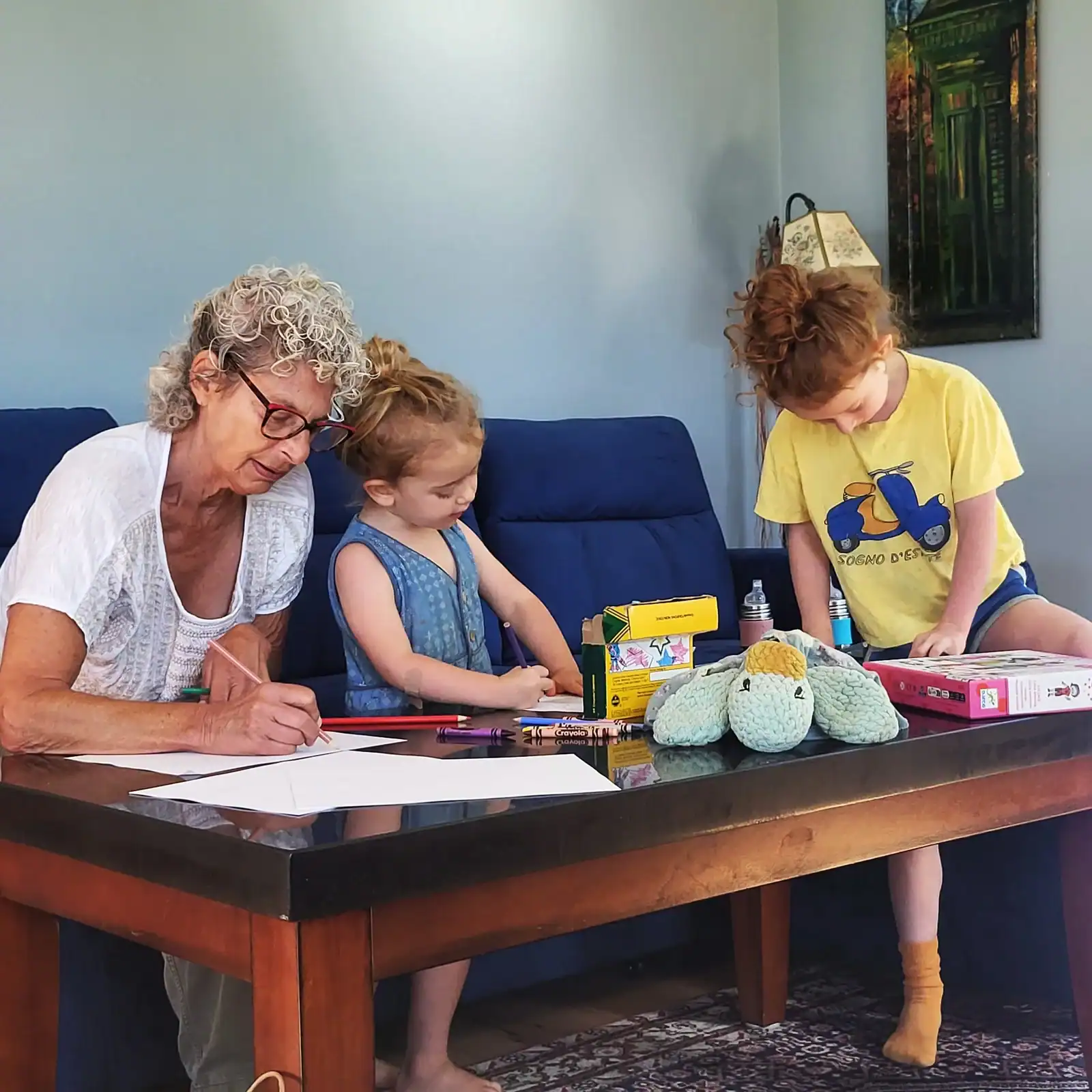
Nancy with her favorite board members!
What this might look like in your world
The three foundations are where you build from. But most of us aren’t starting fresh — we’re dealing with something specific, right now, that needs attention. Here’s Nancy’s guidance for the situations she sees most often.
If your board feels checked out
Disengagement is almost never about bad intentions. It’s usually about two things: people haven’t been given a meaningful way to be engaged, AND no one has taken the time to know them well enough to create one.
If there are board members who are truly coasting, Nancy says, “Get rid of the dead weight gracefully.” And she means this kindly! Create board emeritus or advisory roles for people who’ve been around for 15 years and rarely show up. Thank them genuinely, move them off, and don’t waste a board seat. At the same time: don’t panic if only two-thirds of your board is actively participating. “That’s how it always is,” Nancy says. “If you’ve got a solid mass of seven, you’re cool.”
For the people who are there, the fix is relationship. Meet for coffee, go for a walk, do whatever fits your style — but get to know them as people. Why are they on this board? What do they care about? What do they think they have to offer? That’s your arsenal as an ED. You can’t leverage what you don’t know.
One more thing Nancy flags here that doesn’t get talked about enough: “You cannot expect to set a culture of active engagement when there is tacit agreement to allow different members to operate under different sets of expectations. Older, white, wealthy members are often given a pass on participation because of their access to money. I see this as an outsider looking in and it is not a good look.” A culture of real engagement has to apply to everyone.
If your board chair doesn’t feel like an ally
Start with shared expectations — about what you each need, how you want to communicate, what kinds of decisions you want to make together. “What are you looking to me for? What type of issues do you want to hear about? How often? How do you best approach me if you need something?” These questions feel basic, and Nancy says she almost never sees leaders actually ask them — especially when there’s already tension.
The racial and generational dynamics here matter too. Nancy has seen this play out over and over: a leader is hired, there’s a significant cultural difference between them and their board chair, and because no one has the upfront conversation about expectations and ways of working, the relationship deteriorates in ways that become very hard to repair. That initial awkward conversation — maybe with a facilitator — is so much easier than what comes after.
Nancy offers90-minute board strategy sessionsspecifically for ED/board chair relationships that need a reset. She describes it as “quick little marriage counseling.”
If your board is micromanaging
Nancy’s rule: pick your battles. “Your job is to focus on the marriage, not the wedding,” she told me — and she means it. If someone wants to weigh in on the font of the newsletter or the color of the gala napkins, let them have it. Is that the hill you want to die on? Probably not. Channel that energy toward something more macro and move on.
The bright lines are personnel and programmatic issues. When board members are having direct conversations with staff, giving “inside information,” or undermining your authority as a leader, that creates real liability — for you and for the organization. “That can very easily lead to inappropriate terminations, which can very easily lead to lawsuits.” Those conversations need to happen clearly, and quickly. Sometimes that’s a direct conversation with the board chair. Sometimes it’s bringing in an outside facilitator under the banner of board development — someone who can name the destructive dynamics without it feeling like an attack.
For programmatic overinvolvement, try a different approach: education. Invite them to shadow what’s actually happening. Let reality test their assumptions. “A little education goes a long way,” Nancy says — and often that’s genuinely all it takes.
Nancy’s post on How to Create Healthy Nonprofit Board and Staff Boundaries is worth a read if you’re navigating this right now.
If you want your board to do more — including fundraising
Stop starting with the ask. “People won’t raise money — or do much of anything — until they’re engaged,” Nancy says. And they won’t get engaged until they feel known, valued, and connected to something real.
This means getting specific about what each person actually brings. Not “they should raise money” — but what are their contacts, their professional skills, their lived experience, their passion? Where does what they care about intersect with what your organization needs? That intersection is where real partnership lives.
Nancy’s framing that I love: you want your board to be ambassadors for your organization AND for the issues your organization addresses. Those aren’t the same thing, and both matter. When someone is genuinely invested on both levels, the doors they open, the connections they make, and yes — the money they raise — follow naturally. But the relationship has to come first.
People won’t raise money — or do much of anything — until they’re engaged.
When to Do This Yourself vs. Bring Someone In
The foundations — building the chair relationship, asking what your board needs, redesigning your meetings — those are yours to do. No one can build those relationships for you, and honestly, the doing of it is the point. A consultant can’t have coffee with your board chair for you.
That said, there are moments where an outside voice can radically change things:
- Your relationship with your board chair has broken down and you’re not sure how to rebuild it — especially if there’s a racial, generational, or cultural dynamic making it harder to navigate alone
- There’s a specific dysfunction on your board (allegiances, boundary violations, a member who derails every meeting) and you need someone who can name it without it feeling like an attack
- You’re bringing in a trainer for board development and want to make sure you vet them properly — because as Nancy says, “if you get your board together for an hour and a half with a shitty trainer, you have poisoned the well and it’s so hard to come back from that”
- You’re recruiting new board members and want to make sure you’re building toward what you actually need, not just filling seats
- You want a thought partner to help you figure out what kind of board you actually need right now — and how to get there from where you are
If You Want Help
Nancy Fournier is a nonprofit leadership coach who works exclusively with women EDs — and board relationships are one of her deepest areas of expertise. After working with hundreds of executive directors, she’s seen every version of this, and she brings both warmth and real directness to helping leaders figure out what’s actually going on and what to do about it.
She’s a good fit if:
- You’re dealing with a specific board dynamic that’s affecting your leadership or your organization’s functioning
- Your relationship with your board chair needs a reset — she offers focused ED/board chair sessions she describes as “quick little marriage counseling,” and says they’re consistently among the most useful work she does
- You want a thought partner who will help you figure out not just what to do, but how to do it in a way that actually sticks
Connect with Nancy!
Try it Yourself
Start here:
- Nancy’s board relationship blog series — nine pieces following the full board lifecycle from recruitment to retirement. Practical, specific, and actually usable. Start wherever you are right now — there’s something for every situation we covered above.
- Board Chair Checklist — a one-page guide to the three core board chair responsibilities
- Board self-assessment tools from the National Council of Nonprofits — accessible and practical, Nancy-approved
Recommended reads:
- Blue Avocado — Nancy’s go-to for practical, community-sourced pieces on board recruitment and governance
- National Council of Nonprofits — down-to-earth board resources that won’t make your eyes glaze over
Go deeper:
- Nancy’s 90-minute board strategy sessions — focused support for ED/board chair relationships that need attention
Questions to Sit With
- How do I honestly feel about my board right now — and is that feeling shaping how I engage with them?
- Can I name the specific value each board member brings — beyond hoping they’ll write checks or show up?
- Do I have a real relationship with my board chair, or just a functional one?
- When did I last ask my board what they want to know — rather than deciding what they should hear?
- Is there dead weight I’ve been avoiding addressing? What’s the cost of leaving it?
- If my board isn’t showing up the way I need them to, what’s my honest role in that?
Not sure Nancy‘s the right fit? Talk to Helia directly!

About Nancy
Nancy Fournier spent her previous life running a bed and breakfast in New Orleans and doing weddings — which she says was excellent training for coaching. (“Your job is to focus on the marriage, not the wedding. If she wants dancing girls, is that the hill you want to die on?”) Now she’s a nonprofit leadership coach who has worked with hundreds of executive directors over more than 30 years, and board relationships are one of her deepest areas of expertise.
She is currently deep in a tractor rabbit hole — after test-driving one on a friend’s Vermont property and discovering she is, in her words, completely in hog heaven — and has definitively moved on from shoes as her splurge of choice.
This article comes from a coffee chat with Nancy in September 2025. These conversations form the heart of the Helia Library — because we’ve learned the most from doing and from talking with other doers willing to share their wisdom. We don’t need to start from blank pages or do everything alone.
As always, take what’s helpful, leave what’s not, and make it your own.