Long Story Short
We’ve been taught that when the work feels siloed, the answer is cleaner lines — tighter departments, clearer lanes, fewer meetings. AND that rarely works. What does work? A shared purpose and good meetings with a clear why. We built you a How To Break Down Silos Toolkit to get you started.
Jess here!
“Cross-Functional Work” is not a phrase that I can get excited about. It’s most definitely corporate jargon and yet, is maybe the most important thing for an organization to nail after its product/service.
“Cross-functional work” really just means: departments figuring out how to work together. Sounds simple, right? We all know that it’s not!
I think part of the problem is that our world really wants to simplify and organize and compartmentalize. And honestly? I don’t think that compartmentalization working. Not at work, not in how we think about identity, not in health, not in communities. We keep trying to draw cleaner lines and, well, from my vantage point, not much is changing for the better.
When I think about the best moments of my career, it’s always about how it felt. In my early days at Revolution Foods, there was never a sense of “that’s your job, that’s my job” — it was always “What are we doing to get more healthy lunches to more kids?” The feeling this mentality created was electric. Helping folks on other teams felt GOOD, and it felt good when they helped me. The good energy built on itself. It was everything I’d ever wanted out of a workplace.
‘Cross-Functional Work‘ really just means: departments figuring out how to work together.
And then came the pressure to grow “smart” and add efficiency. New experienced leaders, more consultants – trying to copy big companies and do it all “right”. After a few months of build up, there was a BIG restructure. Hitting our numbers became the frame, and the team I’d built (one that was out-performing our norms on sales, retention, team retention — the stuff that never happens together) got split into multiple departments. I was legit not supposed to talk to so many of the people I’d hired and managed.
Growth is hard. Everyone was trying to do the best they could. The Operations Team was bearing the brunt of so many things, and tightening the structure was both smart and a Hail Mary and it felt like it gave everyone the best chance. It’s a pattern we’re all taught that seems really responsible. And while that might be true, it felt terrible and for me, felt like the end of the company I loved so much.
Here are a couple of ways of how this showed up:
After the shift, I was “off” menu planning — not my lane, not my job. BUT I KNEW THINGS. I’d been in the field, with the customers, with the food. I had planned the menus for years and had learned that one of our biggest customers in Northern California wouldn’t order red sauce because it sained their concrete(!) so we had to have a GREAT second option on the menu when we had enchiladas or spaghetti. And I knew that the person ordering at a certain school in Louisiana needed enough spicy things to not lose their mind. Now I wasn’t supposed to say anything AND others weren’t supposed to listen if I did.
I didn’t get my bonus — The reality was – I absolutely broke the rules and helped other teams save EXISTING accounts even though my job was supposed to be going after NEW accounts. My markets were out-performing overall – retention was up, new revenue lines in existing accounts was driving – and I was only about 3% shy of my $15M-ish goal. I remember thinking: you’d rather I sit by and let us lose $20+M in current business to keep our lines clean and to maybe get another $500K? What sense does that make? My bonus was only supposed to be $5K – but the whole thing felt like a slap in the face.
Every time I’ve leaned into silos, things feel less alive. Every time I’ve leaned into what are we doing together, really beautiful things come. This article is about what that can actually look like — as a practice, not a vibe.
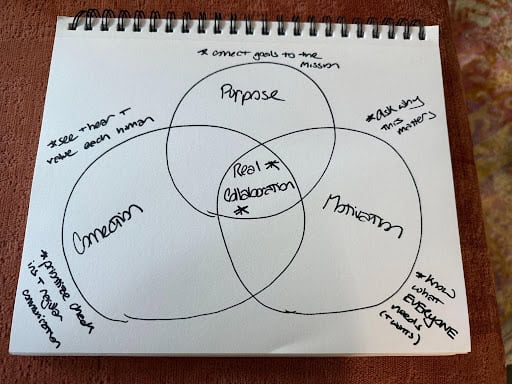
The person who showed me how to break down silos
I was lucky enough to overlap with Alyza Jehangir at Revolution Foods — she ran account management, I was in growth and sales — and she was one of the people who made the early-days “we’re in this together” feeling actually possible, not naive. It was never your job versus my job. It was always: What are we trying to accomplish in this market, and how do I help?
Alyza has been wired for this her whole career. Her first version of this work was at a domestic violence shelter in Fremont, California, where every other week she sat in collaborative meetings with other nonprofits and the city, talking openly about what each of their clients needed, who was serving whom, where the overlap was, and how they could work together to help them. “Because it was mission-driven and we were all on the same page, it wasn’t about doing hard convincing,” she told me. “It was coming together out of purpose.”
She kept finding herself in these roles. School lunches in low income districts, where relationship-building was the job. A London nonprofit working with people living with or affected by HIV, where she came in wondering why she’d been hired, and realized her ability to connect with people — to listen deeply, to really see them — was what made her perfect for the work.
Eventually all of that landed in tech. At PlayStation, she led a global product team responsible for over $1B in annual revenue, navigating cross-functional work across merchandising, supply chain, legal and compliance, marketing, and customer service across multiple markets. Same skill. Same throughline.
When I asked her what makes someone effective across teams, she didn’t start with a framework. She started with humanity: “When I’m in a grocery store and need help, you’re not a VP, you’re not a director. You’re a human being that I just asked to help me get that sugar from the top shelf.” Titles really trip us up. So do departmental maps. They create mental blocks that we’re not supposed to help each other and get in the way of doing the job.
Alyza’s antidote to this is to be the connector — start with a shared why, understand what each person is actually trying to accomplish, bridge across the teams that should be talking and aren’t, and back it all up with enough structure (a stakeholder map, intentional cadences, meetings with actual purpose) to keep things steady when times get hard.
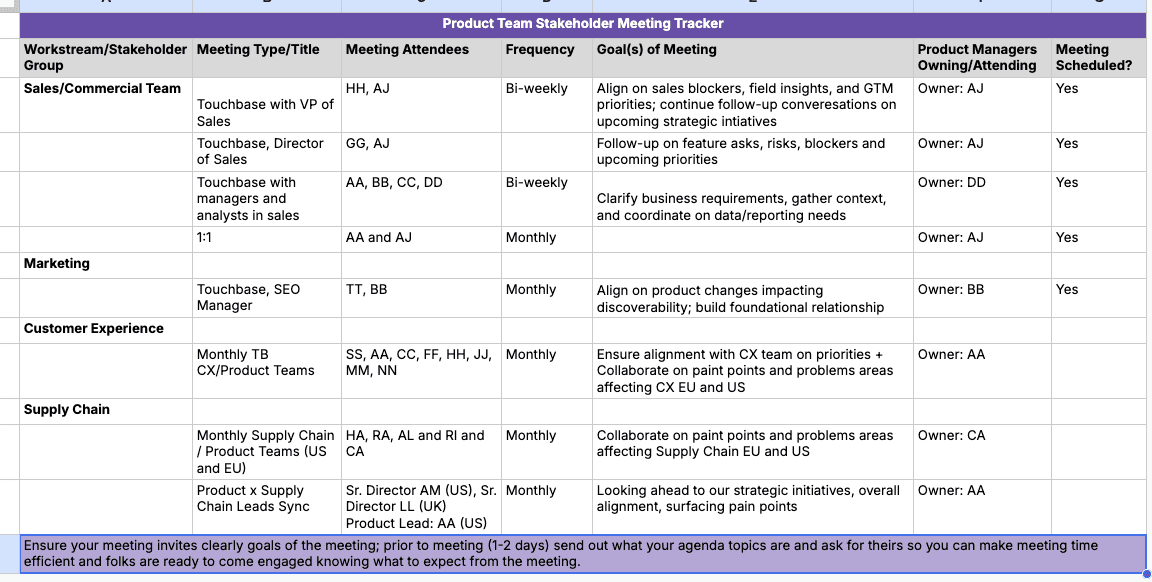
The actual Stakeholder Map Alyza used on a recent project.
The Key Takeaway
Silos are an illusion.
Cross-functional work can happen well at any organization no matter the org chart, as long as there is a shared why and a human willing to be the connector.
How Alyza Breaks Down Silos
If you’re a “just tell me what this looks like in practice” person (aka Helia’s COO, Libby), here’s Alyza’s approach to cross-functional work:
- Step 1: Start with a shared why (at whatever scope you’ve got). Anchor the work in a shared why — an org strategy, a team goal, a project objective, a campaign target. Without it, meetings feel pointless and rapport is just nice conversation. With a shared why and data to back it up, meetings move work forward.
- Step 2: Understand motivations, not titles. What are people actually trying to accomplish? What are they on the hook for? A VP in one department isn’t the same as a VP in another. Titles are context, not hierarchy — for them AND for you.
- Step 3: Be the connector — and model connection so it spreads. Notice which teams should be talking and aren’t. Do the quiet bridging work. Circle back on what you’ve heard. Ask other teams how they see your team. And if you lead a team — do it visibly, so it becomes their discipline, not just your personal quirk.
- Step 4: Build the structure that keeps it running without burnout. Stakeholder map. Cadences calibrated to each relationship (and actually held). Every meeting with a real reason to exist. This is what makes “meetings with a clear why” something you actually run, not just believe in.
If you’re a “tell me how each of these actually works and why” person (aka Helia’s Founder, Jess), read on.
How Alyza Breaks Down Silos
Step 1: Start with a shared why (at whatever scope you’ve got)
Most cross-functional work gets easier when people are clear on what they’re meeting to solve. When that clarity is missing, the default answer becomes “let’s do fewer meetings” — when the actual move is meetings with a clear why.
At PlayStation, Alyza and her VP of Sales built a three-year strategy to reshape how merchandising, supply chain, legal, customer service, and content worked together. They didn’t start with a slide deck. They started with conversations.
“We met with every cross-functional team individually. We gave them the opportunity to tell us what they thought would be needed in their area in order to achieve the three-year vision.”
Then they brought it all back — first to individuals, then cross-functionally, then to executives. The three-year strategy came with three-year OKRs. That meant customer service knew: if we’re going to 50 countries, I need to start thinking about call centers, time zones, language. Supply chain knew what was coming so they could tell customer service. Everyone had purpose and direction because their own goals trickled up into the shared ones.
“It made everybody feel really heard and part of the process. In the corporate sector, that level of collaboration isn’t always valued — it might take a little longer AND you’re building trust that actually holds when things get hard.”
This is what a shared “why” does. It gives everyone something to come back to as a north star when things get hard.
AND you don’t need a three-year strategy for this to work. A team goal can be the why. A project objective can be the why. A campaign target can be the why. In my early days at Rev Foods, we had no formal strategy. What we had was this: we wanted to sell more healthy food to more schools. That was enough of a shared why for departments to figure out how to work together.
If the why doesn’t exist yet — or if leadership hasn’t named one — your job is to name one. Even if it’s provisional. Even if it’s just for your team. Even if it’s only “we’re trying to get X out by end of quarter without anyone burning out.” Give people something to orient around.
When motivations collide (and they will!) — data helps. “Use data to ground folks and get everyone on the same page. You might think X needs to happen, but the data shows Y. Either help us understand how your information relates to this, or — if we’re being driven by data — we have to go in this direction.” Alyza occasionally uses frameworks like RICE (Reach × Impact × Confidence ÷ Effort) to prioritize across teams — not because the framework is magic, but because it shifts the discussion away from whose opinion matters most toward what does the math say?
Try this week: For one cross-team project, ask: What’s our shared why? If you can name it in one sentence that everyone would agree with, you’re ahead of most orgs. If you can’t — start there. Write it down. Test it with one or two people. Refine until it lands.
→ If you’re stuck because the why in your org isn’t landing, or because leadership above you hasn’t named one, book 30 minutes with Helia and we’ll help you figure out how to work with what you’ve got.
Step 2: Understand motivations, not titles
Once there’s a shared why, the next move is understanding the humans who have to work toward it. And that’s more than an org chart exercise.
“One of the first things I do when I come into a new job or a new project is I really understand who all the players are. I create a Stakeholder Map”
Alyza isn’t asking who reports to whom. She’s asking, in this specific work:
- Who’s actually a decision-maker?
- Who’s an influencer?
- Who needs to be consulted?
- Who needs to be informed?
“Titles don’t do the work you think they do. Every department is different. A VP in one is very different from a VP elsewhere. Rather than breaking down by titles, break down by decision-makers, influencers, the ones who need to be influenced, the consultants.”
A VP might not be the decision-maker in their org; the senior director might be. Don’t get stuck on titles.
Then, for each person, figure out what they are actually trying to accomplish. “Marketing folks have different motivations than someone in legal. Everyone has things they need to meet and report on — supply chain is focused on different things than customer service.” Their yearly goals. Their department’s priorities. Knowing what motivates each person will help you understand why they might be pushing for or against a decision, and knowing THAT can help you move the conversation back toward the shared goal.
While you’re at it — map what really matters, too. Ask:
- What’s actually at stake in this work?
- What downstream implications might affect the people you’re talking to?
- What are the small things that you can compromise on in service of the shared why?
Alyza dedicates time and effort to creating a Stakeholder Map because she understands how titles can change the dynamics of a room, no matter how progressive the folks at the table are.
She goes back to that grocery store metaphor: “When I’m in a grocery store and I can’t reach the sugar on the top shelf, you’re not a VP, you’re not a director. You’re a human being that I just asked for help. If someone would help a stranger in a grocery store, they can and should help others in achieving the shared goal, no matter their title. That’s not to say that a VP should help by doing data-entry, but they should clear road blocks so that the folks who are supposed to be doing the data entry have time to do the data entry.
A title indicates function. It doesn’t mean someone is untouchable, or that their work is more important than yours.
Try this week: For one cross-functional project, sketch a quick map. For each key person: are they a decision-maker, influencer, consultant, or informed? What are they trying to accomplish? What’s their current relationship to this work?
Step 3: Be the connector — and model connection so it spreads
This might be the move that quietly does the most work.
Alyza doesn’t just show up to her own meetings. She notices which teams should be talking and aren’t, and she does the small work of bridging that gap.
Sometimes it’s as simple as “you two should talk,” and other times she makes sure the meeting happens:“I heard your team talking about this. This team was talking about it too. Are you guys talking to each other? No? Okay — well, let’s use the time we already have scheduled to bring those conversations together.”
This isn’t about being the hero in the middle. It’s being honest that silos exist and connection doesn’t happen by accident.
Being a connector also means circling back on what you’ve heard — in a way that isn’t transactional. “I know you mentioned this last time. Here’s what I’ve learned about it so far. Have you learned more? Okay, now what do we do with this information?” If you don’t have a good memory, take notes and circle back. People remember who actually listened to what they said last time.
And a version of this that’s easy to miss: ask other teams how they see YOUR team. Alyza would ask her cross-functional partners — “How do you think things are going with product, program, and engineering right now? Is there something we could have done better on this project?” It shifts the room from “here’s what we need from you” to “here’s what we’re building together, and how are we doing at it?” This is especially important when your own function can be cliquey.
If you’re a leader, here’s the part that makes cross-functional work stick beyond you: it spreads when leaders do it visibly. Alyza didn’t just practice this herself — she modeled it so her team picked it up as a discipline. Her whole team used the stakeholder map. They took relationship management seriously because she did. They identified their own core partners because they understood why those relationships mattered. The foundation had to be there before the tool worked for anyone.
If you’re waiting for a culture of cross-collaboration to show up before you change how you work, you’ll be waiting a long time. The faster path is to do it yourself, out loud, so your team sees it — and then make it a team practice:
- Name the shared “why” with your team.
- Talk about who you’re meeting with and why.
- Ask them to do the same.
Try this week: Notice one place where two teams should be talking and aren’t. Use a meeting you already have with one of them to tee up the connection — or send a three-line email introducing them around the shared thing. If you lead a team, name out loud why you’re doing it.
→ If you’re a leader trying to shift how your whole team shows up cross-functionally, that’s often where someone who’s done it before makes the biggest difference. Email Alyza at [email protected]with subject line “Helia Help.”
Alyza doesn’t just show up to her own meetings. She notices which teams should be talking and aren’t, and she does the small work of bridging that gap.
Step 4: Build the structure that keeps it running without burnout.
For all the human-first stuff, Alyza is deeply organized about how she does this. She builds a stakeholder map. She sets cadences. She categorizes who she needs to meet with, how often, and why.
Here’s the part most people miss: not every stakeholder gets the same cadence. Some are daily. Some are weekly. Some are monthly. Some are quarterly. Some are twice a year. Some just need you to reach out when specific questions come up. Figure out the right cadence for each relationship — based on what this work actually needs, not what feels fair.
And then — hold the cadences. “Try your best to not reschedule those meetings and really keep them. And come to the meeting every time with some type of ask, some important information, or a circle back. Every meeting should have a purpose — an update, an ask, or a reflection worth sharing.” If there isn’t one, Alyza cancels and sends the email. “People love to complain about meetings — but if there’s no reason to meet, don’t. Send a clear email. You’re valuing their time AND the communication.”
And critically: structure isn’t static. When a weekly meeting is no longer warranted, switch to monthly. Then quarterly.“There might be a project where you need constant communication with someone, and then eventually that peters out. You want to honor what you had — so maybe you move from daily to monthly, but you don’t just drop it.”
This is what makes Alyza’s approach different from “just be nice to people.” The curiosity is the intention. The structure is what makes it sustainable. Without the map, you forget who you haven’t talked to in six weeks. Without the cadence, your 1:1s get rescheduled into oblivion. Without a reason for the meeting, your time with someone becomes another thing they resent.
The structure isn’t the opposite of warmth. It’s what lets the warmth develop organically instead of being performative. And this — finally — is what makes “meetings with a clear why” something you actually run, not just believe in. The answer was never fewer meetings. The answer is meetings held well.
Try this week: For one current project, sketch your own stakeholder map. For each key relationship: how often should we actually connect? What’s the purpose? What do they need from me? What do I need from them? Look at your calendar and ask: which recurring meetings could become an email? Which 1:1s have I been rescheduling, and why?
When Things Get Tricky
Not everyone will meet you in this. A few scenarios Alyza has seen:
The person who won’t engage. Alyza asks herself: is this uphill-battle hard, or just challenging? If it’s uphill, don’t force what isn’t working. If they’re genuinely integral, be direct: “This has to happen. Can you tell me how we can best work together? Is there a process that would make this easier?” If they’re not integral, maybe you meet them twice a year, not weekly. Or work with someone else on their team. You’re not burning bridges — you’re getting the work done.
The bully. “I don’t think anyone should have to work with a bully.” Go to their boss, go to HR, don’t engage. “If you’re walking into a meeting tense about how someone might treat you, that’s not personal discomfort — it’s a structural problem. It’s not part of the job. We need to stop normalizing it.” Being a connector has limits. Being harmed isn’t one of the tradeoffs.
When leadership above you isn’t aligned. This is the hardest one, and Alyza has lived it. At PlayStation, year one of her three-year strategy executed beautifully. Years two and three fell apart — not because the stakeholder work at Alyza’s level was wrong, but because the C-suite above her wasn’t aligned with each other and wasn’t communicating down. “I wish I would have had more support from my own boss.” This is the reality of being a connector in an organization that doesn’t fully model it: you can build it at your level, and sometimes that still isn’t enough to hold the whole thing. AND the work you built at your level still mattered — for your team, for the time it held, for what people carried forward.
Which brings us to the honest truth of all of this:
You don’t control whether your organization values this. You do control whether you personally name a why, show up as a connector, and model it for whoever’s watching.
That’s where the practice starts. And it builds — one shared why, one mapped stakeholder, one honest conversation, one connection nobody asked you to make, at a time.
When to try this yourself vs. bring in help
A lot of this is a mindset shift you can start practicing tomorrow — next meeting, next project, next 1:1. Pull up a piece of paper, write down the shared why at whatever scope you’ve got, sketch a quick stakeholder map, note what you think is driving each person. Start there.
Where it gets harder:
Where it gets harder:
- You’re stepping into a role where the culture is deeply siloed and you’re trying to shift how the team works together
- You’re building or rebuilding cross-functional partnerships at senior levels where trust has broken down
- You’re trying to lead a multi-year strategy across teams and the org hasn’t done that kind of work before
- You’re a leader whose own boss isn’t modeling cross-functional work, and you’re trying to hold the approach without enough support above you
Those moments benefit from someone who’s lived it.
If you want help
Alyza Jehangir runs Jehangir Studio, a space for individuals, creatives, and organizations to interrupt inherited patterns shaping their systems and set into motion new ways of thinking, operating, and creating. Her work is rooted in systems thinking — the belief that to change how an organization moves, you have to first understand the larger forces shaping it. She looks beneath the surface: the patterns in decisions, communication, and structure that are shaping outcomes — and translates that into clear direction teams can act on.
She’s a good fit if:
- You’re leading work that requires real alignment across teams, and you can feel that it’s not happening
- You’re in a moment of evolution — growing, expanding, or preparing for what’s next — and you need someone who can see what’s shaping the system before you build
- You’re navigating a strategic shift and need someone who can hold the human and structural sides at once
- You want clarity that translates — into decisions, structures, and ways of working your team can actually use
Connect with Alyza!
Try it Yourself
Alyza’s How to Break Down Silos Toolkit — the full set of tools Alyza uses to do this work:
- Alyza’s Stakeholder Map — the framework for organizing who you need to connect with, how often, and why. Use it when you’re stepping into a new role, starting a project, or when cross-functional work has stopped making sense.
- First-Meeting Questions — the actual questions for understanding what someone is trying to accomplish, what they care about, and how they think — without it landing as an interview.
- The Connector’s Moves — the four specific bridging moves Alyza uses when she notices disconnect: the bridging email, the meeting tee-up, the circle-back, and the outside-view ask. Scripts and templates for each.
Recommended reading:
- The RICE framework — A prioritization tool Alyza uses that cuts through opinion with data (Reach × Impact × Confidence ÷ Effort). Useful when teams can’t agree on what matters most. Includes a downloadable template.
- The professional-managerial class, according to Catherine Liu — A podcast conversation Alyza recommends. Liu argues that liberal elites maintain power through claims of moral superiority and expertise, often reinforcing the very systems they claim to challenge. Useful for anyone questioning hierarchy at work.
- The House of the Spirits by Isabel Allende —— Alyza re-reads this every decade for how it illustrates that the micro is the macro — the power structures inside a single family a direct mirror of what’s playing out in a country. A reminder that we are always inside systems, and that seeing the ones closest to us clearly is how we begin to understand the larger ones — and our role within them.
Questions to Sit With
- What’s the shared why in the work I’m doing right now? Could everyone on my team name it?
- Where am I playing my role when I could be connecting across silos?
- Who am I avoiding or deferring to because of their title, and what would change if I approached them as a human trying to solve a problem?
- Do I actually understand what motivates the people I work with most closely — or am I assuming?
- If I lead a team, am I modeling cross-functional work visibly enough that my team sees it as practice — not just my quirk?
- Which of my recurring meetings have a real purpose, and which are just on the calendar?
- What would it look like to show up as a connector this week — not in a big reorganizing way, but in one small one?
Not sure Alyza‘s the right fit? Talk to Helia directly!
This article comes from a coffee chat with Alyza Jehangir in May 2025. These conversations form the heart of the Helia Library — because we’ve learned the most from doing and from talking with other doers willing to share their wisdom. We don’t need to start from blank pages or do everything alone.
As always, take what’s helpful, leave what’s not, and make it your own.
About Alyza
Alyza Jehangir runs Jehangir Studio, a systems-focused advisory practice that helps leaders clearly see how their organizations work so people, systems, and strategy move together in support of growth, scale, and transformation. Her work begins with a system read: an honest, structured read of how people, systems, and strategy currently connect in practice across leadership, teams, and functions. From there, Alyza partners closely with leadership to translate insight into action—embedding the work into existing priorities, decision-making, strategic planning, and the organization’s long-term direction.
Work with Alyza