Long Story Short
Natalie Bergstrasser went from “AI is for someone else, let me know when it’s useful” to using it to help write a $4M grant in 30 days. She learned that AI still needs a human brain behind the wheel, it won’t flatten your voice if you know how to use it, and you don’t have to figure it all out before you start. AND she built you templates and guide’s in her AI For Fundraising Toolkit so that you don’t have to start from scratch!
Why We’re Sharing This Story
Jess here. I think a lot about a line I came across not long ago: “It’s a hard time to be human. We know too much and too little.”
That’s exactly where I am with AI. On one hand, there’s SO much information — tools, prompts, frameworks, think pieces, hot takes. LinkedIn is full of people who seem to have it all figured out.
On the other hand, I genuinely feel like the more I learn, the more aware I become of how much is still unknown. How fast it’s all moving and how many questions don’t have clean answers.
The honest truth is that I’m still figuring it out. We’re all figuring it out. And I’ve stopped expecting to arrive at some place where it all makes sense. Where I can confidently say “yes, THIS is the right way to use AI.” That place doesn’t exist, and I think the folks who pretend it does are the ones I trust the least.
What I keep coming back to instead is: what do I know NOW? What can I do NOW? And who’s doing interesting things that I can learn alongside?
That’s what drew me to Natalie’s story. She’s the type of person who forgets her iCloud password every time she logs in and she had zero interest in AI for the longest time. But last year she was wrangling a toddler AND drafting grant proposals and did not need one more new thing to figure out. AND then a client asked her to use ChatGPT to write a $4M grant in 30 days. And… she said yes. She learned in real time and made the deadline!! Then, instead of keeping what she learned to herself, she started building templates and guides and how-to’s so other people could benefit too.
That is so deeply Helia. We don’t need to start from blank pages. We don’t need to do it alone. And we don’t need to have all the answers before we start moving.
As AI becomes more and more a part of how we all work, I want us to stay curious AND stay honest about the complexity. Natalie does both. She’ll straight-up tell you, “I saw a post that said ‘AI is theft’ and I was like, I actually don’t know what you mean.” And then she digs in instead of waiting until she has the perfect answer. I find that incredibly refreshing. She’s learning in public, staying grounded in her values, and bringing other people along. That’s the spirit.
It’s a hard time to be human. We know too much and too little.
Natalie’s Story
As told by Natalie Bergstrasser
I never set out to become an “AI person.” In fact, I had zero interest in it for the longest time. I’d been doing fundraising for a while, working with a handful of nonprofits, but AI always felt like this very “out-there” thing, like one more thing I didn’t have time to learn. I thought, “That’s for someone else. You let me know how and when it can be useful to me.”
But then I had the opportunity to work with Matthew McAllister at SolarAPP+ Foundation, who specifically asked me to use ChatGPT to help write a $4M grant in just 30 days. It was no small task: dozens of pages of narrative, budgets, and attachments across multiple partners and time zones. They were a new and ambitious organization, still shaping their broader strategy for scale. That meant we were building the proposal in real time — making sure it aligned with their big vision and fit within the structure of a government grant, all while keeping momentum toward submission.
Clean energy was also not my area of expertise (I grew up in an oil and gas state!). This was a chance to see how AI might help make up for that steep learning curve. Could it reduce the research lift? Could it help them keep building their organizational voice while we moved fast? We acknowledged that we didn’t know yet and gave it a try.
The end result? We made the deadline and SolarAPP Foundation was recommended for full funding. And ChatGPT cut the workload significantly.
Things I’m Learning About Using AI
ChatGPT has evolved dramatically since then and so has my skill in using it. In just six months, there’s been a big expansion of what it can help me do to support nonprofits.
That said, AI still needs a human brain behind the wheel.
During the SolarAPP project, I asked ChatGPT to help describe the environmental impact of streamlining solar permitting. It gave me a stat that sounded impressive until one team member gently pointed out that the number reflected the impact of a single home, not a whole state. It was a humbling reminder that AI can sound right and still be wrong.
Newer features like ChatGPT’s Deep Research function make a big difference. You can point it to real sources — IRS 990s, organization websites — instead of letting it guess. But it still needs you to ask, “Where did that come from?” or tell it, “Use only verifiable sources.” You’re always the one steering.
A few weeks ago, I got to talk to a hyperlocal nonprofit about fundraising. They asked me, “What do you know about fundraising?” And it was kind of like… a ‘hold my beer’ moment.
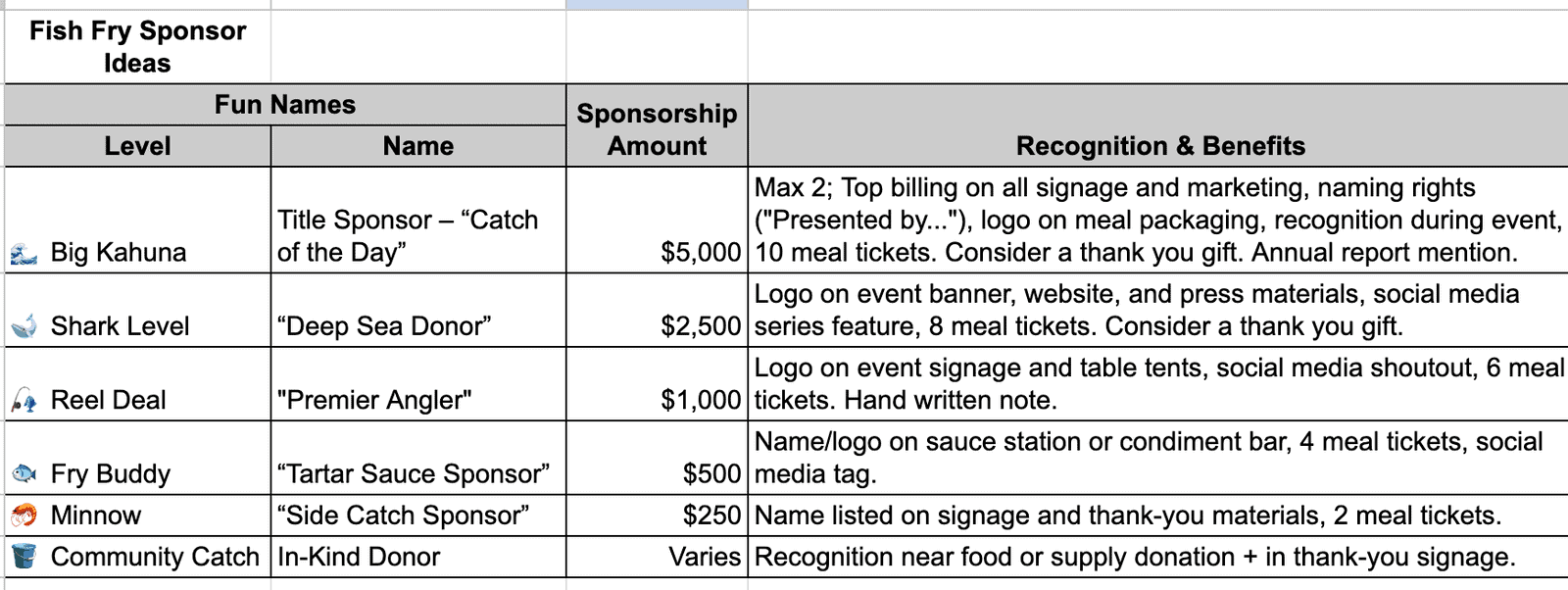
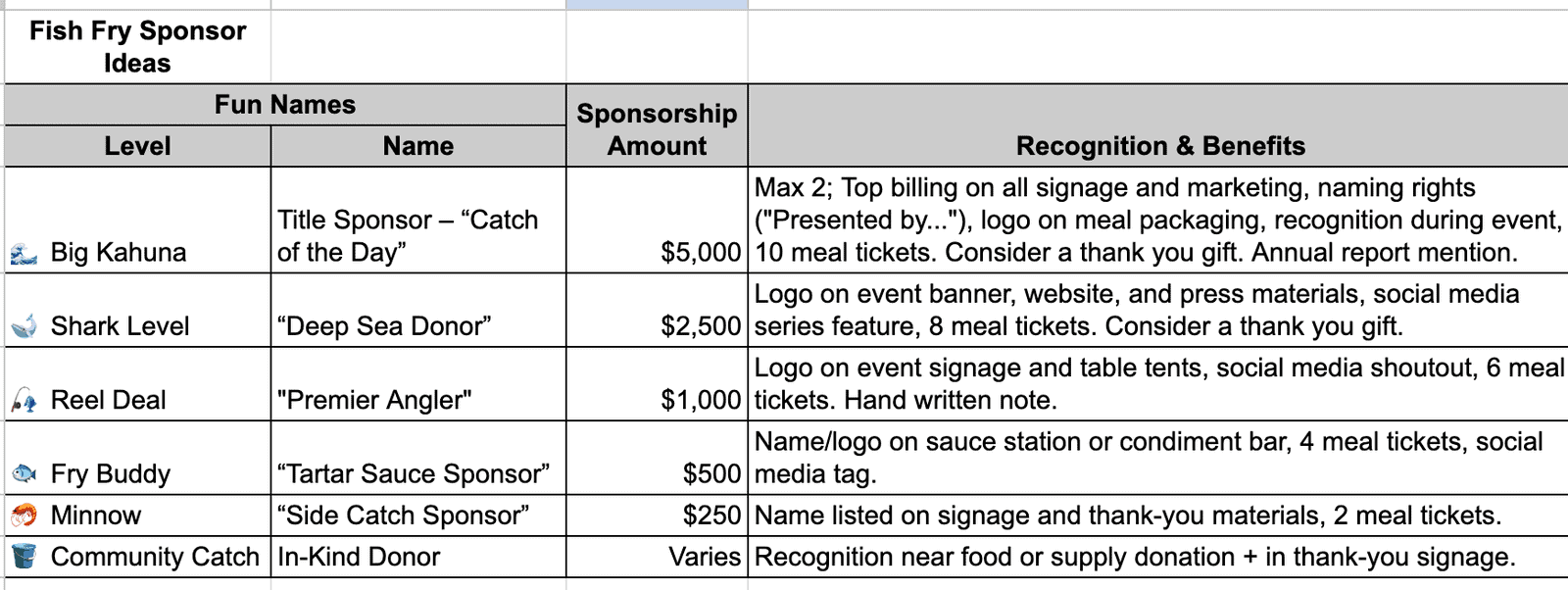
They were planning a fish fry fundraiser where ticket sales were the primary tactic. I encouraged them to think more about sponsorships — they’re a hyper-local feeding program in a town of about 10,000 people. I told them, “You need to be approaching every single business in your town.” Then we used ChatGPT to help us think through the how: sponsorship levels, amounts, businesses to approach, and names for each tier based on the size of the town and local economy.
It gave us fish-based names. Big Kahuna. Deep Sea Donor. Tartar Sauce Sponsor. The Reel Deal. Fry Buddy. And one name that I can’t share here had us laughing and then deleting it real quick (turns out ChatGPT doesn’t always catch innuendos.)
Maintaining Your Authentic Voice
A turning point for me was when I started working with our incredible partners atLA Más. Their messaging is so deeply aligned with who they are and how they actually work, which is rare, especially in the nonprofit world. A lot of people worry that AI won’t reflect their voice, their story, or their culture.
Here’s the approach that works: I put their previous writing — newsletters, proposals, marketing materials — into ChatGPT and prompt it to describe their tone and messaging. Then I say, “Use this tone and messaging to write this next thing.” Grant report. Social media blurb. Newsletter draft. Whatever it is.
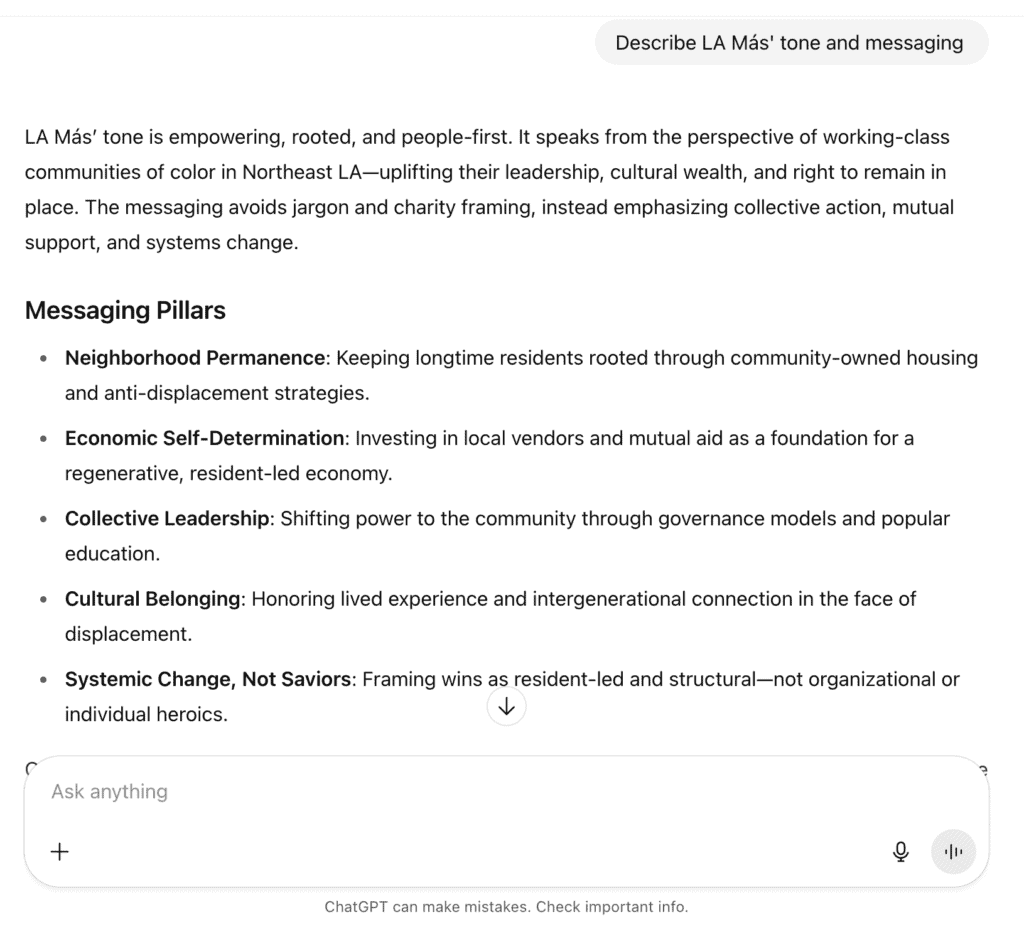
A screenshot of Natalie’s actual chat with ChatGPT to nail down LA Más’ tone.
When it’s not quite right, I redirect. “That sounds too corporate.” “That sounds elitist.” “That sounds cringy.” It adjusts. You’re still the one steering. AI is just a tool that helps you think it through and get it done faster.
The SolarAPP project shows what’s possible. It was probably 100 pages of work. It still took me a lot of hours, but it probably cut the workload down by 40%. More importantly, it built reusable systems and helped establish the organization’s voice for future opportunities.
Natalie’s Practical Tips
Use AI for the stuff that drains you. Summarizing emails when brain fog hits. Translating newsletter content into social media posts. Let AI handle the mechanical parts that eat your time and energy so you can focus on relationships.
Create different personas for different audiences. “I create different personas with distinct tones. One voice for a local communications committee, another for volunteers, and another for professional communication. I even have one for writing out chore instructions for my kids!”
Stay honest about the ethics, even when you don’t have the answers. “I know people have strong feelings about it, and for good reason. I just don’t know yet.” Natalie is careful about personally identifiable information, thoughtful about where custom GPTs are accessible, and mindful of community context. She’s honest about what’s still unresolved: questions about equity, environmental impact, labor, and the tension between innovation and harm. She’s actively listening to those speaking on these subjects and moving thoughtfully and she invites others to do the same.
If you want help
Natalie Bergstrasser offers hands-on fundraising strategy support, custom GPT creation, and AI training tailored to your nonprofit’s voice and values. She’s based in Colorado, trained as a social worker, and genuinely believes the money of the world can and should belong to people doing good work. Reach out at [email protected] with the subject line “Helia Connect.”
Connect with Natalie!
Try This Yourself
- The Finding Funders Guide — A step-by-step guide with copy-paste prompts for generating, organizing, and verifying a funder list tailored to your organization’s programs and geography.
- How to Create a Customized Organizational GPT — the specific prompts and language she uses to train it on tone and messaging
- How to Build Your AI Knowledge Base Using Rick Mulready’s C.O.R.E. Framework — immediate steps to “onboard” AI to your work
Recommended reads + listens
- LA Más AI Use Case Library — real examples of prompts, inputs, and outcomes from their work together
- Rick Mulready’s free AI Newsletter — practical tips Natalie uses every week
- AI Masterclass on MasterClass — helped her move beyond basic prompts
- Fast Forward’s AI and Data Bootcamps for Tech Nonprofits — for technical foundation building
Questions to Sit With
- What repetitive tasks in your work are stealing time from the things that actually matter?
- Where are you stuck in endless wordsmithing cycles when you could be building relationships?
- If you could cut 30–40% off your writing time, what would you do with those extra hours?
- What values do you want to make sure are reflected in any AI tools you use?
- What’s one small, frustrating process that could be your first experiment with AI?
Not sure Natalie‘s the right fit? Talk to Helia directly!
This article comes from a coffee chat with Timothy in February 2026. These conversations form the heart of the Helia Library — because we’ve learned the most from doing and from talking with other doers willing to share their wisdom. We don’t need to start from blank pages or do everything alone.
As always, take what’s helpful, leave what’s not, and make it your own.
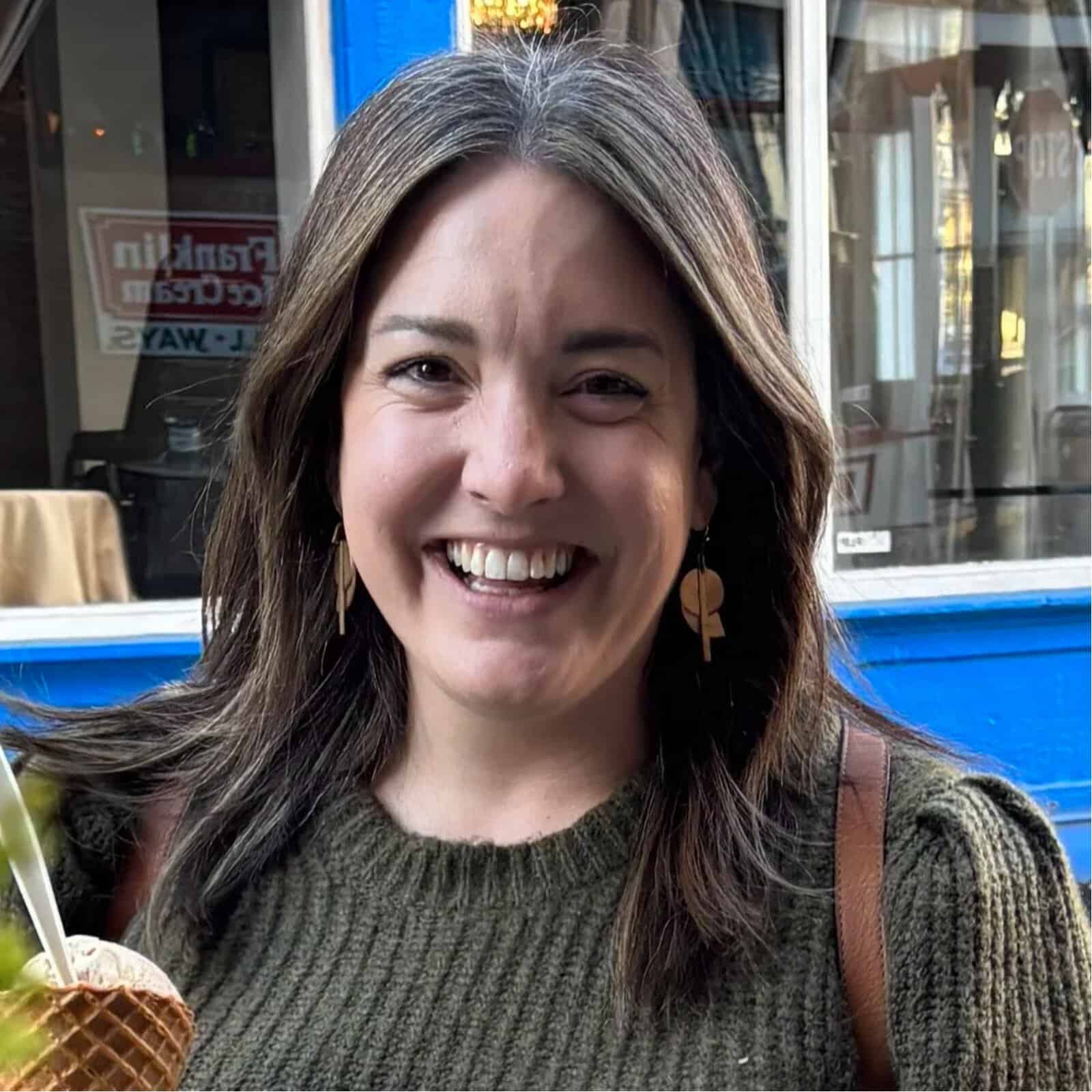
About the Contributor
Natalie Bergstrasser has to change her iCloud password every single time she tries to log in — and has been doing it for ten years. She loves Asana to the point that she would make you pay her to try a different project management platform. She’s a social worker by training who finds fundraising genuinely fun, has an incredible gift for turning complex ideas into clear and compelling language, and only adopts new technology when someone demonstrates clear value. (Now she’s the one demonstrating the value.) She’s based in Colorado, from Oklahoma, and loves working with nonprofits serving vulnerable populations.