Long Story Short
The best fundraising plans start with what you’re already great at — not a forty-page strategy someone else designed. Check out Helia’s Fundraising From Your Strengths Toolkit ifyou want a head start.
Jump to How!
Fundraising plans stress me out.
I know they work for a lot of people. There can be something really powerful about having it all mapped out and, for a lot of organizations, the discipline of building a real plan is exactly what’s missing when a development team is struggling. I’m not saying don’t do it.
But, for me, personally? A forty-page strategy with color-coded timelines and twelve campaign tracks makes me want to hide under my desk.
Not because the work isn’t important. It’s because I know what happens to me when I’m in the plan: I stop being in the world. I’m executing something I wrote down weeks ago instead of paying attention to what’s actually happening right now and responding to it. And if I’ve learned anything in my 20+ years of fundraising, it’s that being responsive is what makes the difference between hitting my goals and not.
At Think of Us, my counterpart, Sixto, and I had, at best, a two-page fundraising plan. We got really clear on what we were good at and what we enjoyed. We picked a few things on that list and did those well. We were disciplined about weekly pipeline tracking. We stayed responsive to the world changing around us. And we went from a $700K organization to roughly $6M in two years — with $70M raised in year three.
I don’t share that to brag. I share it because I want you to know: you don’t need the forty-page plan to successfully fundraise. AND you do need some structure. The trick is building the kind of plan and structure that works for you — and then staying loose enough to adapt when the world brings something you couldn’t have predicted.
The fundraising process I’m about to share isn’t a best practice I discovered from a book nor a framework I designed intentionally. It’s what Sixto and I figured out by necessity, and what I’ve come back to ever since because it actually works.
The Key Takeaway
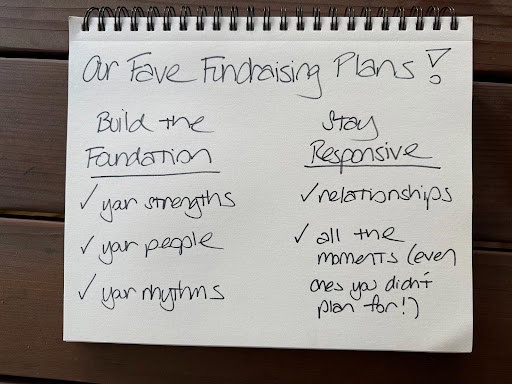
A great fundraising plan is 50% building the right foundation — knowing what you’re good at, mapping your relationships, creating a structure you’ll actually use — and 50% staying responsive to what the world brings forward.
Everything else — the structure, the pipeline, the regular rhythms — is in service of that.
Jess’s Fundraise From Your Strengths Approach
If you’re a “just get me the framework” kind of person (aka Helia’s COO, Libby), our Fundraising Planning Toolkit gives you everything you need to build this. The toolkit includes a step-by-step planning process, a strengths and relationship mapping exercise, campaign design templates, a 90-day action planning guide, and an anonymized 2025 Fundraising Plan Example so you can see what one org’s version actually looked like in practice.
If you’re a “help me understand why this works” kind of person (aka Founder Jess), read on. Here’s what we’re going to walk you through:
- Step 1 — Start with your strengths: what lights you up, what you’re actually good at, and what you want to build from
- Step 2 — Map your relationships: who are your true believers, who’s close, and who you’re deliberately not pursuing Matters
- Step 3 — Design your menu: a few campaigns and engagement tracks built around your specific strengths and the different ways people can show up to support
- Step 4 — Build the rhythm: a pipeline and weekly process that keeps things moving and gives your whole team visibility
What Makes This Approach Work
Step 1: Start with your strengths — and be honest about them
Before you open a blank document or look at what you raised last year, start here: what do you and your team actually bring to this? Not what you think you should be doing. What genuinely lights you up AND what you’re actually good at.
This sounds soft. It isn’t.
It’s the difference between a plan you’ll execute and one you’ll abandon by March.
At Think of Us, Sixto and I were both good at deep, long-term relationships with national foundations — understanding how systems-change funders thought, what they cared about, how funding flowed. Sixto brought incredible energy for events, networking, and speaking — he is a genuinely electric speaker, and almost every engagement brought in at least one new relationship. So we built around that. We leaned into foundation relationships. We kept putting Sixto on stages. We invested in the research and narrative work that would let us show up credibly with the funders who cared about what we cared about.
What we did NOT do: individual donor campaigns, online fundraising, grassroots giving, large fundraising events. Not because those things don’t work — they do, for the right organizations. But they weren’t us. They weren’t our strengths, they didn’t excite us, and trying to do them would have pulled us away from the things that were actually working.
At LA Más, an organization that Helia supports, the team found a completely different groove — board engagement, community problem-solving, personalized funder communications, and one annual community event that brings people together and activates funders and sponsors in a way that feels authentic to who they are. No major gala. Just an intentional presence that matched their actual strengths and culture.
In Helia’s experience, the question isn’t “what’s the best fundraising strategy?” It’s “what’s the best fundraising strategy for us, right now, with what we have?” Start there — and be ruthlessly honest about the answer.
And honestly — what do you like? What makes you feel energized versus exhausted? That matters too. Fundraising you dread doing is fundraising you won’t do.
It’s what Sixto and I figured out by necessity, and what I’ve come back to ever since because it actually works.
Step 2: Know your people — really know them
The second piece is your relationships. Not a contact list. Not a spreadsheet of prospects. The actual humans who know you, believe in you, and would go to bat for you — and the ones who are close to that but not quite there yet.
We think about this in tiers:
- Tier 1 are your true believers — the people who will make calls, open doors, co-host things, advocate when you’re not in the room.
- Tier 2 are the people who’ve seen your work and gotten genuinely excited about it.
- Tier 3 are the folks who know you exist and think well of you but haven’t fully engaged yet.
At Think of Us, we invested heavily in keeping our Tier 1s close — quarterly investor roundtables that gave key supporters a chance to engage with each other, not just with us. Visits when we were traveling. Calls to ask for advice, which kept relationships warm and kept us learning. This infrastructure wasn’t complicated. But it meant that when things happened — when opportunities came in, when introductions were made — we had a foundation to build from. An introduction that launched a major revenue project came through a Tier 1 relationship we’d been building for years.
Journey House, another org Helia loves, takes a different approach that’s deeply theirs: they focus on family foundations and their legacy donors, building relationships not just with one generation but across families — over years and decades. These aren’t transactional relationships. They’re genuine, long-term partnerships where the family knows the organization and the organization knows the family. That depth of relationship is Journey House’s superpower, and their plan is built around nurturing it.
Finally, being clear about who you’re NOT spending energy on is just as important as being clear about who you are. Time is a limited resource. Every minute you spend chasing someone who is not in your priority tier is a minute you can’t devote to the right people. It’s tempting to go off course, so prepare for this by explicitly and name who you’re not pursuing at this moment.
Step 3: Design a menu, not a mandate
Here’s where most plans go wrong: they’re too prescriptive. They require specific activities on specific timelines — and when the world doesn’t cooperate, the plan becomes irrelevant.
What actually works, in our experience, is having a menu of options. Different ways to build relationships and share your work, based on your strengths, that you can deploy when the moment is right. And building that menu around the different ways different people can show up and contribute.
At Think of Us, the menu included: national foundation relationships, earned revenue through state contracts and research partnerships, Sixto’s speaking engagements, and a targeted push around our Away from Home report. A foundation funded the report work, Sarah Weissman led the strategy, and Sixto co-wrote a New York Times op-ed with Sarah that opened doors none of us could have fully anticipated. What started as a three-month sprint turned into sustained earned media — podcast appearances, a speaking tour, a partnership with the American Bar Association that brought state and federal lawyers directly into the work and created funding relationships from across the country. We didn’t plan for all of that. We planned for the report. The rest came from staying responsive and having the infrastructure to move when things showed up.
The YWCA Glendale & Pasadena’s menu spans events, legacy giving, and foundation relationships — and they’ve thought carefully about how to activate different people around each track. Board members step into roles that match their strengths: making introductions to funders, chairing events, recruiting sponsors, hosting house parties, maintaining one-on-one relationships with longtime donors, speaking at community events. Volunteers show up differently than staff. Staff show up differently than board. The result is a plan where everyone has a clear role — and where the organization can move across multiple tracks at once without any one person carrying everything.
The goal isn’t to do everything. It’s to do a few things really well and, in doing so, to have enough flexibility that when something unexpected appears, you can say yes.
Finally, being clear about who you’re NOT spending energy on is just as important as being clear about who you are.
Step 4: Build in rhythms that keep it alive
The last piece is the one people skip, and it’s the reason most plans end up in a drawer by March.
Fundraising doesn’t work as a quarterly crisis activity. It works as a consistent rhythm. A pipeline you’re actually using. Regular touchpoints with your relationships. Weekly check-ins that keep things moving without consuming everything.
We recently started working with Unlocked Labs on building exactly this infrastructure, and even in the early stages, the difference is already visible. They’re now running weekly pipeline meetings with projected probabilities, last step, and next step for every prospect. What that’s created is real clarity: what happened last week, what we want to do next, and an infrastructure the whole team is empowered and enabled to act from — and not siloed in one person’s head. For the first time, there’s clear visibility into where they are against their goal of raising $5M+ this year, and everyone on the team can see it and contribute to it.
This is what makes a fundraising plan sustainable: not the sophistication of the strategy, but the consistency of the practice. (For a deeper dive into the pipeline infrastructure that makes this work, Andrea Chen’s piece Fundraising That Runs Itself (Almost) is essential reading.)
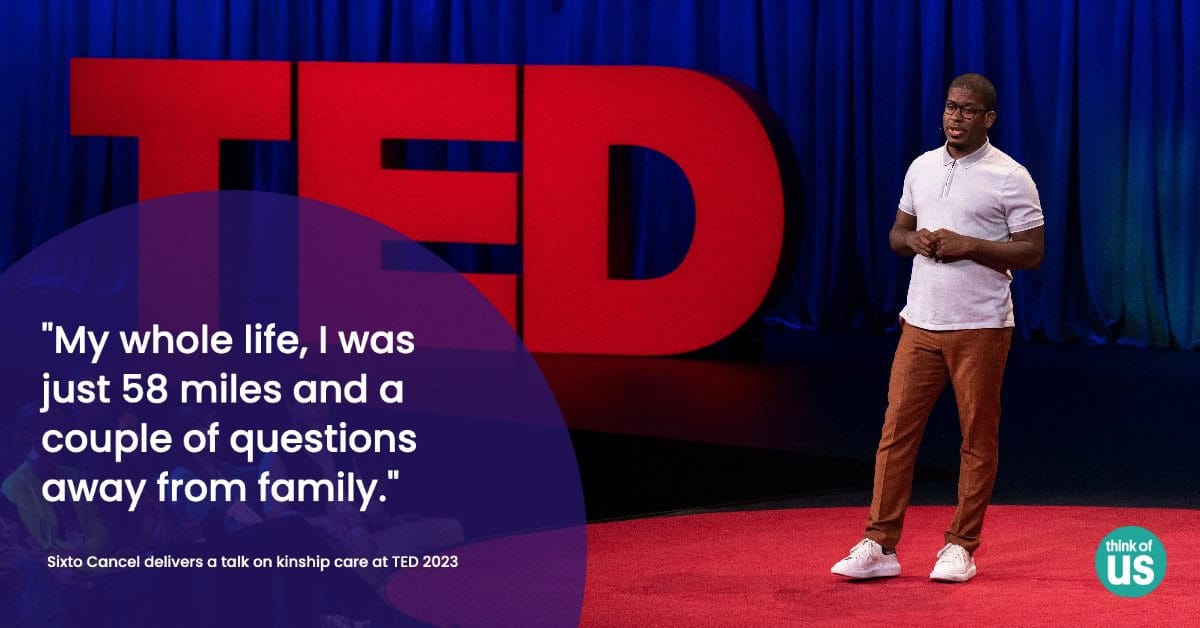
Sixto, the founder of Think of Us, on stage at TED.
What This Looks Like in Real Life (Think of Us)
Years one and two:
- A two-page plan, clarity on strengths, a simple pipeline, quarterly investor roundtables, and Sixto on stages.
- Earned revenue through state contracts and research partnerships alongside national foundation relationships.
- A focused sprint around our Away from Home report that turned into sustained momentum we couldn’t have predicted.
- No large fundraising events, no individual donor campaigns. Just a few things done really well — and the flexibility to respond when things showed up.
Year three: an introduction to the Audacious Project through a relationship we’d been building for years. A grueling, year-long process to raise $50M — $70M total that year. We would never have been in the room if we hadn’t built the foundation we did in years one and two.
The lesson isn’t “do what we did.” It’s that the plan worked because it was built around who we actually were and what we actually could execute. Not a best practice someone handed us.
When to Do This Yourself vs. Bring Someone In
The toolkit below will get you a long way. If you have a clear sense of your strengths, a relationship map you trust, and the discipline to run a weekly pipeline meeting — you can build something really solid on your own.
Consider bringing someone in if:
- You have a goal but genuinely don’t know where the dollars are going to come from — not “we haven’t written the plan yet” but “we don’t have a clear picture of the pipeline that gets us there”
- You have names in a spreadsheet but nothing is actually moving — things are slipping, ownership is fuzzy, and the weekly meeting keeps getting cancelled
- You’re about to walk into a big moment — a funder conference, a major proposal deadline, a leadership transition — and you want to be genuinely prepared, not just winged
- You’ve hit a ceiling on the funders you already know and need help getting into new rooms
- You’re running something bigger than your current capacity can support: a multi-million dollar campaign, a dual-track strategy, a situation where the person who’s been doing the fundraising is stepping back
Outside support works best when there’s something specific to work on together — a pipeline to build, a campaign to run, a moment to get ready for. If you’re not sure whether you’re there yet, the coffee chat below is genuinely just a conversation.
If You Want Help
At Helia, we’ve raised hundreds of millions of dollars — for organizations we’ve led and organizations we’ve supported. Jess Skylar, Andrea Chen, and Natalie Bergstrasser work together on most fundraising engagements, bringing strategy, execution, and hands-on-keyboard support across the full pipeline. We don’t hand you a deck. We get in there with you and get it done.
We’re a good fit if:
- You need someone actually doing the work alongside you — drafting emails, running the weekly meeting, building the pipeline — not handing you a framework and leaving
- You’re navigating a fundraising pivot, a campaign, or a growth moment and want someone who’s been there
- You want to expand your network and need help getting into rooms you’re not already in
- You want your whole team using the same language and approach
- You want to build the plan AND have someone hold the thread while you execute it
Connect with Jess!
Try it Yourself
The Fundraising Planning Toolkit — everything you need to build a plan that’s actually built around you:
- Fundraising Planning Process — step-by-step from vision to implementation, with worksheets and session agendas
- Anonymized 2025 Fundraising Plan Example — see how one of our partners put this into action
- Campaign Inspiration Guide — a menu of campaign ideas and components to mix and match
Not sure Jess‘s the right fit? Talk to Helia directly!
Questions to Sit With
- What fundraising activities have you genuinely enjoyed — where did you see the most traction with the least struggle?
- If you had to cut your current fundraising activities in half, which ones would you keep and why?
- Is your plan built around your actual strengths, or someone else’s template?
- How much of what’s on your plan feels like “we should do this” vs. “we’d actually be excited to do this”?
- When something unexpected came up last year — a new introduction, an unexpected opportunity — were you in a position to respond? What would have made that easier?
- Is your pipeline living somewhere the whole team can see it, act from it, and feel clear on what’s next?
This article is Helia’s perspective — built from twenty years of doing this work across organizations of every size and stage. We share what we’ve learned because we don’t need to start from blank pages or do it all alone.